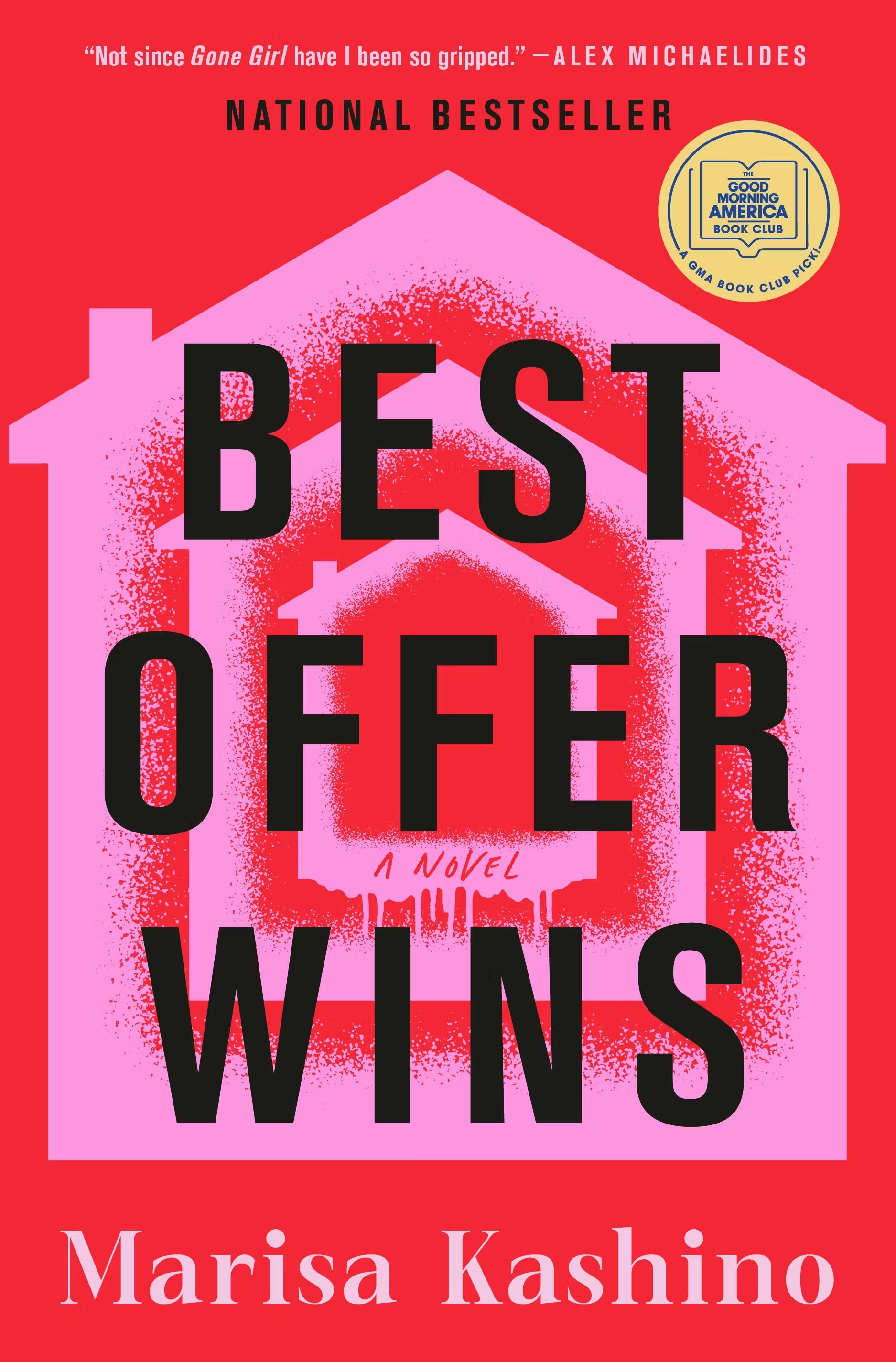
There are few modern anxieties more quietly consuming than the housing market. It’s no longer simply about finding shelter; for many people, buying a home has become tangled up with adulthood, stability, fertility, class mobility, and self-worth. Best Offer Wins understands this with unnerving precision.
On the surface, the novel is a darkly comic thriller about an increasingly desperate woman trying to buy a house in the brutally competitive Washington, D.C. suburbs. But beneath the escalating absurdity and suspense is something more emotionally recognisable: the exhaustion of feeling perpetually locked out of the life you thought adulthood would eventually deliver.
What surprised me most while reading Best Offer Wins is how quickly the novel moves from satire into psychological discomfort. At first, Margo Miyake’s obsession with securing the “perfect” suburban house feels exaggerated in an entertaining way. Then, gradually, the humour starts curdling into something darker. The line between understandable desperation and outright delusion becomes increasingly difficult to locate.
The novel has already drawn attention for its sharp social commentary and morally unravelling protagonist, and honestly, that reputation feels deserved. This is one of the few contemporary thrillers I’ve read that captures the emotional violence of late-stage economic insecurity without losing its sense of entertainment.
For readers wondering, Is Best Offer Wins worth reading?—absolutely. It’s sharp, compulsively readable, deeply stressful in the best possible way, and unexpectedly emotionally perceptive beneath its increasingly chaotic surface.
Themes and Deeper Meaning
What makes Best Offer Wins more interesting than many domestic thrillers is that it understands obsession as socially produced rather than purely individual.
Margo is not simply “crazy.” She is the logical endpoint of a culture that increasingly equates homeownership with personal success, adulthood, stability, and even moral worth. The novel repeatedly shows how economic systems create emotional desperation and then individualise the resulting breakdowns.
I found the book especially sharp in its exploration of time anxiety. Margo constantly feels as though she is running out of time—time to buy a home, to start a family, to achieve the version of adulthood she imagined. One of the novel’s recurring ideas is that modern adulthood increasingly feels like a race people are permanently losing.
There’s also a fascinating undercurrent surrounding class aspiration. The house itself becomes less about practical living and more about symbolic entry into a social identity Margo desperately wants to claim. She is chasing not merely property, but validation.
The novel also explores marriage under economic pressure surprisingly well. Margo and Ian’s relationship feels strained not because they lack affection, but because prolonged instability has distorted how they communicate and see themselves. Financial precarity quietly infects intimacy throughout the novel.
And perhaps most effectively, Best Offer Wins captures the psychological absurdity of the modern housing market itself. The novel exaggerates reality, certainly, but not by as much as it initially seems.
Writing Style and Narrative Voice
Marisa Kashino writes with impressive tonal control.
The novel is consistently funny, but the humour is acidic rather than comforting. Much of it emerges from Margo’s increasingly unhinged rationalisations and observations. You find yourself laughing and then immediately questioning why you’re laughing at all.
Margo’s first-person narration is one of the book’s greatest strengths. She is emotionally volatile, manipulative, insecure, intelligent, and deeply self-justifying in ways that feel psychologically convincing. I found her both exhausting and strangely compelling.
The pacing is excellent. The novel moves quickly without feeling shallow, and Kashino escalates the tension carefully. Early scenes of awkward open houses and bidding-war frustration gradually evolve into increasingly unsettling behaviour, but the progression never feels abrupt.
What impressed me most is how visually cinematic the writing feels. The neighbourhoods, staged homes, awkward suburban interactions, and emotionally suffocating house tours are rendered with vivid clarity.
The satire also lands because Kashino clearly understands the world she’s critiquing. Her background covering real estate journalism gives the novel a level of specificity that prevents the social commentary from feeling generic.
Character Analysis
Margo Miyake is one of those protagonists who becomes increasingly difficult to defend while remaining emotionally understandable throughout.
At first, her frustration feels entirely relatable. Eighteen months of failed bidding wars, financial stress, fertility anxieties, and the humiliating performative rituals of house-hunting would destabilise almost anyone. But what makes the novel compelling is watching Margo cross ethical boundaries while continuing to justify herself internally.
I appreciated that Kashino never softens her worst impulses. Margo manipulates people constantly, lies reflexively, and becomes increasingly consumed by resentment and entitlement. Yet the novel still allows glimpses of vulnerability underneath the obsession.
Ian functions effectively as both partner and emotional counterweight. Their marriage feels believable because neither person is entirely right or wrong. Economic pressure has simply exhausted them differently.
The homeowners themselves gradually emerge as more complicated than Margo initially assumes, which deepens the novel’s critique of projection and aspiration. Margo increasingly treats the house as a fantasy object onto which she projects an idealised version of life itself.
And honestly, one of the novel’s strongest achievements is making readers partially root for Margo even while recognising how alarming she becomes.
Strengths of the Book
One of the novel’s greatest strengths is its premise, which feels painfully contemporary without becoming gimmicky.
The housing crisis is rarely treated as thriller material, but Kashino demonstrates how emotionally destabilising modern house-hunting can actually become. The novel transforms bidding wars and suburban aspiration into genuine psychological horror.
The pacing is another major strength. Best Offer Wins is extremely difficult to put down because each bad decision naturally escalates into a worse one.
I also admired how effectively the novel balances satire and emotional realism. It skewers upper-middle-class suburban aspiration while still understanding why people crave those symbols of security so desperately.
And perhaps most importantly, Margo herself is an excellent thriller protagonist—morally compromised, increasingly unstable, but emotionally legible throughout.
Weaknesses or Criticisms
That said, the novel occasionally pushes plausibility close to its breaking point in the later sections.
As Margo’s schemes escalate, readers will need to accept a certain level of heightened thriller logic. Personally, I didn’t mind this because the novel’s psychological momentum remains strong, but some readers may find the later developments overly extreme.
There are also moments where the satire becomes slightly repetitive, particularly regarding suburban status culture and performative adulthood.
And while the ending is undeniably memorable, reactions appear somewhat divided. I actually thought the extremity fit the emotional logic of the novel, even if it occasionally strained realism.
Overall Reading Experience
Reading Best Offer Wins felt like watching someone spiral in slow motion while recognising enough truth in their panic to feel deeply uncomfortable.
The novel is genuinely entertaining, but also strangely stressful. Kashino captures the emotional claustrophobia of economic anxiety incredibly well—the sense that adulthood itself is becoming financially unattainable for many people.
I found myself simultaneously horrified by Margo and deeply sympathetic toward the pressures shaping her behaviour. That tension is exactly what makes the novel work.
And beneath the thriller mechanics, there’s something genuinely sad here about modern adulthood, delayed stability, and the increasingly impossible standards people feel expected to meet.
Who Should Read This Book?
If you’re asking, Who should read Best Offer Wins?—this is ideal for readers who enjoy darkly comic domestic thrillers with strong social commentary.
If you appreciated Yellowface, The Guest, or Gone Girl, this will likely resonate strongly.
It’s especially suited to readers interested in stories about class anxiety, suburban aspiration, millennial burnout, and morally deteriorating protagonists.
Final Verdict
Best Offer Wins is sharp, funny, unsettling, and surprisingly emotionally intelligent beneath its escalating chaos.
Marisa Kashino understands that the modern housing market is not merely an economic issue—it’s a psychological one. The novel captures how deeply ideas of homeownership, adulthood, family, and self-worth have become entangled in contemporary life.
So, is Best Offer Wins worth reading? Absolutely.
It’s one of the more distinctive recent domestic thrillers I’ve read—not simply because of its premise, but because it recognises something many people quietly feel already: that under enough pressure, even ordinary dreams can become dangerous obsessions.
Leave a Reply