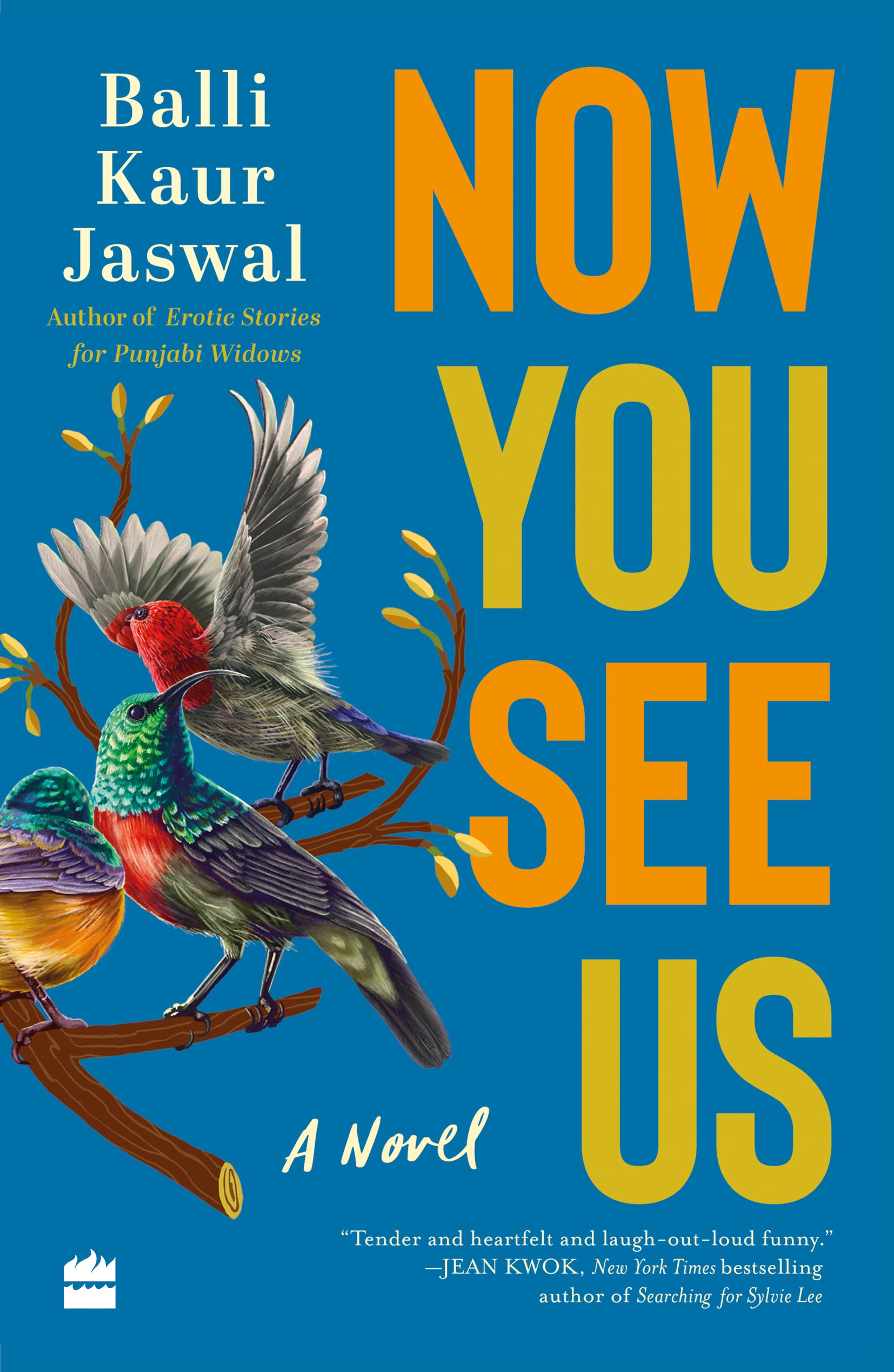
Author: Balli Kaur Jaswal
Genre: Mystery, SingLit
There are novels that try to “give voice” to invisible communities, and then there are novels that simply allow those communities to exist fully on the page—messy, funny, flawed, resilient, contradictory. Now You See Us by Balli Kaur Jaswal belongs firmly in the second category, and that distinction matters.
Set in Singapore and centred on Filipina domestic workers, the novel opens with a murder accusation, but it quickly becomes clear that the mystery itself is only part of the story. What Balli Kaur Jaswal is really interested in is visibility: who gets seen as fully human, whose suffering is minimised, and how entire systems depend on certain people remaining unnoticed except when something goes wrong.
What impressed me most while reading Now You See Us is how confidently it balances tone. It moves between humour, grief, anger, tenderness, and suspense without feeling fragmented. That’s not an easy thing to pull off, especially in a novel carrying such obvious social and political weight.
For readers asking, Is Now You See Us worth reading?—absolutely. It’s one of the sharper and more emotionally grounded Singapore-set novels I’ve read in recent years, and one that feels particularly urgent in what it chooses to centre.
Summary
Now You See Us follows three Filipina domestic workers in Singapore: Corazon, Angel, and Donita.
Corazon, often called Cora, is an experienced domestic worker who has returned to Singapore under emotionally complicated circumstances after previously retiring back to the Philippines. Angel works as a caregiver for an elderly man while dealing with heartbreak and uncertainty about her future. Donita, the youngest and most impulsive of the three, is new to Singapore and struggling with a controlling employer while trying to maintain a relationship with an Indian migrant worker.
Their lives intersect through shared routines, friendships, and the quiet solidarity that forms among workers living under constant scrutiny. But the story shifts dramatically when another Filipina domestic worker, Flordeliza Martinez, is accused of murdering her employer. Most people assume Flor is guilty almost immediately. Donita, however, believes she saw Flor elsewhere around the time of the murder and becomes convinced that something about the case does not add up.
From there, the novel unfolds as both a social drama and a mystery, with the three women gradually uncovering truths that extend beyond the murder itself.
Themes and Deeper Meaning
The title Now You See Us is, in many ways, the novel’s central thesis.
Domestic workers in Singapore are everywhere—raising children, cleaning homes, caring for the elderly—yet they are often treated as background figures rather than individuals with inner lives. Jaswal tackles this directly, but what makes the novel effective is that she doesn’t reduce her characters into symbols or moral lessons. Instead, she gives them humour, contradictions, desires, and bad decisions. They are not idealised victims. They are people.
One of the novel’s strongest themes is invisibility within systems of labour. The women are expected to know everything about the households they work in while revealing as little as possible about themselves. Their labour is intimate but their personhood is often ignored. I thought the book captured this imbalance remarkably well, particularly in scenes where employers speak about their domestic workers as though they are both indispensable and disposable at the same time.
The novel also explores surveillance in multiple forms—social media scrutiny, employer monitoring, immigration regulations, even gossip within worker communities themselves. A recurring tension throughout the book is how little privacy these women are allowed. Pregnancy tests, confiscated phones, restrictions on movement, suspicion of theft—these details are woven into the story in ways that feel organic rather than overly explanatory.
What stayed with me most, though, was the novel’s treatment of friendship. The relationships between Cora, Angel, and Donita provide emotional grounding to the story. Their solidarity never feels sentimentalised. They support one another, but they also disagree, judge, and misunderstand each other in believable ways.
Writing Style and Narrative Voice
Balli Kaur Jaswal writes with impressive control here.
The prose is highly readable without becoming simplistic, and the narrative moves with a confidence that makes the shifts between humour and tension feel natural. There’s a conversational quality to parts of the novel that works particularly well in dialogue-heavy scenes, especially among the domestic workers themselves.
One thing I appreciated is how vividly Singapore is rendered—not the polished, tourist-facing version of the city, but the layered, socially stratified reality beneath it. Jaswal has a sharp eye for social detail, whether she’s describing affluent households, migrant worker gathering spaces, or the subtle hierarchies embedded in everyday interactions.
The pacing is generally strong, though the novel occasionally stretches slightly in the middle sections as it juggles multiple storylines. Still, I rarely found myself disengaged because the characters remain compelling even when the mystery temporarily recedes.
The mystery itself is well-structured, though I’d argue the book works best not as a conventional whodunit, but as a social novel with a mystery framework.
Character Analysis
The real achievement of Now You See Us lies in its characters.
Cora is probably the emotional centre of the novel. Her grief surrounding her nephew Raymond unfolds gradually, and Jaswal handles this storyline with real sensitivity. There’s a weariness to Cora that feels deeply earned, but also a resilience that prevents her from becoming defined solely by suffering.
Donita, meanwhile, brings energy and unpredictability to the story. She’s impulsive, stubborn, and often reckless, but she also drives much of the plot forward. I found her frustrating at times, but intentionally so. She feels young in a believable way—someone trying to maintain autonomy in an environment designed to limit it.
Angel’s storyline is quieter but equally affecting. Her experiences as both caregiver and queer woman add another layer to the novel’s exploration of invisibility and vulnerability. Jaswal handles these elements thoughtfully without turning them into defining “issues” that overshadow the character herself.
Even many of the employers are drawn with nuance. Some are cruel, some oblivious, some genuinely conflicted. The novel resists flattening people into simple moral categories, which gives it greater emotional credibility.
Strengths of the Book
One of the novel’s greatest strengths is its balance between storytelling and social commentary.
This could easily have become a didactic novel, but Jaswal is too skilled a storyteller for that. The political realities emerge naturally through character and situation rather than overt lectures.
The mystery element also works surprisingly well as a structural device. It gives the novel momentum while simultaneously exposing broader societal prejudices—particularly how quickly guilt is assigned to someone already occupying a vulnerable social position.
The friendships between the women are another standout. Their interactions provide warmth and humour without undermining the seriousness of the larger themes.
And perhaps most importantly, the novel succeeds in making its characters feel visible in exactly the way its title suggests.
Weaknesses or Criticisms
If I have one criticism, it’s that the novel occasionally takes on slightly too much.
There are moments where the sheer number of issues being addressed—labour exploitation, online harassment, queer identity, class inequality, Duterte-era violence in the Philippines, employer abuse—makes the narrative feel somewhat crowded.
A few secondary storylines could probably have been streamlined without losing the novel’s overall impact.
I also felt that the mystery resolution, while satisfying enough emotionally, wasn’t necessarily the strongest part of the book structurally. By the end, I was more invested in the women themselves than in the mechanics of the crime.
Still, these are relatively minor criticisms in the context of what the novel accomplishes overall.
Overall Reading Experience
Reading Now You See Us felt immersive in a way that many socially conscious novels struggle to achieve.
It’s informative, certainly, but it never feels like reading a lesson disguised as fiction. Instead, it feels lived-in. The characters’ routines, frustrations, jokes, fears, and small moments of joy accumulate into something emotionally convincing.
I found myself especially affected by the quieter scenes—the women talking on their day off, exchanging gossip, navigating the complicated emotional terrain of working inside someone else’s home.
The novel’s greatest success is that by the end, these women do not feel symbolic. They feel specific and unforgettable.
Who Should Read This Book?
If you’re asking, Who should read Now You See Us?—this is an excellent choice for readers who enjoy socially conscious literary fiction with strong character work and accessible prose.
If you appreciated novels like Erotic Stories for Punjabi Widows, or fiction that combines humour with sharp social observation, this will likely resonate strongly.
It’s also particularly worthwhile for readers interested in Singaporean literature and stories about migrant labour, class, and gender dynamics in Southeast Asia.
Final Verdict
Now You See Us is a sharp, compassionate, and deeply readable novel that manages to entertain while still asking difficult questions about labour, privilege, and visibility.
What makes it especially effective is that it never loses sight of its characters in service of its themes. Jaswal understands that the most powerful way to challenge invisibility is not through abstraction, but through specificity.
So, is Now You See Us worth reading? Without question.
It’s a novel that exposes uncomfortable realities, but it also insists on humour, friendship, and humanity amid those realities—and that balance is exactly what makes it memorable.
Recommended Similar Books
If Now You See Us resonated with you—particularly its focus on marginalised communities, female friendship, and social systems operating beneath everyday life—there are several novels that explore similar territory.
A natural starting point is Erotic Stories for Punjabi Widows, which similarly blends humour, mystery, and sharp cultural commentary while centring women whose voices are often suppressed.
Convenience Store Woman by Sayaka Murata shares Now You See Us’s interest in invisible labour and the social expectations imposed on women, though in a quieter and more surreal register.
For another layered exploration of women navigating restrictive systems, Kim Jiyoung, Born 1982 by Cho Nam-joo examines gendered expectations and societal invisibility in contemporary Korea with similarly sharp observational detail.
Readers interested in Singaporean and Southeast Asian social fiction may also appreciate Sugarbread, which explores family, race, and identity in Singapore through a very different but equally emotionally grounded lens.
Together, these novels share a common strength: they illuminate the lives of people society often overlooks, not by turning them into symbols, but by allowing them to exist fully and unapologetically on the page.

Leave a Reply