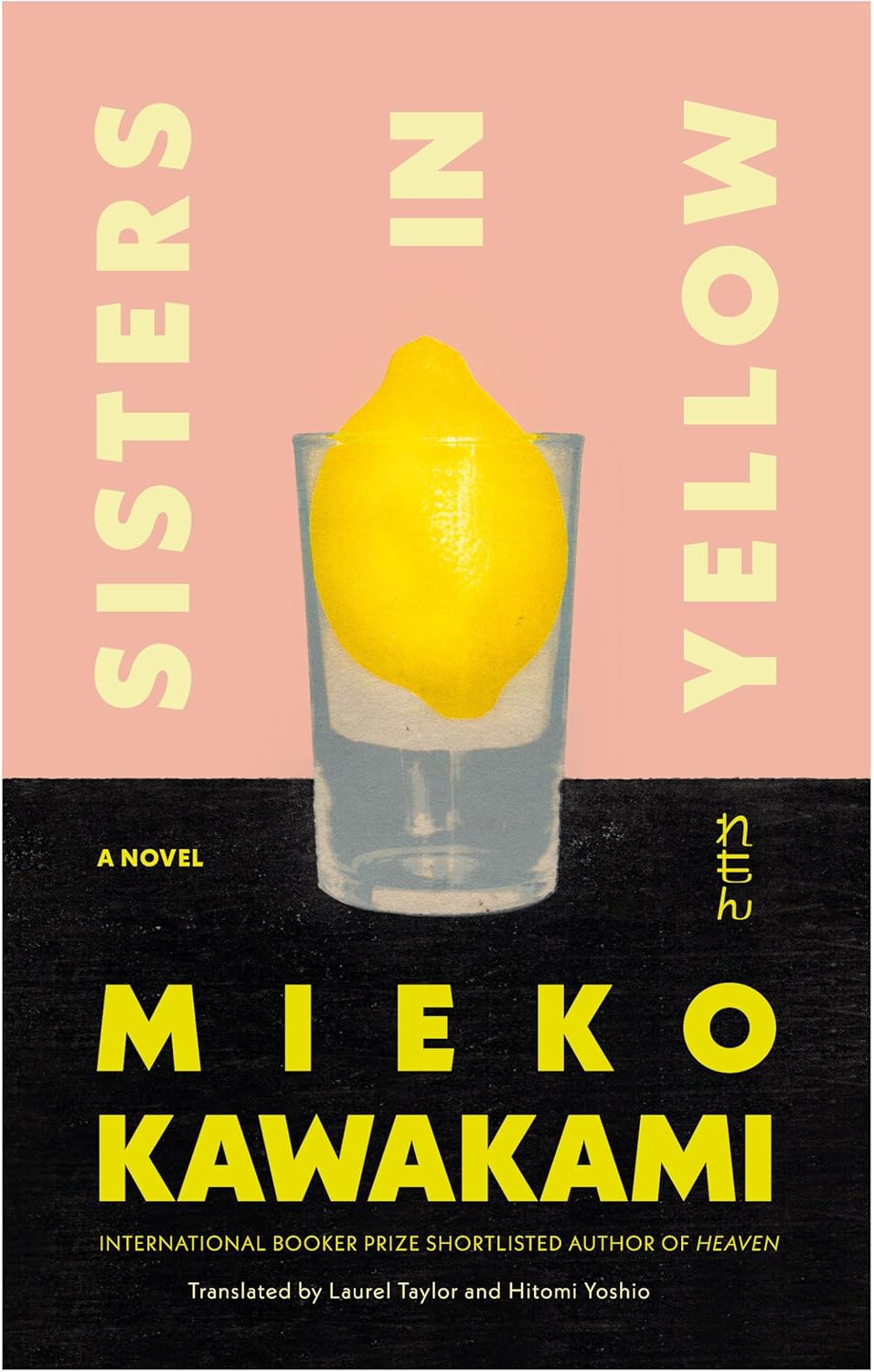
Author: Mieko Kawakami
Genre: Literary fiction, Crime Fiction, Psychological Fiction
There’s something quietly hypnotic about Sisters in Yellow by Mieko Kawakami. It begins almost casually, with memory and regret drifting together during the isolation of the Covid-19 pandemic, before gradually unfolding into something darker and far more emotionally bruising. The novel has been marketed in some places as crime fiction, and technically that label fits—there are crimes, betrayals, and an atmosphere of mounting dread—but the book feels much more interested in survival than suspense.
What struck me most while reading it is how effectively Kawakami captures instability. Financial instability, emotional instability, social instability. Her characters live with the constant awareness that their lives could collapse at any moment, and that tension hums beneath nearly every interaction.
The English title, Sisters in Yellow, feels fitting, though there’s also something hauntingly fragile about the original Japanese title, which translates more directly to Yellow House. Both versions point toward the same idea: the desperate attempt to create safety, belonging, and meaning in a world that offers very little permanence.
For readers wondering, Is Sisters in Yellow worth reading?—absolutely, though it’s not an easy or comforting novel. It’s one of Kawakami’s most emotionally sprawling works, and perhaps one of her bleakest.
Summary
The novel is narrated by Hana, who, during the early months of the pandemic, comes across news that Kimiko Yoshikawa—a woman central to her past—has been arrested for the prolonged abuse and imprisonment of another woman. The discovery forces Hana to revisit memories she has spent years trying not to examine too closely.
From there, the narrative moves back to the late 1990s and early 2000s, where teenage Hana is living a precarious existence with her unreliable mother in Tokyo. Her life changes when she meets Kimiko, an older woman who seems glamorous, independent, and emotionally attentive in ways Hana’s mother is not.
Kimiko eventually opens a small bar called Lemon, and Hana becomes deeply involved in both the business and Kimiko’s life. Over time, two more young women—Ran and Momoko—join their orbit, and together they attempt to create a kind of makeshift family within the unstable world of Tokyo nightlife and petty crime.
But beneath the warmth and intimacy of their shared life is a growing sense of fragility. Money disappears. Relationships shift. Desperation quietly accumulates. What begins as a story about found family gradually transforms into something far more unsettling.
Themes and Deeper Meaning
What makes Sisters in Yellow so compelling is that it understands poverty not simply as lack of money, but as a condition that reshapes how people think, trust, and survive.
Hana becomes obsessed with financial security almost to the point of compulsion. She hoards cash in boxes, clings to superstitions about the colour yellow bringing fortune, and increasingly measures safety in terms of accumulation. I found this portrayal remarkably effective because Kawakami never romanticises it. Hana’s fixation is understandable, but it slowly distorts her relationships and judgment.
The novel is also deeply interested in female friendship and surrogate family structures. The relationships between Hana, Kimiko, Ran, and Momoko are messy, loving, manipulative, protective, and sometimes destructive all at once. Kawakami refuses to simplify these women into symbols of empowerment or victimhood. Their bonds sustain them, but they also trap them.
There’s a recurring tension between care and control throughout the novel. Kimiko gives Hana stability and affection, but there’s always an undercurrent of dependence that becomes increasingly troubling over time.
What stayed with me most, though, is the novel’s treatment of memory. Adult Hana narrates with the uneasy awareness that she may not fully understand her own past. Certain moments feel distorted by guilt, nostalgia, or repression. The result is a narrative that constantly questions whether remembering itself can ever be entirely reliable.
Writing Style and Narrative Voice
Kawakami’s prose here is deceptively plain. Large stretches of the novel focus on routine—working shifts, counting money, eating meals, cleaning apartments—and yet the cumulative effect becomes strangely immersive.
At first, I wondered whether the pacing would become too repetitive. The novel is long, and Kawakami deliberately lingers in everyday detail. But gradually, those repetitions start to feel essential. They create the sense of lives narrowing around necessity and survival.
Hana’s voice is emotionally restrained in ways that make the occasional bursts of insight or panic hit harder. She narrates many events with a kind of detached practicality, even when describing deeply disturbing situations. That emotional distance becomes part of the novel’s atmosphere.
The structure also works well. Beginning during the pandemic before moving backward creates an immediate sense of foreboding. From the start, readers know something terrible has happened—or will happen—and that tension quietly shapes everything that follows.
Character Analysis
Hana is one of Kawakami’s most frustrating and compelling protagonists.
She is deeply sympathetic at times, especially in her early loneliness and hunger for stability. But she also becomes increasingly difficult to defend. Her obsession with money and control slowly transforms her relationships, and Kawakami never asks the reader to excuse her behaviour simply because of her circumstances.
Kimiko is perhaps the novel’s most fascinating figure. She exists somewhere between protector, manipulator, older sister, and surrogate mother. I kept changing my mind about her throughout the book, which feels entirely intentional. She is charismatic and caring, but there’s also something quietly dangerous about the emotional dependency she creates.
Ran and Momoko add further complexity to the household dynamic. Momoko, in particular, stood out to me because of how vulnerable and awkward she feels within the group. Kawakami gives each woman enough emotional specificity that the shared house never feels symbolic or abstract—it feels lived in.
Strengths of the Book
One of the novel’s greatest strengths is its emotional realism. Kawakami captures the psychological effects of insecurity with extraordinary precision.
The atmosphere is also incredibly strong. Even during quieter sections, there’s a persistent sense of instability hovering beneath the surface.
I also admired how uncompromising the book is. It refuses neat morality or simple redemption arcs. These characters make terrible decisions, often repeatedly, but the novel remains deeply invested in understanding them rather than condemning them outright.
And despite its length, the novel builds emotional momentum impressively well. By the final sections, I found myself completely absorbed.
Weaknesses or Criticisms
That said, Sisters in Yellow is undeniably demanding.
The pacing can feel slow, particularly in the middle sections where routine and repetition dominate. Readers expecting a tightly plotted thriller may struggle with how diffuse the narrative sometimes becomes.
There are also moments where the emotional restraint risks creating distance. Kawakami often withholds dramatic confrontation in favour of quieter accumulation, which may frustrate some readers.
Still, I suspect many of these “weaknesses” are inseparable from what the novel is trying to achieve.
Overall Reading Experience
Reading Sisters in Yellow felt immersive in a slightly suffocating way.
The novel creates a world where every small financial setback feels catastrophic, where emotional dependency becomes difficult to separate from survival, and where hope itself starts to feel unstable.
It’s not a book I rushed through. I found myself reading it in stretches, sitting with its atmosphere afterward. Certain scenes lingered long after I’d finished—not necessarily the dramatic ones, but the smaller moments of exhaustion, affection, or quiet desperation.
Who Should Read This Book?
If you’re asking, Who should read Sisters in Yellow?—this is ideal for readers who appreciate literary fiction focused on female relationships, economic precarity, and psychological complexity.
If you enjoyed Breasts and Eggs or Heaven, this feels like a darker, more sprawling extension of Kawakami’s interest in vulnerability and survival.
It’s also an excellent choice for readers who enjoy slow-burn literary noir where atmosphere and character matter more than conventional suspense.
Final Verdict
Sisters in Yellow is a haunting, emotionally layered novel about money, dependency, and the fragile forms of belonging people build when traditional systems fail them.
It’s messy in ways that feel intentional. The characters are often difficult, the pacing deliberately immersive rather than propulsive, and the emotional resolutions remain stubbornly unresolved.
So, is Sisters in Yellow worth reading? Absolutely.
It’s one of those novels that slowly tightens around you while you’re reading it, until by the end, you realise it has become less a story about crime and more a devastating examination of how people survive together—and sometimes fail to.
Recommended Similar Books
If Sisters in Yellow resonated with you, there are several novels that explore similar themes of female friendship, economic instability, and morally complicated survival.
Convenience Store Woman by Sayaka Murata similarly examines precarious labour and social alienation, though in a more surreal and darkly comic register.
Grotesque by Natsuo Kirino offers a harsher, more overtly disturbing exploration of female relationships, economic pressure, and violence within urban Japan.
For readers interested in emotionally messy found-family dynamics, A Little Life shares a similar fascination with intimacy, trauma, and dependency, though with a very different tone.
And for another quietly devastating portrait of women navigating unstable social systems, Kim Jiyoung, Born 1982 by explores gender, labour, and emotional exhaustion with comparable clarity and restraint.

Leave a Reply