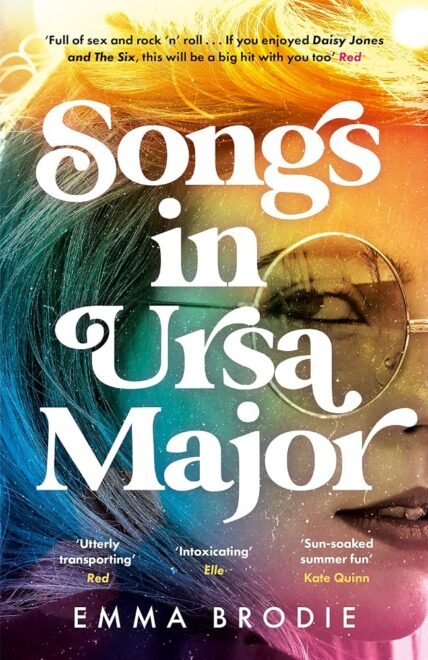
There’s something wonderfully romantic about the music scene of the late 1960s and early 1970s. Long-haired musicians writing songs in dimly lit studios, outdoor festivals filled with barefoot concertgoers, and albums that seem to capture entire relationships within a handful of lyrics. It was an era that produced some of the most enduring music of the twentieth century, along with plenty of complicated love affairs.
In Songs in Ursa Major, Emma Brodie draws inspiration from this world, particularly the relationship between Joni Mitchell and James Taylor, to tell the story of a young singer-songwriter whose extraordinary talent threatens to be overshadowed by the man she falls in love with.
The novel follows Jane Quinn, an aspiring musician living on a fictional island off the coast of Massachusetts. When an unexpected opportunity propels her into the spotlight, she finds herself navigating the intoxicating world of recording contracts, touring musicians and celebrity relationships, all while trying to maintain control of her own artistic identity.
It’s a premise that will feel familiar to readers who enjoyed Taylor Jenkins Reid’s Daisy Jones & The Six. Both novels explore the music industry during a particularly glamorous period, with complicated romantic relationships and the difficulties women encounter when their professional ambitions collide with the expectations of those around them.
But Songs in Ursa Major is less interested in the spectacle of rock-star excess than in the quieter question of what happens when a woman is expected to sacrifice her own ambitions to support someone else’s.
At its heart, this is a story about music, love and the difficult process of discovering that being someone’s muse isn’t necessarily the same as being recognised as an artist in your own right.
Synopsis
It’s the summer of 1969, and the residents of Bayleen Island are preparing for their annual folk music festival.
The headline performer is Jesse Reid, a talented and increasingly famous musician whose soulful voice and guitar playing have made him one of the most exciting names in folk rock.
But when Jesse is injured in a motorcycle accident shortly before his performance, the festival organisers are left scrambling to find a replacement.
Enter Jane Quinn.
At nineteen, Jane is the lead singer of a local band called The Breakers. She’s spent much of her life surrounded by music, but her ambitions have largely remained confined to the island where she grew up.
When The Breakers are unexpectedly invited to perform on the festival’s main stage, Jane delivers a performance that changes everything.
Suddenly, record executives are interested, industry professionals are making promises, and the possibility of a successful music career no longer seems quite so impossible.
Meanwhile, Jesse remains on the island while recovering from his accident. When he meets Jane, the two discover a shared passion for songwriting and an immediate creative connection.
Their friendship gradually develops into a romantic relationship, and Jane soon finds herself touring alongside Jesse as her own career begins to take off.
But life in the music industry is considerably more complicated than she imagined.
While Jesse enjoys the privileges associated with being an established male star, Jane must contend with sexist expectations, difficult professional decisions and the constant possibility that her achievements will be attributed to her relationship rather than her talent.
As their careers become increasingly intertwined, Jane begins to discover that love, fame and artistic independence aren’t always compatible.
What Works Well
One of the strongest aspects of Songs in Ursa Major is its ability to capture the atmosphere of the early 1970s music industry.
The recording studios, concert venues, backstage conversations and long stretches spent travelling between performances create a world that feels both glamorous and exhausting.
There’s a tendency to romanticise this period as an era of extraordinary creativity and artistic freedom, when musicians could write deeply personal songs and build entire careers around their own experiences.
Brodie captures that appeal, but she also examines the less attractive machinery operating behind the music.
Record labels are businesses, managers have financial interests, and an artist’s public image can become almost as important as the songs they produce.
Jane enters this world believing that her talent should speak for itself.
Unfortunately, talent is only part of what determines success.
What makes her story compelling is the way she gradually discovers that being a gifted musician doesn’t necessarily mean having control over her career.
The people who manage, promote and distribute her music often have their own ideas about what kind of artist she should become.
And because she’s a young woman entering an industry dominated by powerful men, her decisions are judged according to expectations that don’t necessarily apply to her male counterparts.
This imbalance becomes especially apparent in her relationship with Jesse.
Jesse is already established, wealthy and professionally respected when Jane enters the industry. His talent is recognised as something belonging entirely to him.
Jane, meanwhile, must constantly negotiate the possibility that people will view her as Jesse’s girlfriend first and a musician second.
It’s an uncomfortable dynamic, particularly because Jesse genuinely admires her talent.
The problem isn’t simply that he wants to hold her back. It’s that his position allows him to take certain freedoms for granted, while Jane cannot necessarily make the same choices without facing different consequences.
I think this is one of the novel’s most interesting ideas.
A romantic partner can be supportive in principle while still benefiting from a system that treats the other person unfairly.
The relationship between Jane and Jesse also provides an appealing contrast between artistic connection and emotional compatibility.
They understand each other through music, but that doesn’t necessarily mean they understand how to build a healthy relationship.
Their shared creative interests draw them together, while the pressures of fame, addiction and professional ambition introduce difficulties that talent alone cannot resolve.
Another strength is the attention given to Jane’s family history.
Her upbringing on Bayleen Island and her complicated relationship with her absent mother influence how she approaches both love and success.
Jane’s ambitions aren’t simply about becoming famous. They’re also connected to questions about who she is, where she comes from and whether she can build a different future from the one she has inherited.
The island setting gives these themes a tangible foundation.
Even as Jane travels further into the world of celebrity and professional music, Bayleen represents something more permanent: a place where her value isn’t entirely determined by record sales, publicity or professional approval.
What Could Be Better
The most obvious criticism of Songs in Ursa Major is that its overall narrative follows a relatively familiar trajectory.
A talented young woman receives an unexpected opportunity, enters a glamorous industry, falls in love with an established star and gradually discovers that fame comes with considerable personal costs.
It’s a structure readers will recognise from stories such as A Star Is Born, and the novel doesn’t always move far enough away from those conventions to feel entirely unpredictable.
This is particularly noticeable in the romantic relationship.
Jane and Jesse’s initial attraction is easy to understand. They’re both talented musicians, they share a genuine creative connection, and their circumstances bring them into close contact during an exciting period of their lives.
However, the deeper emotional foundations of their relationship are not always as convincing as the professional and artistic connections that surround it.
Their romance occasionally relies on the familiar intensity of two passionate artists falling for one another, rather than developing through the sort of quieter interactions that make a relationship feel fully believable.
This is a reservation also raised in contemporary critical reviews, which have generally been more enthusiastic about Brodie’s depiction of the music industry than the romantic elements.
The novel’s use of real-life musical history may also work against it for readers who are already familiar with Joni Mitchell and James Taylor.
Brodie has openly acknowledged their relationship as an important inspiration, and the parallels are difficult to miss once you’re aware of them.
That can make the story enjoyable as a fictional interpretation of a fascinating musical era, but it also means some developments may feel less surprising.
Readers who approach the novel with little knowledge of the musicians behind its inspiration may find it easier to experience Jane and Jesse as entirely independent fictional characters.
The pacing is another consideration.
Although the novel begins with an exciting festival performance, parts of the story are more interested in recording sessions, personal relationships and Jane’s emotional development than dramatic events.
This works well when the focus remains on her struggle for artistic independence, but readers expecting a constant succession of performances, scandals and backstage conflicts may find certain sections slower.
None of these limitations makes the premise unappealing. They simply suggest that the novel’s greatest strengths lie in its atmosphere and exploration of the music business rather than the originality of its romantic storyline.
Themes and Discussion
One of the most compelling themes in Songs in Ursa Major is the distinction between being talented and being allowed to succeed on your own terms.
Jane possesses considerable musical ability, but entering the professional music industry means surrendering at least some control over how that talent is presented.
Record executives have opinions about her sound, her appearance and the audiences she should appeal to.
Her relationship with Jesse creates another problem.
Because he is already famous, his presence can open doors that might otherwise remain closed to her. Yet accepting that assistance also risks reinforcing the assumption that her career exists because of him.
It’s a frustrating contradiction.
Jane wants the opportunities that come with professional success, but she doesn’t want her identity reduced to someone else’s romantic partner.
The novel also explores how differently men and women are treated within creative industries.
Male musicians are often granted considerable freedom to behave badly, make mistakes and reinvent themselves. Women, meanwhile, may find their personal relationships, appearance and perceived morality subjected to much greater scrutiny.
Brodie uses these double standards to examine the emotional cost of success, particularly when an artist must constantly defend the legitimacy of her achievements.
Another significant theme is the relationship between love and ambition.
Jane and Jesse are drawn together by their music, but their careers do not necessarily develop in ways that benefit them equally.
This raises the question of whether two ambitious people can support each other’s dreams without one eventually becoming secondary to the other.
The novel doesn’t suggest that romantic love and professional success are inherently incompatible.
Instead, it explores how unequal circumstances can complicate even relationships built on genuine affection.
Addiction is another important part of the story.
Jesse’s struggles reveal a darker side of the music industry, where extraordinary talent and public admiration can coexist with serious personal difficulties.
Fame may provide access to wealth, attention and professional opportunities, but it doesn’t necessarily protect someone from emotional pain or destructive behaviour.
Jane must navigate the uncomfortable reality that loving someone doesn’t mean being able to resolve their problems.
The novel also examines the role of family history in shaping personal identity.
Jane’s relationship with her mother and the circumstances of her upbringing influence how she understands independence, abandonment and emotional attachment. As she becomes more successful, she must decide which aspects of her past she wants to carry forward and which she needs to leave behind.
Perhaps the most appealing theme, however, is the idea of finding your own voice.
For a musician, that phrase has a literal meaning, but Brodie also uses it to explore Jane’s gradual development as an independent person.
She begins the novel with remarkable talent but relatively little experience of the world beyond her island.
Her journey through love, professional success and disappointment forces her to reconsider what she actually wants from her life.
And that process turns out to be more complicated than simply becoming famous.
Writing Style
Emma Brodie’s writing is particularly effective when describing music and the atmosphere surrounding its creation.
The novel’s settings are richly connected to the sounds, personalities and cultural mood of the late 1960s and early 1970s.
Rather than treating music as a convenient backdrop for romance, Brodie gives considerable attention to the creative process itself.
Recording sessions, songwriting decisions and professional disagreements become important parts of the narrative because they reveal how Jane understands herself as an artist.
The fictional songs also contribute to the story’s sense of authenticity.
Brodie developed lyrics for Jane’s music, and some were subsequently set to music in collaboration with her musician brother, Benjamin Brodie. This attention to the songs helps establish Jane’s artistic identity beyond the more familiar conventions of a celebrity romance.
The prose is generally accessible and descriptive, making the novel an approachable choice for readers who enjoy historical fiction with a strong sense of atmosphere.
Brodie’s interest in the industry also gives the narrative a level of specificity that helps distinguish it from a purely romantic story.
The contrast between Bayleen Island and the professional music world is especially effective.
On the island, Jane’s music is connected to family, familiarity and personal expression.
Once she enters the recording industry, those same creative abilities become commercial products, subject to outside opinions and financial expectations.
This change in setting mirrors her gradual understanding of what professional success involves.
At 336 pages in the US paperback edition, the novel offers a substantial story without becoming an especially lengthy historical saga.
Final Verdict
Songs in Ursa Major is an atmospheric and engaging novel about music, romance and the complicated reality of being a talented young woman in the early 1970s recording industry.
Emma Brodie captures much of what makes this period so appealing, from outdoor music festivals and creative experimentation to the extraordinary personalities who shaped popular music.
But the novel’s most interesting material lies beneath that glamorous surface.
Jane Quinn’s experiences demonstrate how easily a woman’s professional achievements can become entangled with her romantic relationships, particularly when the man she loves already enjoys greater fame, wealth and influence.
The relationship between Jane and Jesse is certainly an important part of the story, although I think the novel’s broader exploration of artistic independence is ultimately more compelling than the romance itself.
Its familiar rise-to-fame structure and occasional reliance on conventional romantic drama may disappoint readers looking for a particularly original narrative.
Nevertheless, the historical atmosphere, attention to songwriting and thoughtful examination of gender inequality give the book plenty of appeal.
I would recommend Songs in Ursa Major to readers who enjoyed Daisy Jones & The Six, particularly those interested in the creative lives of female musicians and the complicated relationships behind famous songs.
It’s also an appealing choice for anyone fascinated by the music of Joni Mitchell, James Taylor and the singer-songwriter movement of the early 1970s.
At its heart, this is a story about a young woman who must decide whether she wants to be remembered as someone else’s great love or as an artist whose music deserves to stand on its own.
And perhaps that’s the novel’s most compelling idea: falling in love with another musician can inspire extraordinary art, but finding your own voice sometimes means learning when to sing alone.

Leave a Reply