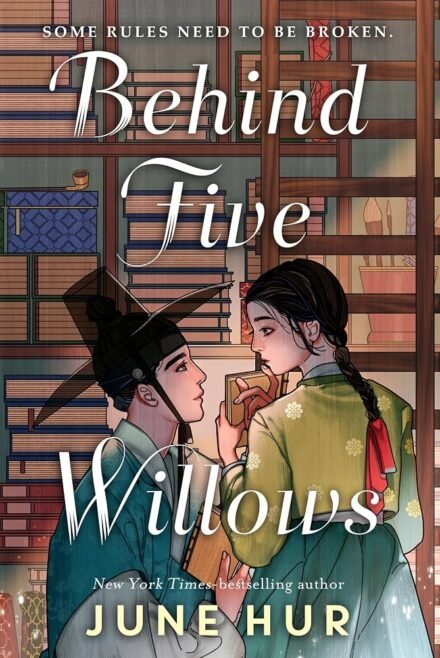
There’s something immediately appealing about a novel in which two people fall in love through their shared passion for books, especially when those books happen to be illegal.
In Behind Five Willows, June Hur takes the familiar romantic misunderstandings of Jane Austen’s Pride and Prejudice and transports them to eighteenth-century Korea, where reading and writing fiction have become dangerous activities. The result is a historical romance involving secret identities, forbidden literature, social expectations and two people who are considerably more compatible than either is initially prepared to admit.
The premise is particularly intriguing because it combines two very different literary traditions. Austen’s novels are famous for their sharp observations about marriage, class and the sometimes ridiculous behaviour of people convinced of their own good judgment. Hur, meanwhile, has established herself as an author of Korean historical fiction, drawing on the politics and social restrictions of the Joseon dynasty to create stories that feel both culturally specific and surprisingly contemporary.
Behind Five Willows brings these interests together through Haewon, a young woman who secretly earns money transcribing banned novels, and Seojun, a wealthy nobleman’s son who is concealing his own literary ambitions.
There’s plenty to enjoy in this combination, particularly for readers who appreciate slow-burn romances, clever literary references and historical settings that offer more than a decorative backdrop.
It is, however, a noticeably gentler novel than some of Hur’s earlier work. Readers expecting the darker mysteries associated with The Red Palace or A Crane Among Wolves should be prepared for a story that places considerably more emphasis on romance, character development and the pleasure of reading.
Synopsis
In 1792, during Korea’s Joseon dynasty, eighteen-year-old Shin Haewon is growing up in a family whose declining finances have made her future increasingly uncertain.
As the second daughter, she is expected to marry well, preferably to someone whose wealth and position can improve the family’s circumstances. But Haewon has ambitions of her own, even if pursuing them means breaking the law.
With the government restricting the publication and circulation of fiction, she secretly works as a book transcriber under the pseudonym Magpie, producing handwritten copies of forbidden stories for an underground bookshop called Five Willows.
It’s dangerous work, but Haewon loves literature too much to give it up, particularly the novels written by an anonymous author known as Black Lotus.
What she doesn’t know is that Black Lotus is actually Yu Seojun, the nineteen-year-old son of a powerful government official.
Seojun has spent much of his life trying to live up to his father’s expectations. As the only son of a wealthy noble family, he is supposed to embody respectability, discipline and unquestioning obedience. Writing fiction is certainly not part of that plan.
Yet his secret literary life offers an escape from those expectations, and his correspondence with Magpie has become one of the few things that gives him genuine happiness.
When Haewon’s older sister begins courting a wealthy gentleman, Haewon is reluctantly recruited to accompany them on their outings.
Unfortunately, the gentleman brings along his best friend, Seojun, whose stiff manners and apparent arrogance make an immediately poor impression.
Neither Haewon nor Seojun realises that the person they find so irritating in real life is also the person whose writing they have come to admire.
As their paths continue to cross, the growing threat of government censorship makes their secrets increasingly difficult to protect.
What Works Well
The most interesting aspect of Behind Five Willows is its decision to place literature itself at the centre of the romance.
Haewon and Seojun are not simply two people who happen to enjoy reading. Books are essential to their identities, and their involvement in the circulation of forbidden fiction represents an act of quiet rebellion against the expectations of their society.
For Haewon, transcribing novels offers a degree of financial independence that would otherwise be difficult to achieve. It also gives her access to ideas and experiences beyond the limited possibilities available to a young woman of her social position.
For Seojun, writing provides an opportunity to express a part of himself that his family would consider unsuitable.
Their shared love of fiction creates a connection that is more meaningful than their initial encounters would suggest.
This is also where Hur’s adaptation of Pride and Prejudice becomes particularly effective.
Like Elizabeth Bennet and Mr Darcy, Haewon and Seojun make assumptions about each other based on limited information. Haewon interprets Seojun’s reserved behaviour as arrogance, while Seojun initially looks down on Haewon because of her social status.
Neither is especially interested in reconsidering those judgments.
Yet through their anonymous correspondence, they have already developed an appreciation for qualities they fail to recognise in each other face-to-face.
It’s a clever romantic device, particularly because readers understand the connection long before the characters do.
The pleasure therefore comes less from discovering their secret identities and more from watching two intelligent people gradually realise how thoroughly they have misjudged one another.
Another strength is the historical setting.
Hur doesn’t simply transpose Austen’s characters into Korean clothing and leave the rest of the story unchanged. Instead, she uses the social and political circumstances of Joseon Korea to give the romance its own tensions.
Class differences are particularly significant.
Haewon’s family is struggling financially, while Seojun enjoys the privileges associated with wealth and status. Their circumstances shape not only how they are treated by others but also what they believe is possible for their futures.
Marriage carries important financial and social consequences, especially for women whose opportunities for independence are limited.
The restrictions surrounding books also give the story a sense of urgency.
In a society where fiction is viewed with suspicion, something as seemingly harmless as copying a novel becomes an act with potentially serious consequences.
There’s an appealing irony in the idea that stories about imaginary people could be considered dangerous enough to suppress.
Hur’s decision to make both protagonists participants in this underground literary culture gives the novel more substance than a conventional historical romance built entirely around courtship.
What Could Be Better
The biggest potential limitation of Behind Five Willows is that its connections to Pride and Prejudice are sometimes quite obvious.
For readers who know Austen’s novel well, the initial misunderstandings, contrasting family circumstances and gradual change in the protagonists’ opinions will feel familiar.
That’s not necessarily a problem. Part of the enjoyment of a literary retelling comes from recognising how an author adapts familiar characters and relationships to a new setting.
However, readers hoping for a particularly radical reinterpretation may find that Hur remains relatively close to the original romantic framework.
The pacing may also divide opinion.
Although the threat of government censorship creates an underlying sense of danger, much of the novel concentrates on conversations, misunderstandings, family obligations and the gradual development of Haewon and Seojun’s relationship.
Readers who enjoy slow-burn romance are likely to appreciate this approach.
Those expecting a fast-paced historical thriller, especially after Hur’s previous books, may find themselves wishing for more action or a stronger mystery.
The romance itself may also feel somewhat restrained to readers accustomed to contemporary romantic fiction.
This is partly a consequence of the historical setting, where social conventions severely limit how openly the characters can express their feelings.
Their relationship develops through letters, observations and carefully managed interactions rather than physical intimacy.
That restraint is appropriate to the story, but it does require patience.
There is also the question of whether the novel fully explores its larger political concerns.
Government censorship, restrictions on women’s lives and class inequality are fascinating subjects, yet the romance remains the central focus.
Readers interested primarily in the history of literary censorship in Korea may therefore wish that the novel devoted more attention to the wider consequences of these policies.
Nevertheless, these reservations are closely connected to the kind of book Hur has chosen to write. Behind Five Willows is fundamentally a historical romance with political and literary themes, rather than a comprehensive account of the period.
Themes and Discussion
One of the central themes of Behind Five Willows is the power of literature to challenge established ideas.
For Haewon and Seojun, fiction provides more than entertainment.
It allows them to imagine lives beyond the roles assigned to them by their families and society.
Haewon is expected to marry well and behave according to the conventions governing respectable young women. Seojun is expected to inherit his father’s position and maintain the family’s reputation.
Neither has much freedom to pursue interests that conflict with these obligations.
Books offer a different possibility.
Through reading and writing, they can explore unfamiliar perspectives, question accepted assumptions and express thoughts that might be considered inappropriate in ordinary conversation.
This helps explain why censorship is such an important part of the novel.
Controlling the circulation of stories is not simply about restricting entertainment. It is also about controlling which ideas people encounter and the possibilities they are encouraged to imagine.
Another important theme is the relationship between social class and personal freedom.
Haewon and Seojun are both constrained by society, but they experience those restrictions differently.
Seojun’s wealth gives him opportunities unavailable to Haewon, yet his privileged position also comes with expectations about his behaviour and future.
Haewon has fewer resources and less social standing, but she demonstrates considerable determination in creating opportunities for herself.
Their relationship challenges the assumptions each has made about the other’s circumstances.
The novel also explores the difficulty of balancing filial duty with personal ambition.
Both protagonists care about their families, yet their individual desires conflict with what their parents expect.
This tension is particularly interesting in the context of historical Korean society, where family reputation and social obligations played a substantial role in shaping personal decisions.
It’s also a theme that remains familiar in contemporary Asian fiction.
The circumstances may have changed dramatically, but the pressure to pursue a respectable career, make a suitable marriage or fulfil parental expectations continues to appear in stories set centuries later.
Perhaps the most appealing theme, however, is the difference between someone’s public identity and their private self.
Haewon and Seojun initially dislike each other because of the impressions they create in person.
Yet through their anonymous correspondence, they discover qualities that might otherwise have remained hidden.
Their letters allow them to communicate without the immediate interference of social status, appearance or family reputation.
It’s a romantic idea, but also an interesting observation about how easily people can be misunderstood when judged primarily by the roles they occupy.
Writing Style
June Hur’s writing is particularly well suited to historical fiction because of her attention to the social details that shape her characters’ lives.
Rather than treating the Joseon setting as a purely decorative backdrop, she incorporates restrictions surrounding marriage, class and literature into the decisions her characters must make.
The novel also uses contrasting perspectives, allowing readers to understand the misunderstandings between Haewon and Seojun more clearly than either character does.
This creates opportunities for humour, particularly when the protagonists are confidently wrong about one another.
The influence of Jane Austen is apparent in the dialogue and social observations, although Hur’s prose remains accessible to contemporary young adult readers.
The correspondence between Magpie and Black Lotus is another important element of the narrative.
Their letters provide a contrast to the more formal interactions they share in public, revealing a degree of emotional honesty that their respective social positions would otherwise discourage.
At 336 pages, the novel is a manageable length for readers who enjoy historical romance without wanting to commit to an expansive historical saga.
Hur also includes supplementary material about the historical background, giving interested readers a starting point for learning more about the period.
Final Verdict
Behind Five Willows offers an appealing combination of Korean historical fiction, literary romance and Austen-inspired social comedy.
June Hur takes the familiar enemies-to-lovers dynamic of Pride and Prejudice and gives it a distinctive historical context, where books are forbidden, social expectations are restrictive and writing fiction can carry serious consequences.
The strongest aspect of the premise is the relationship between literature and personal freedom.
Haewon and Seojun’s shared love of books isn’t simply a convenient way to bring them together. It’s also the means through which they begin questioning the expectations placed upon them.
Their anonymous correspondence adds a particularly charming dimension to the romance, allowing readers to see how compatible they are long before the characters recognise it themselves.
The novel may not satisfy everyone. Its deliberate pacing, recognisable Austen parallels and relatively restrained romance are likely to appeal more to readers who enjoy character-driven historical fiction than those seeking an action-packed thriller.
Readers familiar with Hur’s darker historical mysteries should also approach this as a different kind of story.
Nevertheless, Behind Five Willows has an engaging premise and a thoughtful historical setting that makes its familiar romantic structure feel fresh.
I would particularly recommend it to readers who enjoy Korean historical dramas, Jane Austen adaptations and novels in which books play an important role.
It’s also a promising choice for anyone who likes the idea of two people falling in love through words before they learn to appreciate the person behind them.
Ultimately, Behind Five Willows is a story about discovering that the person you think you know may be very different from the person they truly are, and that sometimes, books can help us recognise what society has taught us to overlook.


Leave a Reply