Singapore has a reputation for clean government, political stability and an exceptionally efficient civil service. These are qualities that frequently appear in discussions about the country’s transformation from a newly independent nation into one of Asia’s wealthiest economies. What we hear considerably less about are the personal stories behind that transformation, particularly those involving political dissent, detention and people whose experiences do not fit comfortably into the familiar national narrative.
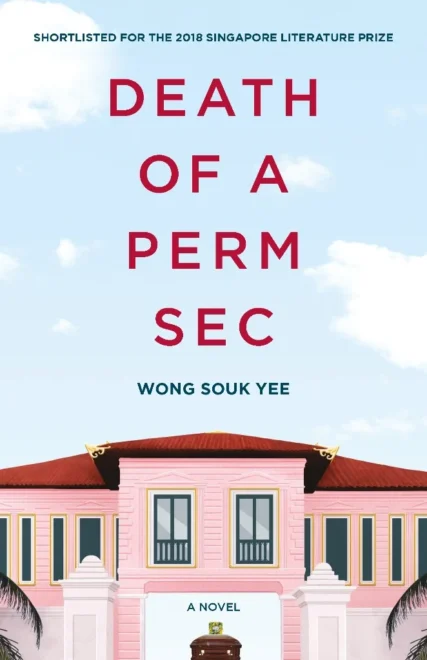
In Death of a Perm Sec, Singaporean author Wong Souk Yee takes readers into a considerably darker version of the country’s political past. Set in the 1980s, the novel begins with the suspicious death of a senior civil servant who has been accused of accepting millions of dollars in bribes. What initially appears to be a straightforward case of suicide develops into a political mystery involving powerful officials, questionable investigations and secrets reaching back to Singapore’s tumultuous early years.
It’s an intriguing premise for a local novel, particularly because political thrillers are not the first genre that comes to mind when discussing Singaporean fiction. We have no shortage of books about family expectations, cultural identity and the everyday experiences of growing up in Singapore, but considerably fewer that explore the country’s political institutions through the conventions of crime fiction.
Wong is also an unusual author for this particular story. A playwright and former political detainee, she was among those detained in 1987 during Operation Spectrum, when the Singapore government alleged the existence of a Marxist conspiracy. Her experiences give the novel a distinctive perspective on the relationship between political power, personal freedom and the way history is remembered.
First published in 2016, Death of a Perm Sec was a finalist for the inaugural Epigram Books Fiction Prize and was subsequently shortlisted for the Singapore Literature Prize in 2018.
Although the novel is presented as a murder mystery, its ambitions extend well beyond identifying who might have been responsible for a man’s death. It also asks what happens to ordinary families when the institutions they have trusted become the very institutions they have reason to fear.
Synopsis
Chow Sze Teck is the permanent secretary of Singapore’s fictional housing ministry, a powerful and respected civil servant whose career has placed him close to the country’s political leadership.
But his reputation is in ruins.
Accused of accepting millions of dollars in bribes, Chow is found dead in circumstances that initially suggest suicide. A combination of alcohol, morphine and Valium appears to provide a straightforward explanation for his death, especially given the enormous scandal surrounding him.
Yet questions soon emerge about what actually happened.
As a Criminal Investigation Department inspector begins examining the circumstances of Chow’s death, his family discovers that the investigation may not be as impartial as it appears.
The family’s difficulties are compounded by the loss of their father’s status and influence. Once accustomed to wealth, privilege and access to powerful people, Chow’s four children must contend with the consequences of being associated with a disgraced public official.
Meanwhile, connections to Singapore’s political past begin to emerge, raising the possibility that Chow’s death is linked to secrets far more significant than the corruption allegations against him.
What initially looks like a personal tragedy gradually becomes a story about political survival, institutional power and the danger of knowing too much.
Set against the background of Singapore’s post-independence history, Death of a Perm Sec combines a murder investigation with the experiences of a family whose privileged position can no longer protect them.
What Works Well
One of the most interesting aspects of Death of a Perm Sec is its willingness to examine a side of Singapore that rarely receives much attention in mainstream popular fiction.
The country’s political history provides considerable material for a thriller. Singapore’s separation from Malaysia, the ideological struggles of the early post-independence period, the use of detention without trial and the concentration of political power all raise questions that can be explored through fiction without requiring the novel to function as a conventional historical account.
Wong draws on this material to create a story in which the circumstances surrounding one man’s death gradually reveal a much larger political landscape.
The premise is particularly effective because Chow is not an obvious outsider challenging the establishment. He is someone who has spent his career working within it.
His position should, in theory, provide influence, connections and a degree of security. Yet once he falls from favour, those advantages become remarkably fragile.
This reversal gives the novel one of its most compelling ideas: proximity to power does not necessarily offer protection when the people controlling that power decide you have become a liability.
The involvement of different investigative authorities adds another dimension to the story. Rather than treating law enforcement as a straightforward source of truth, the novel questions whether investigations can remain independent when political interests are involved.
This creates an uncomfortable atmosphere of uncertainty, particularly for Chow’s family, who must decide whom they can trust.
I also think the decision to focus on the family’s experiences makes the political material more accessible.
A novel concerned entirely with government officials, political manoeuvring and historical disputes could easily become rather dry. By examining the effect of Chow’s death on his four children, Wong gives readers a more personal way of understanding what it means to lose social standing and institutional protection.
The siblings have grown up with different expectations and have made different choices about their lives. Their father’s disgrace affects them in different ways, exposing tensions that wealth and status may previously have allowed the family to overlook.
There’s something particularly interesting about how quickly social relationships can change once a family loses its position.
People who were previously friendly may become distant. Professional opportunities disappear. The assumptions that once made everyday life feel predictable no longer apply.
This is a familiar pattern in stories about political scandals, but it becomes especially striking in a society where professional reputation and personal connections can have considerable influence over an individual’s opportunities.
Another strength is the novel’s historical perspective.
Wong’s experiences as a former political detainee inevitably influence the way readers approach her portrayal of interrogation, state authority and political dissent.
Although the novel is fictional, its concerns are connected to real debates about Singapore’s political history. That relationship between fiction and historical memory makes it more provocative than a conventional murder mystery.
Rather than simply asking readers to solve a crime, Wong encourages them to consider whose experiences are preserved in the official record and whose accounts may be overlooked.
What Could Be Better
The novel’s considerable political ambitions also create some of its limitations.
Readers looking for a tightly constructed detective story may find that the murder investigation sometimes competes with the book’s wider interest in Singapore’s political history.
The initial premise offers plenty of suspense. A senior civil servant is found dead, the circumstances are suspicious, and the investigation suggests that powerful people may have something to hide.
But as the narrative expands, attention shifts towards political manoeuvring, historical events and the difficulties faced by Chow’s family.
These developments are important to the novel’s larger concerns, although they can interrupt the momentum of the central mystery.
The family storyline may be particularly divisive.
Following all four siblings allows Wong to explore how people respond differently to the loss of wealth, status and security. However, it also means that the narrative must distribute its attention across several characters whose personal circumstances are not always equally compelling.
Some readers may find these domestic episodes essential to understanding the story’s social commentary. Others may wish that the novel spent more time developing the investigation.
The political references present another challenge.
For Singaporean readers familiar with the country’s history, certain events and characters may be relatively easy to recognise. The fictional circumstances invite comparisons with real political scandals, public figures and controversies.
But this familiarity can cut both ways.
Readers with little knowledge of Singapore’s political past may struggle to understand the significance of particular references, while those who recognise the historical parallels may find themselves concentrating more on identifying the real-world inspirations than appreciating the fictional characters as independent creations.
There is also the question of how directly the novel communicates its political position.
Political fiction can be particularly compelling when readers are allowed to observe conflicting motivations and draw their own conclusions. When the author’s interpretation becomes too apparent, characters sometimes risk feeling like representatives of particular arguments rather than fully developed individuals.
This is a potential difficulty for a story so closely connected to contested historical events.
The ending has also attracted mixed responses. Some published readers have questioned whether the novel’s final developments provide enough resolution, particularly after the many political and personal conflicts introduced earlier.
For a mystery, that is an important consideration. Readers generally expect the investigation to deliver some degree of satisfaction, even when the larger issues remain unresolved.
Death of a Perm Sec is therefore likely to work better for readers interested in political questions and historical context than for those expecting a conventional detective thriller.
Themes and Discussion
One of the central themes of Death of a Perm Sec is the relationship between power and truth.
In a conventional murder mystery, the investigation is generally understood as a search for an objective explanation of what happened. Detectives examine evidence, question witnesses and gradually reconstruct the circumstances surrounding a crime.
Wong complicates that structure by placing the investigation within a political environment where powerful institutions may have reasons to influence what becomes publicly accepted as the truth.
This raises a much larger question: what happens when the people responsible for uncovering wrongdoing are also accountable to institutions whose reputations might be damaged by the investigation?
The novel’s treatment of this question is particularly relevant to its historical setting.
Singapore’s post-independence years were shaped by significant political and ideological conflicts, and interpretations of those events remain contested. By connecting Chow’s death to the country’s earlier history, Wong challenges the assumption that the past can be understood through a single, uncontested narrative.
Another important theme is the fragility of social privilege.
Chow’s family has benefited from his senior position in the civil service, but those advantages prove remarkably insecure once his reputation collapses.
The siblings’ experiences demonstrate how closely social standing can become connected to professional status and political relationships.
This is particularly interesting in a society where educational achievement, respectable employment and professional success are frequently treated as measures of personal worth.
The novel suggests that the security associated with those achievements may be more conditional than people realise.
Loyalty is another recurring concern.
Chow’s circumstances raise questions about what individuals owe the institutions they serve, especially when personal conscience comes into conflict with professional obligations.
For someone whose career has been built within a powerful organisation, challenging that organisation may involve considerable personal risk.
Yet remaining silent can carry a different kind of cost.
This tension is closely connected to the novel’s exploration of political dissent.
Wong’s depiction of interrogation and detention reflects her interest in how state authority affects individual lives, particularly when people are accused of threatening the political order.
These experiences also highlight the importance of distinguishing between the official explanation of an event and the different accounts that may exist among those involved.
The novel is not a substitute for historical research, and readers should not treat its fictional characters or allegations as established accounts of real events. Nevertheless, it provides an opportunity to consider how fiction can examine subjects that remain difficult or controversial within public discussion.
Perhaps the most compelling theme is the effect of political conflict on ordinary relationships.
A scandal may begin with accusations against a senior official, but its consequences extend far beyond the individual concerned.
Family members experience embarrassment, fear, financial insecurity and the loss of friendships or opportunities they once took for granted.
By concentrating on these personal consequences, Wong reminds readers that political power is not merely an abstract concept debated in Parliament or discussed in history books.
It can determine how people live, whom they trust and what they feel safe enough to say.
Writing Style
Wong Souk Yee’s background as a playwright is relevant to the way Death of a Perm Sec combines political confrontations with scenes of family conflict.
The novel moves between the investigation surrounding Chow’s death, the experiences of his children and the larger political struggles connected to Singapore’s history.
This creates a narrative that operates on several levels.
At its most immediate, the story is a mystery about a suspicious death. At another level, it is a family drama about the collapse of privilege and the difficulties of rebuilding a life after public disgrace.
The historical material adds a third dimension, allowing the author to examine questions about government authority, political opposition and the treatment of dissent.
These strands don’t always receive equal attention, which helps explain why the pacing can feel uneven.
The early sections establish the central mystery with a degree of urgency, while the later development of the family and political storylines creates a broader, more reflective narrative.
Wong also incorporates recognisably Singaporean settings and social details, grounding the political subject matter in everyday life.
The result is a novel whose appeal depends at least as much on its historical and political concerns as on its suspense.
Readers who enjoy fiction that invites discussion about real events may appreciate this approach, while those who prefer mysteries driven primarily by clues, suspects and carefully timed revelations may find it less satisfying.
Final Verdict
Death of a Perm Sec is an ambitious and provocative Singaporean political thriller that uses a suspicious death to examine the uncomfortable relationship between institutional power, historical memory and personal freedom.
Wong Souk Yee approaches the country’s political past from a perspective that differs considerably from the narratives commonly encountered in school textbooks or celebratory accounts of Singapore’s development.
The novel’s greatest strength lies in its willingness to raise difficult questions about authority and accountability, particularly through the experiences of a senior civil servant whose fall from grace exposes the fragility of his family’s privileged position.
The central mystery provides an engaging starting point, but the book’s wider political and historical concerns ultimately become its defining feature.
This is both an advantage and a limitation.
Readers looking for a conventional detective novel may find the changing focus, large cast and less neatly resolved political questions frustrating. Those interested in Singapore’s political history, however, are likely to find plenty worth considering.
I think the novel is particularly interesting when approached as an alternative perspective on the country’s past rather than simply as a crime thriller.
Singaporean literature has an important role to play in preserving experiences that might otherwise receive little attention, particularly those involving people who lived through contentious periods of the country’s history.
Fiction cannot establish historical truth on its own, and it shouldn’t be expected to. What it can do is encourage readers to question familiar assumptions, recognise the human consequences of political decisions and seek out perspectives they might not otherwise encounter.
Death of a Perm Sec is valuable for contributing to that conversation.
I would recommend it to readers interested in Singaporean fiction, political thrillers and historical narratives that challenge conventional accounts of national development.
Ultimately, the novel asks a question that extends beyond the circumstances of Chow Sze Teck’s death: when powerful institutions control so much of public life, who gets to decide which version of history will be remembered?



Leave a Reply