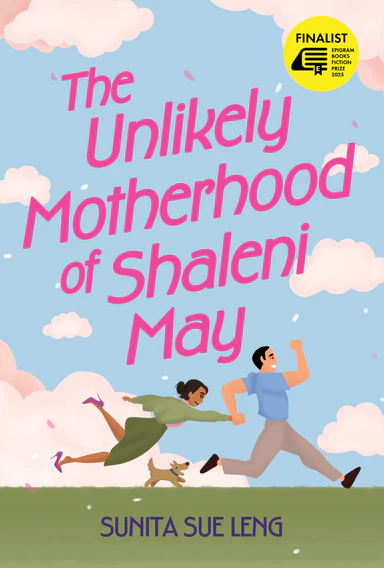
Some novels about motherhood focus on the moment of becoming a parent. Others focus on the sacrifices that follow. The Unlikely Motherhood of Shaleni May takes a slightly different approach. It asks what happens when motherhood arrives much later than expected, after a woman has already built an identity, routine, and version of adulthood that never included raising a child.
That premise gives the novel much of its emotional texture. Rather than exploring first-time motherhood through the lens of youth or conventional family expectations, Sunita Sue Leng examines what it means to enter parenthood at forty-five, carrying decades of habits, insecurities, disappointments, and assumptions about who you are.
At first glance, the novel presents itself as warm contemporary fiction, filled with humour, family complications, and observations about modern parenting culture. And certainly, those elements are present. The book is often funny, particularly when Shaleni finds herself navigating digital-age motherhood alongside hyper-competitive parents, unsolicited advice, and social expectations that seem designed to make every mother feel inadequate.
But what surprised me most while reading The Unlikely Motherhood of Shaleni May is how much loneliness sits beneath its humour. This is not simply a story about parenting. It’s a story about reinvention, belonging, aging, marriage, and the uncomfortable reality that major life changes do not automatically resolve older emotional wounds.
For readers wondering, Is The Unlikely Motherhood of Shaleni May worth reading?—yes. It’s an emotionally sincere and often surprisingly thoughtful novel that succeeds because it treats motherhood not as a magical transformation, but as a complicated, ongoing negotiation between who you were and who you are becoming.
Themes and Deeper Meaning
One of the novel’s strongest themes is the idea that motherhood is not a singular identity but an ongoing adjustment.
Shaleni enters parenthood carrying decades of established independence. Unlike many coming-of-age motherhood narratives, she is not simultaneously discovering adulthood. She already knows who she is—or at least thinks she does. The challenge becomes figuring out how motherhood fits into a life that was never built around it.
I found this aspect particularly effective because the novel avoids romanticising maternal instinct. Shaleni does not immediately transform into an endlessly patient, all-knowing parent. She worries, second-guesses herself, feels overwhelmed, and occasionally feels out of place among parents who appear far more confident.
There is also a recurring theme of social comparison. Modern parenting culture often functions like a performance space, particularly in digitally connected environments where every decision seems open to public judgment. The novel captures this pressure with both humour and frustration.
Another significant theme is reinvention later in life. Much contemporary fiction still treats middle age as a period of stability rather than transformation. The Unlikely Motherhood of Shaleni May pushes back against that assumption. Shaleni’s story suggests that personal upheaval, growth, and self-discovery do not end simply because someone has reached a certain age.
The novel also explores family in a broader sense than biology alone. Adoption, chosen bonds, responsibility, and emotional commitment all become central questions throughout the story.
What stayed with me most, however, is the book’s interest in uncertainty. Shaleni repeatedly feels as though she is failing some invisible test of motherhood. The novel quietly argues that uncertainty may actually be one of the most honest parts of parenting.
Writing Style and Narrative Voice
Sunita Sue Leng writes with warmth and accessibility. The prose is straightforward without feeling simplistic, and the novel’s humour emerges naturally from character interactions and everyday situations rather than exaggerated comic setups.
Shaleni’s narrative voice is one of the book’s greatest strengths. She is observant, self-deprecating, occasionally anxious, and often unintentionally funny. Her perspective allows the novel to address heavier subjects without becoming emotionally overwhelming.
The pacing is relatively gentle. Readers expecting a highly plot-driven narrative may find the novel slower than contemporary commercial fiction built around constant twists and dramatic revelations. But the story’s focus is clearly emotional rather than suspense-driven.
I also appreciated how the novel balances humour with vulnerability. Parenting novels sometimes lean too heavily toward either sentimentality or cynicism. Here, the emotional tone generally feels grounded.
The writing is at its strongest during quieter scenes, particularly moments where Shaleni reflects on her changing identity and struggles to reconcile expectation with reality.
Character Analysis
Shaleni is a compelling protagonist largely because she feels recognisably human rather than idealised.
She is caring but uncertain, capable but frequently overwhelmed. What makes her work is that she does not approach motherhood from a position of certainty. She spends much of the novel adapting, questioning herself, and trying to understand what kind of parent she wants to become.
I appreciated that Sunita Sue Leng allows Shaleni to remain flawed. She occasionally misjudges situations, reacts emotionally, or becomes trapped in spirals of self-doubt. These moments make her feel far more authentic than a protagonist who effortlessly navigates every challenge.
Her husband also plays an important role in the narrative, particularly as complications connected to his past begin affecting the family dynamic. The marriage feels lived-in rather than idealised, shaped by years of shared history alongside new pressures.
The supporting cast helps illuminate different attitudes toward parenting, family, and social expectation. Some characters provide warmth and support, while others embody the judgment and pressure that often accompany modern parenting culture.
Strengths of the Book
One of the novel’s greatest strengths is its emotional honesty.
The book consistently acknowledges that parenthood can be joyful and exhausting simultaneously. Rather than presenting motherhood as either perfect fulfillment or complete sacrifice, it occupies the more complicated space in between.
The perspective of an older first-time mother also gives the story a freshness that distinguishes it from many parenting narratives.
I also appreciated the novel’s humour. Much of it emerges from recognisable situations rather than exaggerated comedy, making the lighter moments feel earned.
Another strength is the way the book handles family complexity. Relationships feel layered rather than simplistic, and the emotional conflicts generally arise from believable misunderstandings, fears, and expectations.
Most importantly, the novel treats motherhood as a deeply personal experience rather than a universal formula.
Weaknesses or Criticisms
That said, readers looking for a highly dramatic narrative may find the novel somewhat understated.
The emotional stakes are significant, but the story unfolds through gradual character development rather than major plot twists. Some readers may wish for greater narrative urgency in certain sections.
A few supporting characters could also have benefited from additional depth. While Shaleni is richly developed, some secondary figures function more as reflections of parenting culture than fully independent personalities.
There are also moments where the novel’s themes become slightly repetitive, particularly regarding self-doubt and social judgment.
Still, these criticisms feel relatively minor within the context of the book’s larger emotional success.
Overall Reading Experience
Reading The Unlikely Motherhood of Shaleni May felt quietly comforting without becoming sentimental.
What I appreciated most is that the novel never insists that motherhood solves every problem. Shaleni’s life becomes richer in some ways and more complicated in others. The book allows those contradictions to coexist.
The emotional impact comes less from dramatic events than from accumulation: small moments of connection, insecurity, exhaustion, affection, and growth.
I found myself increasingly invested in Shaleni not because she was extraordinary, but because her struggles felt believable.
The result is a novel that feels warm without being simplistic and hopeful without ignoring difficulty.
Final Verdict
The Unlikely Motherhood of Shaleni May is warm, thoughtful, and emotionally grounded.
Sunita Sue Leng’s debut succeeds because it understands that becoming a parent does not erase uncertainty. If anything, it often magnifies it. The novel treats motherhood not as a destination but as an evolving process shaped by love, fear, resilience, and constant adjustment.
So, is The Unlikely Motherhood of Shaleni May worth reading? Absolutely.
It may be framed around motherhood, but its deeper concerns are universal: how people adapt to unexpected change, how families are built, and how identity continues evolving long after we think our lives have already settled into place.

Editor
Best Book Review Guide publishes independent reviews and reading guides written to help readers make better reading choices.