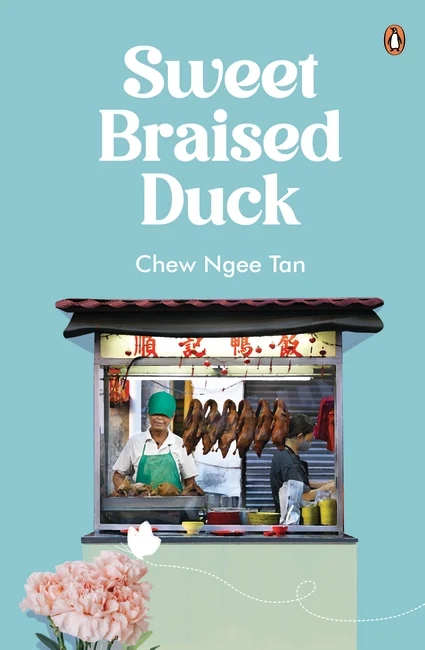
There is something rather special about the stories behind Singapore’s hawker stalls. We might visit the same stall for years, recognise the person preparing our food and develop strong opinions about which version of a particular dish tastes best, yet know remarkably little about the person standing behind the counter.
How did they learn to cook? What made them choose that particular dish? And how much of their lives have been spent perfecting something that customers can finish eating in fifteen minutes?
In Sweet Braised Duck, Singaporean author Chew Ngee Tan explores the life behind one such hawker stall, drawing inspiration from her own father’s experiences growing up in Singapore and eventually becoming a Teochew braised duck rice seller.
The novel follows Kuang, a young boy who migrates from Shantou, China, to Singapore at the age of five. What follows is a journey shaped by poverty, family obligations, personal sacrifice and the considerable difficulties of building a life in a country that is itself undergoing enormous transformation.
Although the title suggests a novel primarily concerned with food, Sweet Braised Duck is much more interested in the experiences that eventually lead Kuang towards his culinary calling. It explores the lives of an earlier generation of Singaporeans for whom education was a privilege, childhood responsibilities arrived far too early and earning enough to feed the family often took precedence over personal ambition.
What makes the premise particularly appealing is its connection to a part of Singapore that is gradually disappearing. The hawker centres and traditional dishes remain, but the lives of the people who built these businesses are not always remembered.
Synopsis
Kuang is only five when he leaves his hometown of Shantou, China, and arrives in Singapore with his family.
Life in his new home is considerably harder than he might have imagined. His family struggles financially, while his abusive grandfather makes an already difficult domestic situation even more challenging.
As the eldest of eight children, Kuang gradually shoulders responsibilities that extend far beyond his age. With seven younger siblings to consider and the family’s finances under constant pressure, he eventually gives up his education to work as an assistant to a fish porridge hawker.
The years that follow are marked by hardship, difficult relationships and the constant struggle to build a more secure future.
Yet Kuang’s experiences also introduce him to different people, trades and possibilities. Through his work, relationships and encounters with Singapore’s changing society, he gradually develops the skills and determination that will shape his future.
Eventually, his journey leads him back to the flavours of his Teochew heritage and the possibility of building a livelihood around braised duck rice.
Inspired by the author’s father’s life, Sweet Braised Duck traces one man’s journey from immigrant child to hawker entrepreneur, while capturing the economic and social realities of an earlier Singapore.
What Works Well
One of the strongest aspects of Sweet Braised Duck is its focus on the sort of Singaporean history that rarely receives much attention in conventional historical fiction.
When we think about Singapore’s transformation from a developing trading port into a wealthy modern city, the narrative often revolves around political leaders, infrastructure projects and economic policies.
But that transformation also depended on ordinary people who worked extraordinarily hard to support their families.
Hawkers, labourers, shopkeepers and small-business owners contributed to the country’s development in ways that were essential, even if their names never appeared in history books.
Kuang’s story provides an intimate perspective on this experience.
His childhood is shaped by circumstances that would be difficult for many young Singaporeans to imagine today. Education is not simply an expected stage of life, and childhood does not necessarily come with the freedom to explore personal interests or ambitions.
When family finances become increasingly difficult, Kuang is expected to contribute.
His decision to leave school and begin working reflects a time when children often had to grow up quickly because there was simply no alternative.
What makes this especially poignant is the contrast with contemporary Singapore, where educational achievement has become such an important part of childhood. Today, parents worry about examination results, enrichment classes and university admissions. For Kuang’s generation, the question was sometimes whether continuing one’s education was financially possible at all.
The novel also offers an interesting perspective on filial responsibility.
As the eldest son, Kuang is expected to help support his family, even when those responsibilities come at considerable personal cost.
There is an uncomfortable tension between loyalty to one’s family and the desire to pursue an independent future. Kuang’s circumstances demonstrate how deeply those expectations could shape an individual’s choices, particularly within traditional immigrant households.
Another appealing aspect is the attention given to Teochew culture and food.
Singapore’s hawker cuisine is often celebrated as a defining part of our national identity, but the dishes themselves carry stories of migration, adaptation and cultural preservation.
Braised duck rice is more than a meal in this context. It represents a connection to Kuang’s ancestral home, the knowledge passed between generations and the possibility of transforming familiar culinary traditions into a sustainable livelihood.
Chew’s decision to draw on her father’s experiences gives the novel an additional layer of significance. This is not simply historical fiction set against the backdrop of old Singapore; it is also an attempt to preserve a family story that might otherwise have remained largely private.
For readers interested in Singapore’s social history, that connection is one of the book’s most meaningful qualities.
What Could Be Better
The most obvious potential disappointment is that Sweet Braised Duck isn’t quite the food-centred novel its title might lead readers to expect.
Anyone hoping for a detailed account of how Kuang develops his signature recipe, establishes his stall and builds his reputation as a hawker may find that these aspects receive less attention than anticipated.
Much of the narrative instead concentrates on his childhood, family relationships and the hardships he experiences before becoming a braised duck rice seller.
This isn’t necessarily a flaw, since those experiences are clearly essential to understanding the person he becomes. Nevertheless, the balance between the family saga and the culinary journey may not satisfy readers who picked up the book primarily because of its food-related premise.
The pacing may also divide readers.
Rather than following one tightly defined conflict, the novel traces different stages of Kuang’s life, moving through personal setbacks, relationships, employment and family responsibilities.
That approach creates a broad portrait of a life, but it can also make the narrative feel episodic.
Some developments receive considerable attention, while others are passed over more quickly. As a result, readers may occasionally feel that they are being told about the events of Kuang’s life rather than being fully immersed in them.
There is also a question of how much the novel contributes to the larger body of Singaporean historical fiction.
Themes of poverty, migration, filial piety and perseverance are important, but they are also familiar territory within stories about earlier generations of Chinese immigrants.
Readers who have already encountered several similar narratives may wish for a more distinctive exploration of the country’s multicultural environment or a greater emphasis on the culinary history promised by the title.
The novel’s relatively straightforward approach is therefore likely to appeal more to readers who appreciate family histories and everyday experiences than to those looking for formally ambitious literary fiction.
Themes and Discussion
At its heart, Sweet Braised Duck is a story about the relationship between sacrifice and opportunity.
Kuang’s life is shaped by decisions that cannot be separated from his family’s circumstances. He gives up educational opportunities because his family needs financial support, and his personal ambitions must repeatedly be weighed against responsibilities to others.
It’s easy to romanticise the perseverance of earlier generations, especially when their stories eventually lead to success. We often hear about hawkers who spent decades perfecting their craft, working long hours and building businesses through sheer determination.
But there is another side to these stories.
Hardship may inspire resilience, yet it also comes at a considerable cost. A child who leaves school to support his family loses opportunities that might otherwise have changed the course of his life.
The novel raises interesting questions about whether sacrifice should always be celebrated, or whether we should also acknowledge the difficult circumstances that made those sacrifices necessary.
Another important theme is migration. Kuang’s arrival in Singapore represents the beginning of a new life, but migration does not automatically offer prosperity or security. Instead, he and his family must navigate unfamiliar circumstances while carrying the expectations, traditions and difficulties of their previous lives with them.
The novel also explores how food can become a connection between past and present.
For immigrant communities, familiar dishes often preserve aspects of cultural identity that might otherwise become diluted over generations. The preparation of a traditional meal involves more than ingredients and cooking techniques. It can carry memories of family members, childhood experiences and places left behind.
This gives Kuang’s eventual connection to Teochew braised duck a symbolic significance beyond its commercial value. His livelihood becomes a way of bringing something from his ancestral home into the country where he has spent most of his life.
Perhaps the most interesting aspect of the story, however, is its perspective on success.
Kuang’s achievements are not measured through prestigious qualifications or professional recognition. His aspirations are more immediate and practical: providing for his family, gaining financial stability and building something of his own.
In contemporary Singapore, where success is frequently associated with educational credentials and high-paying careers, that offers a useful reminder of how differently earlier generations understood the idea of making a good life.
Writing Style
Chew Ngee Tan adopts a relatively straightforward narrative approach, allowing Kuang’s experiences to form the centre of the story.
The novel is divided into four parts, reflecting different stages of his development and the challenges he encounters along the way.
Rather than experimenting heavily with structure or language, the writing concentrates on the circumstances of everyday life, including family interactions, work, food and the social environment of an earlier Singapore.
This approach suits the novel’s origins as a fictionalised account inspired by family history.
The inclusion of Teochew language and cultural details also helps establish the world in which Kuang grows up.
For readers unfamiliar with Teochew expressions, some passages may require additional attention, particularly when moving between the narrative and explanations of unfamiliar terms.
The historical setting provides another important layer. As Kuang grows older, Singapore is changing around him, and the developments in his personal life exist alongside the country’s broader political and economic transformation.
The result is a novel that feels closer to an intimate family chronicle than a conventional plot-driven historical drama.
Readers who enjoy following a character over many years, through ordinary setbacks and gradual achievements, are likely to appreciate this approach.
Final Verdict
Sweet Braised Duck is a thoughtful tribute to an earlier generation of Singaporeans whose lives were shaped by migration, poverty, family responsibility and the determination to build a better future.
Chew Ngee Tan draws on her father’s experiences to tell a story that feels particularly relevant in a country where food is so closely connected to cultural identity, yet the people responsible for preserving those culinary traditions are not always given the same attention.
What I find most appealing about the novel’s premise is the reminder that the hawker stalls we take for granted often represent decades of work, sacrifice and accumulated knowledge.
A plate of braised duck rice might be an ordinary lunch to a customer, but behind it can be a lifetime of difficult decisions, family obligations and perseverance.
The novel is not without limitations. Readers expecting an extensive exploration of Teochew cuisine or the intricacies of running a hawker business may find the focus on Kuang’s early life somewhat frustrating. Its chronological structure and straightforward storytelling may also feel less compelling to those who prefer tightly plotted historical fiction.
Nevertheless, there is considerable value in preserving stories like Kuang’s.
As Singapore continues to modernise, the experiences of earlier generations become increasingly distant from our everyday lives. Books such as Sweet Braised Duck offer an opportunity to remember the people who helped build the country, particularly those whose contributions were made through ordinary work rather than extraordinary public achievements.
I would recommend it to readers interested in Singaporean literature, immigrant family histories and the personal stories behind our hawker culture.
It’s also an appealing choice for younger Singaporeans who want to better understand the circumstances their parents or grandparents may have experienced.
Ultimately, Sweet Braised Duck is less a novel about perfecting a recipe than about the life that leads someone towards it.
And perhaps that’s what makes the story worth telling: sometimes, the most interesting part of a familiar dish is the person who spent a lifetime learning how to make it.

Leave a Reply