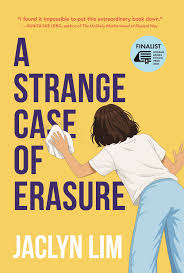
There is a particular kind of exhaustion that comes with being a mother, and it isn’t always about the physical work involved. It’s the mental load of remembering everything, from what needs to be packed for school to the next doctor’s appointment, what the children will eat for dinner, and whether there are enough groceries to last the week. These responsibilities are so deeply woven into everyday family life that they often go unnoticed, even by the people who benefit from them.
In A Strange Case of Erasure, Singaporean author Jaclyn Lim takes this familiar experience and gives it a rather unsettling twist. Her protagonist, Seok Lin, begins to disappear, quite literally, after years of putting her family’s needs before her own.
As a mother myself, I found the premise both amusing and uncomfortably relatable. There have certainly been moments when I’ve wondered how much of my day is spent simply keeping everything running, and how easily the person behind all that work can become an afterthought.
What makes this novel particularly interesting is that Lim doesn’t approach motherhood as a straightforward story of sacrifice or resentment. Instead, she uses a strange medical condition, an AI companion, and the very ordinary routines of a Singaporean household to explore what happens when a woman’s identity becomes so entwined with caring for others that she struggles to recognise herself.
It’s a clever, occasionally unsettling novel, but one that ultimately offers a surprisingly satisfying conclusion.
Synopsis
Seok Lin once had a career and a life that extended beyond her responsibilities at home. After becoming a stay-at-home mother to two children, however, her days have gradually become consumed by school runs, household chores, childcare arrangements and the endless logistics of raising a family.
Then, one day, her toe disappears.
What initially seems like an inexplicable medical problem becomes increasingly disturbing when doctors diagnose her with a rare condition that causes parts of her body to vanish.
Yet even as Seok Lin begins physically disappearing, life at home carries on much as before. There are still meals to prepare, children to look after and household responsibilities that somehow continue to fall on her shoulders.
Feeling increasingly isolated, Seok Lin finds an unlikely source of companionship in Chad, an AI interface that offers the attention and reassurance she struggles to find elsewhere.
As her condition progresses, she is forced to confront uncomfortable questions about her marriage, her role as a mother and the parts of herself that have gradually disappeared long before her body began to vanish.
What Works Well
The strongest aspect of A Strange Case of Erasure is its wonderfully absurd premise, which turns out to be a remarkably effective way of discussing something many mothers experience but rarely articulate.
Seok Lin’s physical disappearance is an obvious metaphor for the emotional invisibility that can accompany motherhood, but I don’t think that makes it any less effective. If anything, the directness of the concept is part of its appeal.
As a mother, what resonated with me most was the relentless mental load that Seok Lin carries.
It’s easy to underestimate how much work goes into managing a household, especially when so much of that work involves remembering, anticipating and planning rather than actually doing something visible.
A parent might spend the entire morning getting everyone ready, organising meals, checking schedules and making sure nothing has been forgotten, only to reach lunchtime and wonder where the day has gone. These are not necessarily dramatic or particularly difficult tasks on their own, but their cumulative effect can be exhausting.
I appreciated that Lim places this experience within a recognisably Singaporean setting. The pressures surrounding children’s education, the logistics of enrichment classes and the expectations placed on mothers all feel familiar. In Singapore, where parents can become deeply invested in ensuring their children have every possible advantage, even the seemingly simple business of raising a child can become surprisingly complicated.
There is also something interesting about the way Seok Lin’s struggles coexist with the love she has for her family. Motherhood isn’t presented as an entirely miserable experience, nor should it be. You can love your children deeply, enjoy spending time with them and still occasionally miss the freedom and independence you had before becoming a parent.
Those feelings aren’t mutually exclusive, although mothers are sometimes made to feel that they should be.
Another aspect I found thought-provoking was Seok Lin’s relationship with Chad, her AI companion.
It’s an unusual addition to a story about motherhood, but it makes sense within the context of her loneliness. When someone feels unheard or unappreciated, the appeal of an endlessly patient companion who listens without interruption becomes easier to understand.
There’s also a certain irony in the idea that artificial intelligence might provide the emotional acknowledgement that a person isn’t receiving from the humans around them.
I liked that the novel introduces this contemporary element without abandoning its focus on domestic life. It gives the story another dimension and raises questions about loneliness, relationships and our growing dependence on technology for emotional support.
What Could Be Better
Although I enjoyed the premise, I can imagine that Seok Lin won’t be an entirely sympathetic character for every reader.
There are moments when her frustration with her circumstances invites questions about how much of her unhappiness comes from the expectations placed upon her and how much comes from the choices she has made.
As a mother, I could understand where some of those feelings were coming from, even when I didn’t necessarily agree with her responses. It’s possible to recognise someone’s exhaustion without believing that every decision they make is justified.
In fact, I think the novel becomes more interesting when Seok Lin isn’t treated simply as a victim of her circumstances. Motherhood involves a complicated mixture of external expectations, personal guilt and the standards we sometimes impose on ourselves.
The central metaphor can also feel fairly obvious. A mother who feels invisible starts physically disappearing, and the connection between those two experiences is hardly subtle.
Readers who prefer their literary fiction to leave more room for interpretation may find the symbolism a little heavy-handed. Personally, I didn’t mind it, largely because the premise gives Lim an inventive way of examining a familiar subject.
I also think readers expecting a conventional mystery might be slightly disappointed. Although the strange medical condition creates intrigue, this isn’t really a novel about solving an elaborate supernatural puzzle. Its real interest lies in Seok Lin’s emotional experience and the relationships that have shaped her life.
Once I approached it as a story about motherhood and identity rather than a mystery to be solved, I found its intentions much easier to appreciate.
Themes and Discussion
At its heart, A Strange Case of Erasure explores the uncomfortable question of how much of yourself you can give to your family before you begin to lose your own identity.
Becoming a mother changes almost every aspect of your life. Your routines, priorities and relationships shift, often in ways you might never have anticipated before having children.
There are wonderful parts to that transformation, of course. Watching your child discover the world, develop their personality and learn something new can be immensely rewarding.
But there are also moments when your own interests, ambitions and needs quietly slip further down the list of priorities.
I think this is where Lim’s novel resonates particularly strongly.
Seok Lin’s predicament isn’t simply that she has too much to do. It’s that she has become so accustomed to defining herself through her responsibilities that she struggles to remember who she is outside them.
The distinction between being needed and being appreciated is another important theme.
A mother can be absolutely essential to the functioning of her household without necessarily feeling seen as an individual. Her work may be relied upon every day, but that doesn’t always mean the effort behind it is recognised.
It’s an uncomfortable contradiction, especially when so much of parenting involves doing things precisely because you love the people you’re doing them for.
The novel also raises questions about marriage and the distribution of domestic responsibilities. When one person gradually becomes the default parent, it can happen so naturally that neither partner fully recognises the imbalance until resentment has already begun to build.
I also found the theme of personal identity particularly relevant beyond motherhood.
Even for people without children, there is something recognisable about becoming so absorbed in a role, whether as a spouse, employee or caregiver, that other parts of your personality slowly fade into the background.
In Seok Lin’s case, that loss becomes physical. For most of us, it happens much more quietly.
Writing Style
One of the things I appreciate about the novel is how Lim combines an almost ridiculous premise with such ordinary, recognisable domestic circumstances.
There is something inherently absurd about a woman discovering that her toe has disappeared, yet the story doesn’t exist in some distant fantasy world. It unfolds against the everyday backdrop of Singaporean family life, where children still need to get to school and dinner still needs to be prepared.
That contrast gives the novel much of its appeal.
The familiar setting also makes its speculative elements more unsettling. Seok Lin isn’t suddenly transported into an unfamiliar universe where the usual rules no longer apply. Instead, the impossible happens within a household that otherwise continues functioning as normal.
Lim’s approach is particularly effective when the everyday details are allowed to speak for themselves. The constant demands of domestic life are already exhausting enough without requiring an elaborate explanation of why Seok Lin might feel overwhelmed.
At 232 pages, A Strange Case of Erasure is also a relatively compact novel. I appreciate books that can explore a substantial idea without necessarily stretching it into a sprawling narrative, and the shorter format feels well suited to this particular story.
Final Verdict
A Strange Case of Erasure is one of those novels whose premise initially sounds almost comical, only to become increasingly poignant as the story unfolds.
Jaclyn Lim takes the invisible labour of motherhood and turns it into something disturbingly literal, using Seok Lin’s gradual disappearance to examine the sacrifices, frustrations and emotional contradictions that can accompany raising a family.
As a mother myself, I found many aspects of the story especially relatable. It’s not that motherhood is inherently miserable or that caring for your family is something to resent. Quite the opposite. There is enormous joy in raising children, but there are also days when you’re so occupied with everyone else’s needs that you realise you’ve barely had a moment to yourself.
I think Lim captures that tension particularly well.
What I especially appreciated, however, was how satisfying the ending felt.
Without revealing what happens, I liked that the novel offers a sense of resolution after spending so much time exploring Seok Lin’s frustration and emotional isolation. There is something reassuring about finishing a story like this without feeling that all the discomfort and difficult questions have been raised simply for the sake of making a point.
The ending doesn’t need to erase the complexities of motherhood to feel rewarding, and I appreciated that sense of emotional closure. It made me look back on Seok Lin’s journey with a little more understanding.
The Singaporean setting is another reason I would recommend the book, particularly to local readers. The familiar pressures of managing a household, raising children and navigating family expectations make the story feel much closer to home than its unusual premise might suggest.
Ultimately, A Strange Case of Erasure is a thoughtful and inventive novel about motherhood, identity and the quiet ways people can lose themselves while caring for others.
I would particularly recommend it to mothers who enjoy contemporary literary fiction, although its themes extend well beyond parenting.
It’s a strange little book with a surprisingly familiar heart, and one whose ending I found especially rewarding.
Leave a Reply