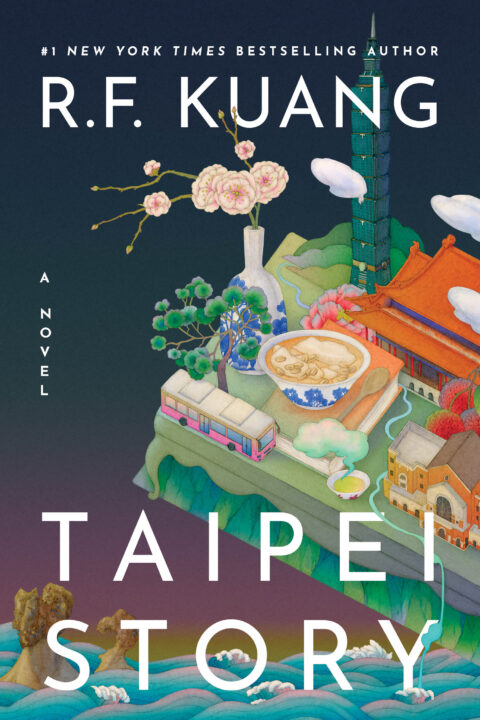
R.F. Kuang has made a career out of writing about uncomfortable subjects. Yellowface took aim at publishing, racial identity and literary ambition, while Babel examined colonialism through the relationship between language and power. With Taipei Story, she turns her attention towards something more personal: the peculiar experience of growing up between cultures, and the uncomfortable realization that returning to your ancestral roots does not necessarily make you feel any closer to them.
The novel follows Lily Chen, a Chinese American college freshman who spends a summer studying Mandarin in Taipei. She arrives hoping to reconnect with a heritage that has become increasingly distant throughout her childhood in America. Unfortunately, learning a language turns out to be considerably more complicated than memorising vocabulary, and Lily soon discovers that cultural belonging is not something you can acquire through an intensive summer course.
What makes Taipei Story interesting is its willingness to explore the less flattering aspects of cultural rediscovery. Lily is awkward, insecure and occasionally spectacularly misguided. Her attempts to understand her identity are complicated by the very ordinary humiliations of being young, making questionable decisions and caring far too much about what other people think.
Synopsis
Lily Chen has spent much of her life in America, gradually losing her fluency in Mandarin and growing increasingly disconnected from her Chinese heritage. When she enrols in an intensive summer language programme in Taipei, she hopes the experience will help her recover some of what she has lost.
Instead, she finds herself struggling with demanding classes, difficult social dynamics and the uncomfortable realization that she knows considerably less about her cultural background than she imagined.
An ill-advised outing with a fellow student soon becomes the subject of campus gossip, leaving Lily increasingly isolated. Then she receives news that her grandfather has died, bringing an entirely different weight to her struggles with language and identity.
What began as a summer of cultural exploration becomes a confrontation with grief, family history and the conversations Lily may never have the opportunity to have.
What Works Well
The most compelling aspect of Taipei Story is its examination of language as something far more complicated than a means of communication.
For children of immigrants, language can carry an enormous emotional burden. Losing fluency in your family’s mother tongue can feel like losing access to an entire part of yourself, particularly when older relatives remain most comfortable expressing themselves in that language.
Lily’s decision to study Mandarin is therefore about considerably more than improving her vocabulary. She wants to recover a connection with her family and perhaps reassure herself that she still belongs to the culture she inherited.
Kuang’s premise challenges the romantic idea that returning to one’s ancestral homeland will automatically produce a profound sense of recognition. Lily arrives in Taipei expecting some form of cultural reconnection, only to discover that sharing an ethnic background with the people around her does not necessarily mean sharing their experiences.
Another strength is the decision to make Lily an imperfect protagonist. Her social difficulties are not simply the result of other people misunderstanding her. She makes mistakes, misjudges situations and struggles to navigate relationships with the confidence she wishes she possessed.
The novel’s treatment of grief also gives its exploration of language greater emotional weight. Lily’s grandfather represents a connection to her family’s past, and his death forces her to confront the limitations of what she knows about him. Suddenly, the Mandarin she has been struggling to learn becomes associated with conversations that can no longer happen.
Where the Novel May Divide Readers
Readers approaching Taipei Story after Yellowface or Babel should be prepared for a different kind of novel.
Kuang’s earlier books feature particularly striking premises, with literary controversies, institutional power struggles and elaborate speculative elements driving their narratives. Taipei Story is considerably more intimate, concentrating on a young woman’s emotional development during an uncomfortable summer abroad.
The stakes are primarily personal, and much of the novel’s tension comes from social embarrassment, difficult relationships and Lily’s internal struggle with her identity.
This narrower focus may appeal to readers who enjoy contemporary literary fiction, particularly novels about awkward young adults trying to make sense of themselves. Those expecting another high-concept Kuang novel may find the premise comparatively restrained.
Lily’s perspective may also prove divisive. Her preoccupation with belonging, social acceptance and her own perceived inadequacies can make her frustrating, although these qualities are consistent with the uncertainty of early adulthood.
There is also an inherent challenge in writing about cultural alienation without making the experience feel overly familiar. The tension between an immigrant family’s heritage and the identity of a child raised elsewhere is well established in contemporary fiction. What distinguishes Taipei Story is the particular attention it gives to language learning, the embarrassment of imperfect fluency and the grief associated with losing opportunities for connection.
Themes and Discussion
One of the most interesting questions raised by Taipei Story is whether cultural identity can ever be something we fully recover.
Lily approaches Mandarin almost as though it were a missing piece of herself. If she can learn the language, perhaps she can finally understand her family, her history and the parts of her identity that have always felt slightly inaccessible.
But language does not provide a straightforward solution. Even as Lily attempts to improve her Mandarin, she must contend with differences in upbringing, social expectations and lived experience.
The novel also explores the uncomfortable position occupied by many members of the diaspora. Lily is culturally Chinese, yet she does not necessarily feel at home in a Chinese-speaking environment. Her American upbringing shapes how she behaves and understands the world, even when she is trying to distance herself from it.
Grief complicates these questions further. Lily’s grandfather’s death reminds her that family history is not an unlimited resource waiting patiently to be discovered. Stories disappear, memories become fragmented and the people who could explain our past will not always be around when we finally decide to ask.
There is something particularly poignant about the idea of learning a language too late to speak it with someone who mattered.
Writing Style
Taipei Story represents a shift towards contemporary coming-of-age literary fiction for Kuang.
The novel’s premise allows her to explore the contradictions of cultural identity through everyday interactions rather than elaborate world-building or institutional conflict.
The mixture of social discomfort, humour and grief is particularly important to the book’s tone. Lily’s experiences in Taipei involve the sort of embarrassing situations that can feel catastrophic at nineteen, even when they might appear relatively insignificant years later.
The contrast between those youthful anxieties and the permanence of losing a family member provides much of the story’s emotional tension.
Readers who enjoy character-driven fiction by authors such as Sally Rooney and Elif Batuman may find the novel’s preoccupations familiar, especially its interest in self-conscious young protagonists navigating relationships, education and identity.
Final Verdict
Taipei Story offers an intimate examination of cultural belonging, language loss and the difficult transition into adulthood. Its most affecting idea is that reconnecting with your heritage cannot undo the years spent growing apart from it, particularly when the people who hold your family’s memories are no longer there to share them.
The novel appears best suited to readers who appreciate introspective, character-driven literary fiction rather than the larger-scale narratives associated with some of Kuang’s previous work.
Its questions about language, family and identity are especially relevant to anyone who has experienced the strange feeling of being connected to a culture without feeling entirely at home within it.
Editorial assessment: A promising and emotionally resonant exploration of diaspora identity, with a quieter premise than Kuang’s earlier novels. A personal star rating should be added after a complete reading.

Editor
Best Book Review Guide publishes independent reviews and reading guides written to help readers make better reading choices.