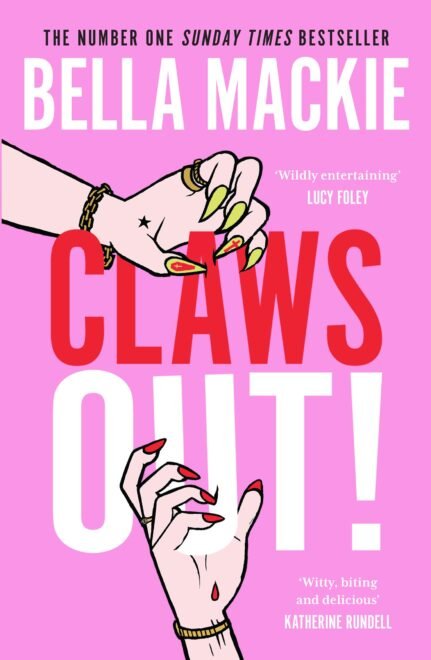
There are books I admire for their beautiful writing, others that leave me thinking about their characters long after I’ve finished, and then there are books that are simply enormous fun to read. Claws Out! by Bella Mackie belongs firmly in the third category, and I don’t think there’s anything wrong with that.
In fact, I gave it five stars precisely because it was so entertaining. It’s the sort of darkly comic thriller that makes you want to keep reading, not necessarily because you’re deeply invested in the wellbeing of its characters, but because they’re all behaving so terribly that you want to know what they’ll do next.
The premise is wonderfully ridiculous. Diana Leyland has been married three times, and all three husbands are dead. Now she’s set her sights on a fourth, a wealthy psychiatrist living in Hampstead whose substantial fortune could finally give her the comfortable life she’s been pursuing. Unfortunately for Diana, his adult daughter has absolutely no intention of letting another woman get her hands on the family money.
What follows is a thoroughly unpleasant battle between two women who are both convinced they’re cleverer than everyone around them.
Neither is especially likeable. Both are motivated by self-interest, and the people caught between them aren’t necessarily much better. Yet that is exactly what makes the novel enjoyable.
Mackie has a talent for creating characters who are difficult to sympathise with but fascinating to observe. They’re vain, entitled, manipulative and often hilariously unaware of their own shortcomings. In another kind of novel, I might find such a cast exhausting. Here, watching their increasingly outrageous behaviour is part of the appeal.
And then there’s the twist.
Without giving anything away, I particularly enjoyed how the story offers more than a straightforward confrontation between a suspected gold-digger and an understandably suspicious daughter. The twist added another layer of fun to a book I was already enjoying.
Claws Out! isn’t trying to be a solemn examination of human nature disguised as a murder mystery. It’s sharp, entertaining and quite happy to let its characters be awful.
For me, that made it a five-star read.
Synopsis: What’s Claws Out! About?
Diana Leyland has always believed that marrying well is the most sensible route to a comfortable life.
Unfortunately, her previous three husbands have all died, and despite her impressive matrimonial history, she still hasn’t secured the kind of wealth she’s been dreaming of.
Her latest prospect is David Farrand, a successful and wealthy psychiatrist who lives in an expensive five-storey house in Hampstead. With his money, social connections and privileged lifestyle, David seems like the perfect candidate for husband number four.
Diana is determined to make the relationship work, particularly because she has an adult son, Zeb, whose own financial prospects are less than impressive.
But David comes with a complication: his daughter, Catriona, better known as Cat.
Cat is accustomed to a comfortable lifestyle and has no desire to see her inheritance disappear into the hands of her father’s new girlfriend. She immediately distrusts Diana, and her suspicions intensify when she discovers that the woman’s three previous marriages all ended with her husbands’ deaths.
Three dead husbands might be an unfortunate coincidence. Or Diana might be considerably more dangerous than she appears.
Cat begins investigating Diana’s past, convinced that there’s something sinister behind the deaths. Diana, meanwhile, has her own plans and isn’t about to let an entitled adult daughter interfere with her future.
As the two women attempt to outmanoeuvre each other, their conflict becomes increasingly nasty, drawing in family members, former stepchildren and people with their own reasons for wanting a share of the money.
The question is no longer simply whether Diana can persuade David to marry her.
It’s whether Cat can uncover the truth before Diana gets exactly what she wants.
What Works Well
1. The characters are awful, and that’s half the fun
Some novels make it difficult to enjoy the story because every character is unpleasant. Claws Out! manages to turn that unpleasantness into its greatest strength.
Diana is unapologetically interested in money, status and the lifestyle that comes with them. She understands how to present herself to the right people, particularly those who might be useful to her.
Cat, meanwhile, is hardly a model of selflessness.
Her suspicions about Diana may be justified, but her determination to protect her father is closely connected to her determination to protect her own inheritance and position within the family.
That makes their rivalry considerably more entertaining than a simple battle between a good daughter and an evil stepmother.
Neither woman occupies the moral high ground.
Both are perfectly capable of rationalising their behaviour, and both seem convinced that the other is the real problem.
I think this is an important part of why the novel works. If Cat were a perfectly innocent daughter trying to rescue a helpless father, the story would be far more conventional. If Diana were merely a cartoon villain with no interesting qualities, her schemes would become predictable.
Instead, the conflict is driven by two women who are selfish in different ways.
And because neither is particularly admirable, the story can take pleasure in watching them behave badly without demanding that readers choose a side.
2. The satire of wealthy London society is deliciously mean
Mackie’s portrayal of affluent Hampstead society gives the novel much of its humour.
The characters are surrounded by wealth, expensive homes, professional prestige and the sort of social connections that encourage people to believe they’re considerably more important than they actually are.
Yet beneath the respectable appearances, their motivations are often embarrassingly ordinary.
They want money, attention, security, admiration and control.
David’s position as a successful psychiatrist is especially amusing within this context. Here is a man whose professional life involves understanding other people’s behaviour, yet whose personal circumstances suggest that expertise doesn’t necessarily translate into good judgment.
There’s a particular kind of comedy in watching characters who consider themselves sophisticated behave with so little self-awareness.
What I appreciate about the satire is that it doesn’t require the characters to acknowledge their own ridiculousness.
Quite the opposite.
The fun comes from the distance between how they see themselves and how they behave.
Diana understands that wealth opens doors, while Cat is desperate to keep those doors closed to anyone who might threaten her position. Neither is especially interested in questioning the system that gives them something to fight over.
That makes their conflict both funny and revealing.
The book isn’t simply making fun of rich people for being rich. It’s exposing the vanity, hypocrisy and territorial behaviour that can emerge when money becomes the organising principle of family relationships.
3. The rivalry between Diana and Cat keeps the story entertaining
At the centre of Claws Out! is a wonderfully simple conflict: two women want control over the same man’s future, and neither intends to surrender.
Diana wants David because he represents the financial security and social position she has spent years pursuing.
Cat wants Diana gone because she sees her as a threat to everything she expects to inherit.
The tension works because both women have legitimate reasons to regard the other as dangerous, even when their responses are unreasonable.
Cat’s concerns about Diana’s previous husbands raise the stakes beyond an ordinary family dispute. At the same time, Diana’s determination to secure her future makes her unwilling to abandon a promising opportunity simply because someone dislikes her.
The result is a battle in which the characters’ personal ambitions are never far from the surface.
I particularly like that the novel doesn’t depend entirely on the reader admiring either woman.
Sometimes the pleasure of a story lies in observing the conflict itself.
You don’t have to approve of anyone’s behaviour to enjoy watching them try to outsmart one another.
And in this case, the more unreasonable the characters become, the more entertaining the situation gets.
4. The twist makes an already enjoyable book even better
One of the main reasons I gave Claws Out! five stars is that it delivers a fun twist.
I’m deliberately keeping this spoiler-free, because I think part of the pleasure is going into the book without knowing precisely how everything will unfold.
For me, a good twist doesn’t necessarily need to be the most shocking development imaginable.
Sometimes the most satisfying surprise is one that adds another dimension to an already entertaining story.
That’s particularly important in a dark comedy.
If the only reason to read a novel is to discover who committed a crime, its entertainment value can depend too heavily on whether the final revelation catches you by surprise.
Claws Out! offers more than that.
The rivalry, the satire and the characters’ increasingly questionable behaviour are enjoyable in their own right. The twist adds to that experience rather than having to carry the entire story.
I think that’s why it worked so well for me.
I was already having fun with the book, and the unexpected development gave me another reason to appreciate how Mackie had constructed it.
I won’t say any more about what happens, except that I would recommend avoiding detailed discussions of the ending until you’ve read it.
What Could Be Better?
It’s worth acknowledging that Claws Out! won’t appeal to every reader, particularly those who prefer their crime fiction more serious or emotionally grounded.
The characters can be exceptionally unpleasant, and there’s little attempt to make them conventionally sympathetic.
Readers who need at least one person to root for may find the constant scheming tiring. Others may struggle with the novel’s deliberately exaggerated portrayal of wealthy London society, especially when the humour depends on selfishness, vanity and a certain amount of cruelty.
The story is also more interested in social satire and entertaining confrontations than in providing the intricate investigative structure of a traditional detective novel.
If you’re expecting a tightly controlled police procedural or a mystery built around painstaking clue-gathering, this may not be what you’re looking for.
But those are matters of taste rather than serious weaknesses in my own reading experience.
I don’t think every thriller needs to be psychologically profound or emotionally devastating. Sometimes I want a story that’s clever, funny and thoroughly entertaining.
Claws Out! delivered exactly that.
And I’d much rather give five stars to a book I genuinely enjoyed than withhold a high rating simply because it isn’t trying to achieve something more literary or serious.
Themes and Discussion
Money makes family relationships considerably uglier
One of the recurring ideas in Claws Out! is that financial self-interest can disguise itself remarkably well as love and concern.
Diana’s desire to marry David is clearly connected to his wealth, but Cat’s opposition isn’t entirely free of financial considerations either.
Both women have something to gain or lose from the relationship.
That makes their arguments about loyalty, protection and family particularly interesting.
When a substantial inheritance is involved, it’s difficult to determine where genuine concern ends and self-interest begins.
The same question extends to the wider cast, where money influences expectations, relationships and the way characters judge one another.
The novel exaggerates these dynamics for comic effect, but the underlying tension is recognisable.
Families don’t always behave rationally when money is involved, and the prospect of losing an expected inheritance can reveal some remarkably unattractive qualities.
Respectability doesn’t necessarily mean morality
Another theme that runs through the novel is the difference between appearing respectable and behaving ethically.
David’s professional status and Hampstead lifestyle place him within a social world that considers itself educated, successful and sophisticated.
But privilege doesn’t necessarily produce good judgment or admirable behaviour.
Similarly, the women competing for his attention and resources understand that social appearances matter, even when their private motivations are considerably less respectable.
Mackie’s satire is particularly effective when it exposes this contradiction.
The characters invest a great deal of energy in maintaining their positions within respectable society, while behaving in ways that suggest they have little interest in the moral standards they claim to represent.
It’s an entertaining reminder that wealth and status are not especially reliable indicators of character.
Why are unlikeable characters so enjoyable to read about?
I think Claws Out! also illustrates why a novel doesn’t need likeable protagonists to be successful.
In fact, I suspect the story would be considerably less entertaining if Diana and Cat were more reasonable people.
A thoughtful conversation about boundaries and financial expectations would probably resolve many of their disagreements.
It would also make for a rather dull thriller.
Instead, their unwillingness to compromise creates the conflict that drives the story.
There’s something liberating about fiction that allows characters to be openly selfish, manipulative and occasionally absurd without insisting that readers identify with them.
We can recognise their faults while enjoying the trouble those faults create.
The important thing is that their behaviour remains interesting.
For me, Claws Out! gets that balance right.
Writing Style
Bella Mackie’s writing is particularly suited to this kind of dark comedy.
The novel relies on sharp observations, social embarrassment and characters whose opinions of themselves are frequently at odds with reality.
The humour is often unkind, but that’s part of its appeal.
Rather than softening the characters to make them more sympathetic, Mackie allows their worst qualities to become sources of comedy.
The narrative also benefits from its willingness to treat seemingly respectable social environments as places of extraordinary pettiness.
An expensive house, a successful career and the right social circle might suggest a world of polished manners and carefully maintained appearances.
Mackie is far more interested in what happens when those appearances begin to crack.
The combination of a murder mystery with a satirical portrait of affluent family life gives the story its distinctive tone.
It’s dark without becoming relentlessly grim, and funny without abandoning the questions surrounding Diana’s previous marriages.
That balance is important.
If the novel were simply a comedy about wealthy people behaving badly, it might eventually feel repetitive. If it focused exclusively on the suspicious deaths, it would lose much of the personality that makes it enjoyable.
Instead, the two elements reinforce each other.
The possibility of murder gives the comedy an uncomfortable edge, while the humour prevents the mystery from becoming overly solemn.
Final Verdict: A Thoroughly Entertaining Five-Star Read
I gave Claws Out! five stars because I found it entertaining from its premise to its wonderfully messy conflict, and because the fun twist made the experience even more satisfying.
It’s not a book filled with admirable people or heartwarming relationships. Diana and Cat are selfish, manipulative and frequently unreasonable, while the wealthy world surrounding them provides plenty of opportunities for Mackie to expose hypocrisy and entitlement.
But that’s precisely what makes it enjoyable.
The story knows what kind of novel it wants to be, and it doesn’t apologise for letting its characters behave terribly.
I particularly appreciate that the mystery doesn’t have to do all the work. Even without the question of what happened to Diana’s previous husbands, the battle between Diana and Cat would provide plenty of entertainment.
The twist is an added pleasure, and one I would rather let readers discover for themselves.
I’d recommend Claws Out! to anyone who enjoys dark humour, unlikeable characters, wealthy people behaving badly and mysteries that don’t take themselves too seriously.
It’s also an easy recommendation for readers who enjoyed Bella Mackie’s earlier fiction, particularly How to Kill Your Family.
For me, the best thing about this book is that it reminded me why I enjoy reading mysteries and thrillers in the first place.
Sometimes I want complicated themes and morally challenging questions. Sometimes I want a story that stays with me for weeks.
And sometimes, I just want to be thoroughly entertained by a cast of terrible people and rewarded with a fun twist.
Claws Out! delivered exactly that.
My verdict: 5/5 stars. Wickedly entertaining, full of awful characters and made even better by a twist I enjoyed.

Leave a Reply