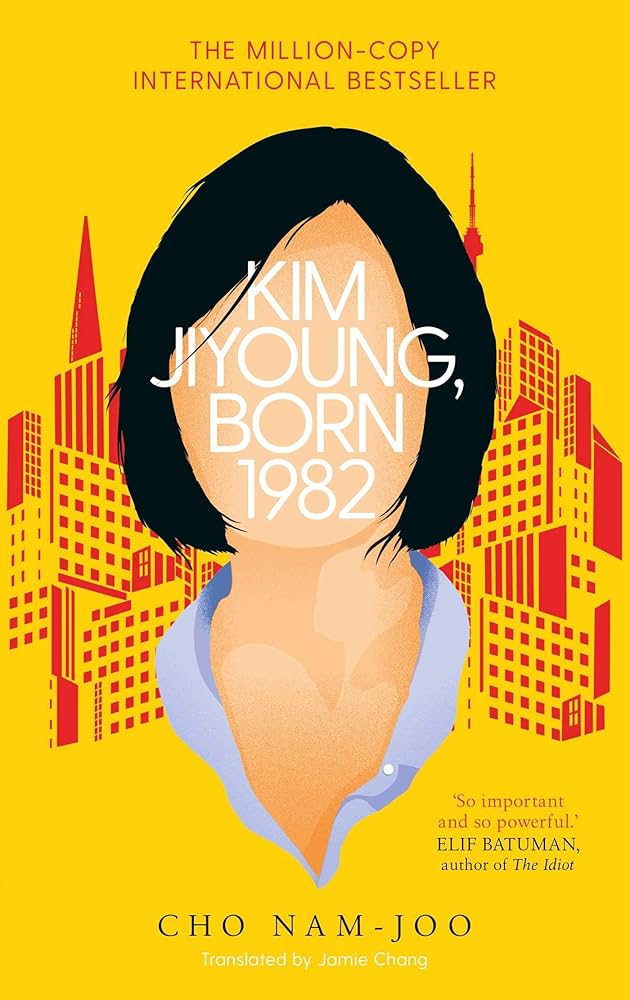
Author: Cho Nam-joo
Genre: Psychological Fiction, Korean Literature
Few contemporary novels have travelled across international literary culture as quickly or as forcefully as Kim Jiyoung, Born 1982 by Cho Nam-joo. When it was first published in South Korea in 2016, the book became both a bestseller and a cultural flashpoint, sparking heated public debate about sexism, feminism, labour inequality, marriage, motherhood, and the ordinary exhaustion of being a woman in modern Korean society.
What’s remarkable is how deceptively simple the novel appears at first. The prose is sparse. The structure is straightforward. The plot, on paper, sounds almost uneventful: an ordinary woman gradually begins exhibiting strange psychological symptoms after years of accumulated social pressure. But that simplicity is precisely what gives the book its force. Kim Jiyoung, Born 1982 is not trying to tell the story of an extraordinary woman. It is arguing that the experiences it depicts are ordinary—and that ordinariness is the problem.
Reading it now, years after its initial publication, the novel still feels startlingly sharp. Some of the statistical references and workplace dynamics are specifically Korean, certainly, but the emotional reality underlying them travels disturbingly well across cultures. The quiet humiliations. The subtle expectations. The constant self-monitoring. The exhaustion of carrying invisible labour while being told repeatedly that inequality no longer exists.
For readers wondering, Is Kim Jiyoung, Born 1982 worth reading?—absolutely. It’s one of the most accessible yet quietly devastating feminist novels of the past decade, precisely because it refuses melodrama in favour of accumulated realism.
Summary
Kim Jiyoung, Born 1982 follows Kim Jiyoung, an ordinary South Korean woman whose life initially appears entirely unremarkable. She grows up in a middle-class family, performs well academically, attends university, finds office work, marries, and eventually leaves her career after becoming a mother.
But shortly after childbirth, her husband begins noticing unsettling behaviour. Jiyoung occasionally starts speaking in the voices and mannerisms of other women she has known—her mother, an old friend, even deceased relatives. These episodes lead her family to seek psychiatric evaluation.
From there, the novel moves backward through Jiyoung’s life, tracing the cumulative pressures, dismissals, and gendered expectations shaping her existence from childhood onward.
The incidents themselves are often subtle rather than overtly dramatic. Teachers prioritise boys’ education. Female students face harassment on public transport. Workplace promotions quietly favour male employees. Marriage redistributes domestic labour unevenly. Motherhood isolates women economically and socially while simultaneously demanding total emotional sacrifice.
What makes the novel especially effective is that none of these moments individually appear catastrophic. Instead, Cho Nam-joo reveals how countless small inequalities accumulate over time until they become psychologically unbearable.
The structure itself resembles a case study or social report at times, blending narrative with sociological observation in ways that make the novel feel both intensely personal and politically systemic.
Themes and Deeper Meaning
At its core, Kim Jiyoung, Born 1982 is about the violence of normalisation.
The novel repeatedly demonstrates how sexism persists not necessarily through spectacular cruelty, but through routine expectations embedded so deeply within everyday life that they become difficult to challenge individually. That cumulative effect is what makes the book emotionally devastating.
One of the novel’s strongest themes is invisibility. Jiyoung’s labour—domestic, emotional, professional—is constantly expected yet rarely fully acknowledged. The irony is brutal: society relies heavily on women’s unpaid and under-recognised work while simultaneously diminishing their autonomy and ambitions.
I found the sections surrounding motherhood particularly powerful because the novel refuses romantic simplification. Jiyoung loves her child, but motherhood also shrinks her world economically, socially, and psychologically. The exhaustion she experiences is not presented as personal failure, but as structural imbalance.
Another recurring theme is internalised adaptation. Women throughout the novel repeatedly minimise their own discomfort in order to preserve social harmony. They learn to avoid danger, apologise preemptively, tolerate unfairness, and manage male emotions constantly. The tragedy is that these survival mechanisms become so normalised they almost disappear from visibility altogether.
What makes the novel especially unsettling is its restraint. Cho Nam-joo does not rely heavily on dramatic breakdowns or overt ideological speeches. Instead, the book accumulates ordinary moments until readers begin recognising the systemic pattern themselves.
And honestly, that quietness is what stayed with me most. The novel understands that oppression often functions not through singular traumatic events, but through relentless repetition.
Writing Style and Narrative Voice
Cho Nam-joo’s prose is intentionally restrained, almost clinical at times.
The writing is sparse, direct, and emotionally controlled. Some readers initially find this style detached, but I think the emotional distance is deliberate. The novel reads partially like documentation, reinforcing the idea that Jiyoung’s experiences are not isolated anecdotes but socially patterned realities.
Statistics and sociological observations are woven directly into the narrative, which gives the book an unusual hybrid structure somewhere between fiction and social analysis. Personally, I thought this worked extremely well. The data prevents readers from dismissing Jiyoung’s experiences as uniquely personal while the narrative prevents the statistics from becoming abstract.
The pacing is also remarkably efficient. The novel is relatively short, but it covers decades of emotional and social conditioning without ever feeling rushed.
What impressed me most is how emotionally effective the restraint becomes. Cho Nam-joo avoids sentimentality almost entirely, which paradoxically makes certain scenes much more painful. The novel trusts readers to recognise injustice without constantly underlining it emotionally.
There’s also a bleak irony running quietly beneath many scenes. Characters repeatedly insist that gender discrimination is outdated even while actively reproducing it in real time.
Character Analysis
Kim Jiyoung is deliberately constructed as an ordinary woman rather than a highly individualised literary heroine.
That choice is essential to the novel’s argument. Jiyoung is not meant to be exceptional. She is competent, intelligent, polite, hardworking, and socially compliant. The point is that even someone who follows every expected social rule remains constrained by gendered systems beyond her control.
At first, some readers may find her emotionally muted compared to more dramatic protagonists. But gradually, that emotional suppression itself becomes part of the tragedy. Jiyoung has spent so much of her life accommodating others that even her breakdown manifests indirectly through borrowed voices rather than open confrontation.
The supporting characters are similarly effective because they rarely appear overtly monstrous. Jiyoung’s father, coworkers, teachers, and husband often behave in ways society considers entirely normal. That normality is precisely what the novel critiques.
Her husband, in particular, is fascinating because he genuinely believes himself progressive and caring. Yet he continues benefiting from unequal domestic arrangements while remaining only partially aware of Jiyoung’s psychological deterioration.
The women surrounding Jiyoung—her mother, coworkers, friends—also reveal different generational responses to patriarchy: endurance, resignation, adaptation, frustration.
Strengths of the Book
One of the novel’s greatest strengths is its accessibility.
Kim Jiyoung, Born 1982 tackles complex systemic inequality through highly readable prose and emotionally recognisable situations. Readers do not need extensive familiarity with Korean feminism or sociology to understand the emotional truth of the novel.
The structural simplicity is another major strength. By avoiding elaborate plotting, Cho Nam-joo keeps the focus squarely on accumulation and repetition.
I also admired the book’s emotional restraint. Lesser novels tackling similar themes often become didactic or emotionally manipulative, but this novel remains remarkably controlled.
And perhaps most importantly, the book succeeds because it understands that structural inequality often appears ordinary to the people living inside it. That insight gives the novel much of its lasting power.
Weaknesses or Criticisms
That said, some readers may find the novel overly schematic.
Because Cho Nam-joo prioritises social critique over psychological complexity, certain characters function more as representatives of social systems than fully developed individuals. Readers looking for richly layered interpersonal drama may find the emotional range somewhat narrow.
The integration of statistics and sociological commentary also divides readers. Personally, I thought it strengthened the novel’s argument, but others may prefer a more purely narrative approach.
Additionally, the emotional restraint that makes the novel effective can occasionally create distance. Some scenes feel intentionally observational rather than immersive.
Still, most of these criticisms stem directly from the book’s deliberate stylistic choices rather than failures of execution.
Overall Reading Experience
Reading Kim Jiyoung, Born 1982 felt quietly infuriating in the most effective possible way.
The novel doesn’t overwhelm through dramatic tragedy. Instead, it slowly accumulates countless recognisable frustrations until the emotional weight becomes impossible to ignore.
I found myself repeatedly thinking, “That’s such a small thing,” immediately followed by, “Except it isn’t small if it happens constantly.”
That cumulative exhaustion is the book’s central emotional achievement.
And despite its heavy subject matter, the novel remains highly readable. I finished it quickly, but it lingered in my thoughts long afterward.
Who Should Read This Book?
If you’re asking, Who should read Kim Jiyoung, Born 1982?—this novel is essential reading for anyone interested in feminist literature, contemporary Korean fiction, or socially grounded literary realism.
If you appreciated books like Breasts and Eggs, Convenience Store Woman, or The Vegetarian, this will likely resonate strongly.
It’s especially worthwhile for readers interested in how structural inequality operates through everyday life rather than overt spectacle.
Final Verdict
Kim Jiyoung, Born 1982 is quiet, restrained, and deeply unsettling precisely because it refuses exaggeration.
Cho Nam-joo understands that systemic sexism survives not only through explicit discrimination, but through endless small accommodations, expectations, and dismissals that gradually reshape a person’s sense of self.
So, is Kim Jiyoung, Born 1982 worth reading? Absolutely.
It’s one of those rare novels that feels both culturally specific and universally recognisable at the same time—a book that reveals how ordinary injustice can become invisible until someone finally documents it clearly enough that it can no longer be ignored.


Leave a Reply