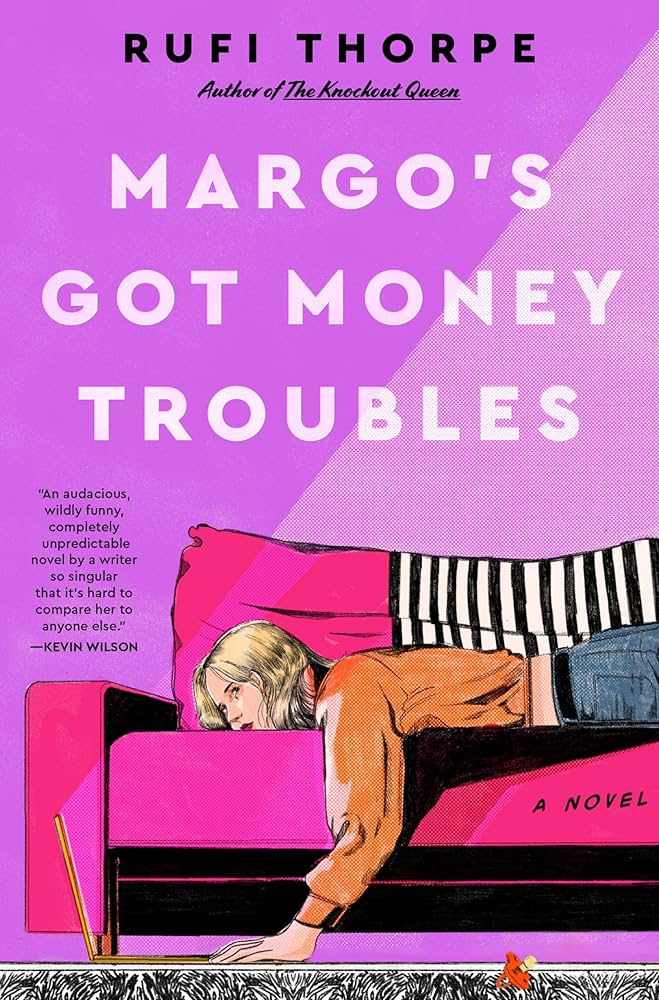
Some novels arrive with premises that sound almost deliberately provocative. A struggling single mother starts an OnlyFans account, receives parenting advice from her former professional wrestler father, and tries to build a stable life while the internet watches. On paper, that setup could easily become broad satire, culture-war commentary, or a purely comic novel built around shock value.
What makes Margo’s Got Money Troubles by Rufi Thorpe so impressive is that it becomes something much richer than any of those descriptions suggest.
Beneath the humour, internet-age absurdity, and occasionally outrageous plot developments is a deeply compassionate novel about economic survival, motherhood, shame, performance, and the increasingly impossible expectations placed on young women. It’s a book that understands how financial desperation can push people into unconventional choices without reducing those choices to either empowerment slogans or moral cautionary tales.
What surprised me most while reading Margo’s Got Money Troubles is how emotionally intelligent it is. The novel could have settled for easy satire of influencer culture or online sex work. Instead, it consistently returns to the emotional reality of a young woman trying to keep her life from falling apart.
For readers wondering, Is Margo’s Got Money Troubles worth reading?—absolutely. It’s one of the sharpest, funniest, and most unexpectedly moving contemporary novels I’ve read in recent years.
Themes and Deeper Meaning
One of the novel’s greatest strengths is how honestly it examines money.
Financial stress is often treated as background noise in contemporary fiction. Here, it becomes the central emotional reality shaping nearly every decision Margo makes. Rent, childcare, groceries, medical expenses, and job insecurity are not abstract concerns. They are constant pressures determining how she moves through the world.
I found the book especially effective because it refuses to romanticise poverty. Margo is intelligent and resourceful, but intelligence alone does not solve structural problems. The novel repeatedly highlights how difficult it is to make “good choices” when every option involves compromise.
There’s also a fascinating exploration of performance throughout the novel. Jinx’s wrestling career becomes an unexpectedly powerful thematic parallel to Margo’s online work. Both professions involve constructing personas, managing audience expectations, and transforming private identity into public entertainment.
The novel also examines modern motherhood with unusual honesty. Margo loves her son deeply, but parenthood is exhausting, isolating, and frequently terrifying. The book avoids idealised depictions of motherhood without becoming cynical about it.
Another recurring theme is judgment. Nearly everyone seems eager to critique Margo’s choices, yet few people offer meaningful support. Thorpe repeatedly exposes the hypocrisy of a culture that condemns vulnerable women while simultaneously profiting from them.
What stayed with me most, though, is the novel’s interest in dignity. Margo spends much of the story trying to maintain a sense of self-worth in circumstances designed to undermine it.
Writing Style and Narrative Voice
Rufi Thorpe writes with extraordinary confidence.
The prose is funny, conversational, and highly readable, but there’s also remarkable emotional precision beneath the humour. The novel moves effortlessly between absurd comedy and genuine vulnerability without feeling tonally inconsistent.
Margo’s voice is one of the strongest narrative voices I’ve encountered recently. She is smart, self-aware, funny, occasionally naïve, and often overwhelmed. Her observations about money, relationships, parenting, and internet culture feel simultaneously specific and universal.
The pacing is excellent. Despite dealing with weighty subjects, the novel remains consistently engaging. Thorpe has a gift for ending scenes and chapters in ways that keep readers moving forward almost compulsively.
I was also impressed by how naturally the novel incorporates internet culture. Many contemporary novels referencing social media already feel dated upon publication. Margo’s Got Money Troubles avoids that trap because it focuses less on platform-specific details and more on the emotional and economic dynamics underlying online performance.
The humour deserves special mention. It’s genuinely funny without relying on constant punchlines. Much of the comedy emerges organically from character interactions and the absurdity of modern life itself.
Character Analysis
Margo is an outstanding protagonist. What makes her compelling is that she feels neither idealised nor excessively flawed. She makes mistakes, occasionally exercises questionable judgment, and frequently doubts herself. Yet she remains deeply sympathetic because the novel allows readers to understand the pressures shaping her decisions.
I appreciated how Thorpe avoids turning Margo into a symbol. She is not meant to represent all young mothers, all sex workers, or all struggling millennials. She remains distinctly herself throughout the novel.
Jinx, meanwhile, nearly steals the book. On paper, he sounds like the kind of eccentric side character who might become exhausting over several hundred pages. Instead, he emerges as one of the novel’s most emotionally complex figures. Beneath his larger-than-life personality lies genuine affection, vulnerability, and regret.
The relationship between Margo and Jinx becomes the emotional heart of the novel. Their interactions are often funny, occasionally frustrating, and surprisingly moving.
Even secondary characters feel unusually layered. The professor who fathers Margo’s child, various friends, family members, and online acquaintances all avoid becoming simplistic caricatures.
Strengths of the Book
One of the novel’s greatest strengths is its emotional generosity.
Thorpe consistently approaches her characters with empathy, even when they behave badly. The book critiques systems and behaviours without reducing people to villains or heroes.
The balance between humour and seriousness is another major achievement. Many novels dealing with financial hardship become relentlessly bleak. Margo’s Got Money Troubles remains funny without trivialising its subject matter.
I also admired how effectively the novel handles contemporary issues. Discussions of sex work, internet culture, motherhood, and economic precarity feel integrated into character and plot rather than inserted as topical commentary.
And perhaps most importantly, the novel is simply enjoyable to read. It’s emotionally intelligent without becoming heavy-handed, socially aware without becoming preachy, and consistently entertaining throughout.
Weaknesses or Criticisms
That said, the novel occasionally feels slightly overextended.
There are moments where the narrative wanders into side plots or thematic explorations that could arguably have been streamlined.
Some readers may also find the latter sections somewhat less focused than the tightly constructed opening chapters.
Additionally, because Margo is such a strong character, a few supporting storylines occasionally feel less compelling by comparison.
There are also readers who may struggle with the novel’s willingness to leave certain moral questions unresolved. Thorpe rarely offers simple answers, which I personally appreciated, but others may find frustrating.
Still, these are relatively minor criticisms within the context of such an ambitious and successful novel.
Overall Reading Experience
Reading Margo’s Got Money Troubles felt unexpectedly exhilarating.
The novel is funny enough to make you laugh out loud, emotionally honest enough to make you uncomfortable, and compassionate enough to avoid cynicism.
I found myself becoming deeply invested in Margo’s success, not because the book turns her into an inspirational figure, but because her struggles feel so recognisably human.
The emotional impact accumulates gradually. By the final sections, what initially seemed like a quirky contemporary premise reveals itself as a genuinely affecting story about survival, family, and self-worth.
Few recent novels have balanced entertainment and emotional depth this effectively.
Who Should Read This Book?
If you’re asking, Who should read Margo’s Got Money Troubles?—this novel is ideal for readers who enjoy contemporary literary fiction with strong character development, sharp humour, and social relevance.
If you enjoyed Yellowface, Such a Fun Age, or Writers & Lovers, this will likely resonate strongly.
It’s particularly suited to readers interested in stories about economic insecurity, internet culture, unconventional families, and women navigating complicated modern realities.
Final Verdict
Margo’s Got Money Troubles is funny, humane, emotionally perceptive, and remarkably timely without feeling trapped by the moment in which it was written.
Rufi Thorpe has crafted a novel that understands the absurdity of modern life while still taking its characters’ struggles seriously. The result is both entertaining and unexpectedly profound.
So, is Margo’s Got Money Troubles worth reading? Absolutely.
It’s one of those rare novels that manages to be socially observant, emotionally moving, and genuinely enjoyable all at once. More than anything, it reminds readers that survival often requires creativity, resilience, and occasionally a willingness to break rules that were never designed with you in mind.

Editor
Best Book Review Guide publishes independent reviews and reading guides written to help readers make better reading choices.