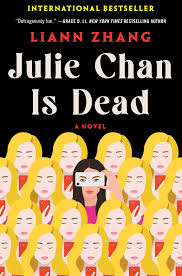
Influencer culture has already begun producing its own literary subgenre: glossy thrillers about curated lives, hidden cruelty, and the psychological instability created by living permanently online. What makes Julie Chan Is Dead stand out within that increasingly crowded space is how sharply it understands performance—not just online performance, but racial performance, class performance, and the exhausting labour of becoming someone more socially desirable.
The premise is immediately gripping. Julie Chan, a struggling supermarket cashier, discovers that her estranged identical twin sister Chloe VanHuusen—an enormously successful influencer—is dead. Instead of reporting the death immediately, Julie makes a decision both horrifying and strangely understandable: she steps into Chloe’s life and assumes her identity.
That setup could easily have become pure satire or campy suspense. Instead, Liann Zhang turns it into something darker and more psychologically observant. Beneath the murder mystery and social media commentary is a novel deeply interested in visibility, desirability, and what people are willing to erase about themselves in order to be seen.
What struck me most while reading Julie Chan Is Dead is how emotionally convincing Julie’s transformation feels, even at its most morally disturbing. The novel understands that envy is rarely just about wanting someone else’s life. Often, it’s about wanting escape from your own.
For readers wondering, Is Julie Chan Is Dead worth reading?—absolutely. It’s sharp, compulsively readable, and far more emotionally layered than its premise initially suggests.
Themes and Deeper Meaning
What makes Julie Chan Is Dead especially effective is that it understands influencer culture not simply as shallow vanity, but as labour.
Julie quickly discovers that Chloe’s glamorous online life is built on relentless performance: constant self-monitoring, brand management, emotional manipulation, and strategic intimacy. The novel repeatedly exposes how influencer culture monetises authenticity while simultaneously destroying the possibility of genuine selfhood.
I found the novel particularly sharp in its exploration of racial identity and desirability. Julie and Chloe are Asian women operating within social systems that reward specific forms of beauty, wealth, and assimilation. Chloe’s success is not presented as accidental—it is carefully manufactured through self-curation and emotional suppression.
Julie’s transformation into Chloe becomes psychologically fascinating because she initially experiences real empowerment through the deception. People treat her differently. They notice her. They listen to her. The novel captures something uncomfortable but true about how social visibility itself can become intoxicating.
There’s also a strong undercurrent surrounding class anxiety. Julie’s decision to impersonate Chloe is morally horrifying, certainly, but the novel makes clear that desperation and precarity shape that decision profoundly. The gap between their lives feels almost absurdly large despite their shared origins.
Another recurring theme is female competition under capitalism. The influencer world portrayed here is simultaneously intimate and brutal. Friendships exist, but they are inseparable from branding, networking, and visibility economics.
And perhaps most interestingly, the novel repeatedly questions whether identity itself has become performative in digital culture. Julie’s impersonation works not because she perfectly knows Chloe, but because Chloe herself had already become a constructed persona.
Writing Style and Narrative Voice
Liann Zhang writes with impressive control over tone.
The novel moves fluidly between satire, psychological suspense, and social commentary without becoming tonally chaotic. That’s not an easy balance to maintain, particularly in a book dealing with internet culture, where satire can easily become heavy-handed or dated.
Julie’s first-person narration is one of the book’s greatest strengths. Her voice is observant, insecure, occasionally bitter, and increasingly unstable in ways that feel psychologically believable. I found her compelling precisely because the novel never tries to make her fully sympathetic. Her choices become progressively more disturbing, but her emotional logic remains understandable.
The pacing is also excellent. The novel unfolds quickly, but not superficially. Each revelation about Chloe’s life deepens the emotional and psychological stakes rather than simply escalating plot twists mechanically.
Descriptions of influencer culture are particularly sharp. Brand trips, content creation, social media interactions, and online image maintenance all feel researched without becoming overly explanatory. Zhang clearly understands the rhythms and anxieties of digital visibility culture from the inside rather than observing it from a detached distance.
Character Analysis
Julie is an exceptionally strong protagonist because she exists in constant tension between victimhood and complicity.
At first, her resentment toward Chloe feels understandable. Julie has spent years financially struggling while watching her twin become socially adored and materially successful. But as she increasingly inhabits Chloe’s identity, the novel begins exposing how deeply Julie herself craves validation, status, and visibility.
I appreciated that Zhang never reduces Julie into a simplistic antihero or cautionary figure. She remains emotionally layered throughout—lonely, ambitious, insecure, manipulative, vulnerable.
Chloe, despite being dead for much of the novel, becomes increasingly complex through Julie’s discoveries. Initially, Julie imagines her sister as effortlessly glamorous and shallow, but the deeper she moves into Chloe’s world, the more emotionally fractured and trapped Chloe herself appears to have been.
The supporting influencer cast is also handled surprisingly well. Lesser novels might flatten them into caricatures of vapid internet celebrities, but here they emerge as competitive, emotionally exhausted individuals trapped within systems demanding constant visibility and self-branding.
Strengths of the Book
One of the novel’s greatest strengths is how effectively it balances entertainment and critique.
Julie Chan Is Dead works extremely well as a thriller. The pacing is sharp, the suspense compelling, and the escalating psychological tension genuinely absorbing.
At the same time, the social commentary rarely feels forced. The critique of influencer culture emerges naturally through character and situation rather than through overt moral lectures.
Julie herself is another major strength. Her emotional complexity prevents the novel from collapsing into simplistic satire or revenge fantasy.
I also admired how current the novel feels without becoming overly dependent on trendy internet references. Many social media novels age poorly almost immediately, but Zhang focuses more on emotional dynamics than platform-specific gimmicks.
Weaknesses or Criticisms
That said, the novel occasionally leans slightly too heavily into thriller escalation in its later sections.
Some plot developments stretch plausibility more than earlier portions of the book, particularly as the psychological tension intensifies.
There are also moments where the supporting influencer characters blur together somewhat, especially during larger group scenes.
And while the social critique is generally sharp, readers already highly familiar with influencer-culture criticism may find certain observations somewhat familiar rather than revelatory.
Still, these criticisms feel relatively minor within the context of how engaging the novel remains overall.
Overall Reading Experience
Reading Julie Chan Is Dead felt addictive in exactly the way the social media ecosystem it critiques is addictive.
I kept wanting to read “just one more chapter,” partly because the pacing is excellent, but also because Julie’s psychological deterioration becomes increasingly compelling to watch.
What stayed with me most, though, was not necessarily the suspense itself, but the emotional sadness underlying the entire story. Beneath the satire and thriller mechanics is a novel about loneliness, invisibility, and the exhausting pressure to become marketable in order to matter socially.
The result is both entertaining and quietly unsettling.
Final Verdict
Julie Chan Is Dead is sharp, unsettling, and impressively emotionally intelligent beneath its glossy thriller surface.
Liann Zhang understands that influencer culture is not simply narcissistic performance—it is a system built around visibility, aspiration, insecurity, and emotional commodification. The novel captures all of that while still remaining enormously readable and entertaining.
So, is Julie Chan Is Dead worth reading? Absolutely.
It’s one of the stronger contemporary novels about internet identity and social performance I’ve read recently, not because it merely critiques online culture, but because it understands how seductive that culture remains even for people fully aware of its damage.

Editor
Best Book Review Guide publishes independent reviews and reading guides written to help readers make better reading choices.