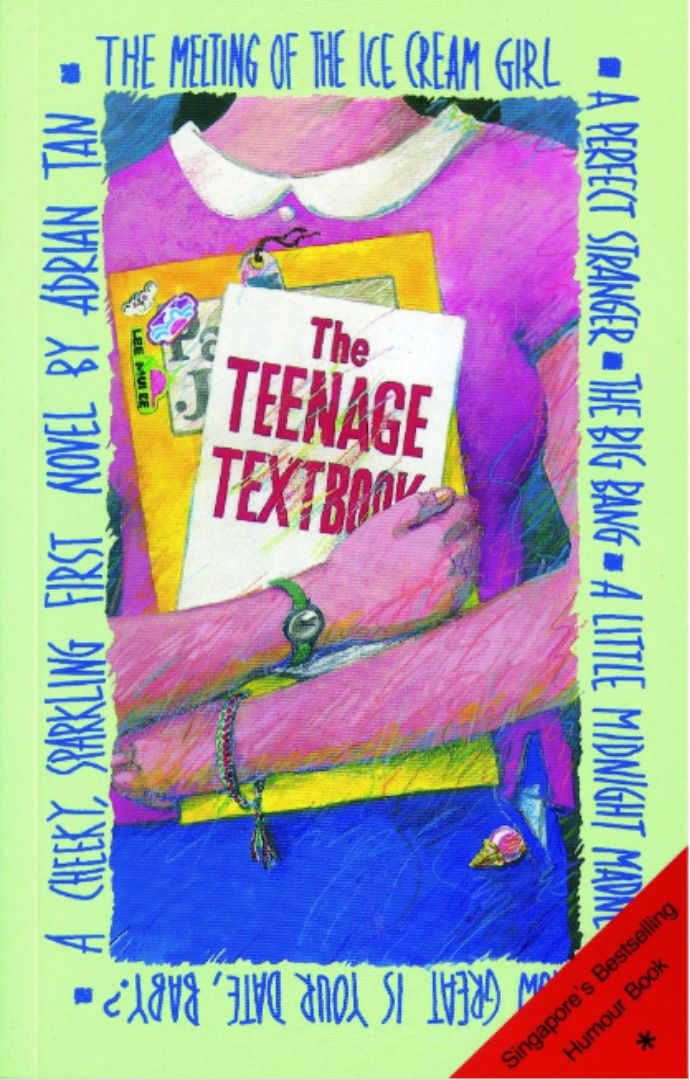
Author: Adrian Tan
Genre: SingLit, Young adult
Some books arrive at exactly the right moment in a culture’s timeline and quietly reshape it. Others, over time, become markers of a particular generation’s voice—imperfect, youthful, but unmistakably alive. The Teenage Textbook by Adrian Tan is one of those rare works that manages to do both.
Originally published in the late 1980s, The Teenage Textbook has since taken on an almost cult-like status in Singapore. It’s often described as a coming-of-age story, and that’s true in the broadest sense. But to reduce it to that would be to miss what makes it enduring. This is a novel that captures a very specific slice of teenage life—awkward, self-aware, occasionally absurd—and renders it with a tone that feels remarkably fresh even decades later.
Reading it now, I found myself oscillating between amusement and recognition. There’s something disarmingly honest about the way Adrian Tan writes adolescence—not as a neat arc of growth, but as a series of contradictions, insecurities, and fleeting triumphs.
For anyone wondering, Is The Teenage Textbook worth reading?—the answer is yes, though perhaps not for its plot alone, but for the voice it preserves.
Summary (Spoiler-Free)
The Teenage Textbook follows the life of a Singaporean teenager navigating school, friendships, crushes, and the general confusion of growing up.
The narrative unfolds episodically, moving through various phases of the protagonist’s teenage years. There is no singular central conflict driving the story forward. Instead, the novel is built from moments—classroom antics, awkward social interactions, tentative romantic encounters, and the quiet anxieties that accompany them.
What emerges is less a conventional storyline and more a portrait of adolescence in motion. The protagonist, along with his circle of friends, moves through a world shaped by school culture, family expectations, and the unspoken rules of teenage social life.
The setting is distinctly Singaporean, yet the experiences it captures—uncertainty, self-consciousness, the desire to belong—feel widely relatable.
Themes and Deeper Meaning
At its core, The Teenage Textbook is about the messy, often contradictory process of becoming oneself.
One of the themes that stood out to me is the idea of performance. Teenagers, perhaps more than anyone, are acutely aware of how they are perceived. The novel captures this through moments of self-consciousness and social navigation, where characters constantly adjust their behaviour to fit in—or to stand out.
There is also a subtle exploration of identity within a structured environment. School, in this book, is not just a setting but a system, one that imposes expectations while also serving as a space for experimentation. The tension between conformity and individuality runs quietly throughout the narrative.
What I appreciated most is how the novel treats its characters with a certain generosity. It does not mock their insecurities, even when it finds humour in them. Instead, it acknowledges the intensity of teenage emotions without overstating them.
There’s also a nostalgic undercurrent, though it never feels overly sentimental. The book doesn’t present adolescence as a golden period, but it recognises its significance—the way small moments can feel disproportionately important at the time.
Writing Style and Narrative Voice
Adrian Tan’s writing is conversational, almost deceptively simple. It reads like someone recounting their teenage years with a mix of clarity and bemusement.
What struck me immediately was the tone. It’s light, often humorous, but never flippant. There’s an ease to the prose that makes it highly readable, yet it carries an undercurrent of observation that elevates it beyond mere anecdote.
The episodic structure suits the subject matter well. Adolescence rarely unfolds in a linear, goal-oriented way, and the novel reflects that. That said, there were moments where the lack of a stronger narrative thread made the story feel slightly diffuse.
Still, the voice carries the book. It’s distinctive without being showy, and it captures the rhythm of teenage thought—the way it shifts quickly from self-doubt to confidence, from introspection to distraction.
Reading it now, I was surprised by how contemporary it feels. While certain references are rooted in its time, the voice itself hasn’t aged in the way one might expect.
Character Analysis
The protagonist serves as both narrator and focal point, offering a lens through which the world of the novel is filtered.
He is not particularly extraordinary, and that is precisely the point. His experiences, thoughts, and reactions feel recognisable, grounded in the everyday realities of teenage life. What makes him engaging is his self-awareness—or, at times, his lack of it.
His circle of friends adds dimension to the narrative. Each character embodies a slightly different approach to adolescence, from the more confident to the more uncertain. These dynamics create moments of humour, tension, and occasional insight.
I did find that some characters remain more sketch-like than fully realised. They function effectively within the context of the story, but I occasionally wanted a deeper exploration of their perspectives.
That said, the novel’s focus is clearly on the protagonist’s internal world, and in that sense, the character work feels appropriate to its scope.
Strengths of the Book
One of the book’s greatest strengths is its voice. It captures a tone that feels authentic and unforced, which is not an easy thing to sustain over the course of a novel.
The humour is another standout element. It arises naturally from situations and character interactions, rather than being imposed. I found myself smiling more than once—not because the jokes were particularly elaborate, but because they felt true.
The cultural context is also handled well. The Singaporean setting is present without being overly explained, allowing readers to engage with it organically.
Perhaps most importantly, the novel succeeds in capturing the texture of teenage life—the small details, the fleeting moments, the sense of being in between stages.
Weaknesses or Criticisms
At the same time, the book’s strengths are closely tied to its limitations.
The episodic structure, while fitting, can make the narrative feel somewhat directionless. There were points where I found myself wanting a stronger sense of progression or resolution.
In terms of depth, the novel occasionally skims the surface of its themes. It touches on interesting ideas about identity and belonging, but doesn’t always explore them in detail.
Additionally, some of the character dynamics could have been developed further. Certain relationships feel lightly sketched, leaving potential emotional depth untapped.
Overall Reading Experience
Reading The Teenage Textbook felt, in many ways, like revisiting a version of adolescence that is both specific and universal.
It’s an easy book to read, but not in a disposable sense. There’s a quiet persistence to it—the kind that lingers after you’ve finished.
I didn’t find it emotionally overwhelming, but I did find it reflective. It prompted a kind of low-level nostalgia, not for specific events, but for a way of thinking and feeling.
Who Should Read This Book?
If you’re asking, Who should read The Teenage Textbook?—this is a novel that will appeal to readers interested in coming-of-age stories, particularly those with a strong sense of place.
If you enjoy character-driven narratives with a conversational tone, this book is likely to resonate.
It’s also a worthwhile read for those curious about Singaporean literature, as it offers a snapshot of a particular time and cultural context.
Final Verdict
The Teenage Textbook by Adrian Tan is not a novel that relies on dramatic storytelling or intricate plotting. Its strength lies in its voice—clear, honest, and quietly observant.
It captures adolescence in a way that feels both grounded and enduring, avoiding the temptation to either romanticise or trivialise the experience.
So, is The Teenage Textbook worth reading? Yes, especially if you’re willing to appreciate it for what it is—a collection of moments that, together, form a thoughtful and engaging portrait of growing up.
It may not offer a definitive statement on adolescence, but it comes remarkably close to capturing how it actually feels—and that, in itself, is no small achievement.
Leave a Reply