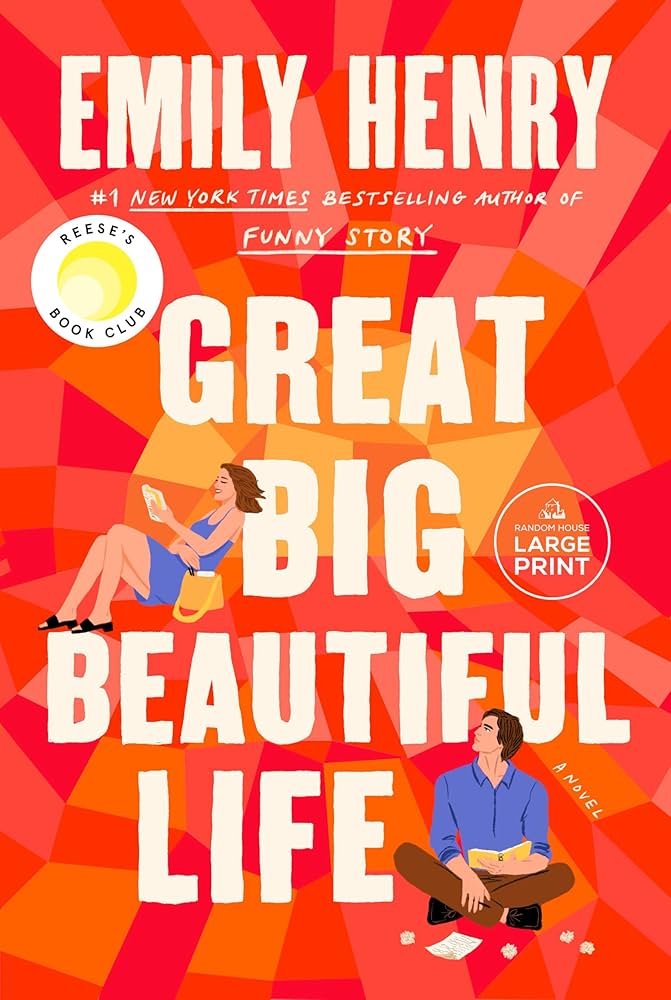
Author: Emily Henry
Genre: Romance, Historical Fiction, Contemporary
There’s a particular kind of expectation that follows a new release from Emily Henry. Her novels have come to define a certain corner of contemporary fiction—romantic, yes, but also reflective, often circling questions about ambition, grief, and what it means to build a life that feels genuinely your own. Great Big Beautiful Life arrives with that same promise, though it leans more deliberately into introspection than some readers might anticipate.
At its heart, this is still recognisably an Emily Henry novel: sharply observed, emotionally aware, and built around characters who feel like they exist just slightly beyond the page. But what sets Great Big Beautiful Life apart is its scale—not in terms of plot, but in its emotional ambition. It’s less concerned with a single relationship arc and more interested in how people piece together meaning from the fragments of their lives.
I went into this expecting something warm and engaging. What I didn’t expect was how quietly thoughtful it would be—how often it would pause, reflect, and resist the easy resolution.
For readers wondering, Is Great Big Beautiful Life worth reading?—the answer is a clear yes, particularly if you’re drawn to character-driven stories that balance romance with deeper emotional inquiry.
Summary (Spoiler-Free Overview)
Great Big Beautiful Life follows Alice Scott, a journalist who is given the opportunity to write the biography of a reclusive, enigmatic woman—Margaret Ives. The catch is that she’s not the only one. Hayden Anderson, another writer, has been invited to compete for the same project, with Margaret offering each of them partial access to her story.
What unfolds is a dual-layered narrative. On one level, there is the developing dynamic between Alice and Hayden—two writers navigating professional rivalry, mutual curiosity, and an undeniable pull toward one another. On another, there is Margaret’s story, revealed in fragments, each version slightly different, each raising more questions than it answers.
The structure creates a kind of narrative tension that is less about what will happen and more about what is true. As Alice becomes more invested—both in Margaret’s story and in her growing connection with Hayden—the boundaries between personal and professional begin to blur.
The novel moves between past and present, between storytelling and interpretation, gradually building a picture that is intentionally incomplete.
Themes and Deeper Meaning
What Great Big Beautiful Life does particularly well is explore the idea of narrative ownership—who gets to tell a story, and how that story changes depending on who is telling it.
Margaret’s shifting accounts of her own life become a central device. They force Alice, and by extension the reader, to confront the idea that truth is not always singular. I found this aspect of the novel especially engaging. It adds a layer of complexity that elevates the story beyond a straightforward romantic or career-driven arc.
There is also a strong emphasis on ambition and self-definition. Alice is not just navigating a potential relationship; she is trying to understand what kind of writer she wants to be, and what compromises she is willing to make. This internal tension feels grounded and, at times, surprisingly relatable.
The romantic thread, while present, is not treated as the sole centre of the narrative. Instead, it exists alongside questions about identity, purpose, and the stories we construct about our own lives.
I appreciated that the novel doesn’t rush to resolve these questions. It allows them to sit, sometimes uncomfortably, within the narrative.
Writing Style and Narrative Voice
Emily Henry’s writing remains one of her strongest assets.
The prose is fluid and engaging, with a conversational ease that makes the book highly readable. At the same time, there are moments of sharp observation—lines that capture a feeling or dynamic with surprising precision.
Alice’s narrative voice is warm, self-aware, and occasionally wry. She feels like a fully realised character, not just a vehicle for the story. Her internal reflections add depth to the narrative, particularly in scenes where the external action is minimal.
The pacing is well-balanced. The novel moves steadily, though it allows for pauses—moments where the focus shifts from plot to character or theme. These sections don’t feel like interruptions; they feel necessary.
The dual narrative structure, alternating between Alice’s present-day experiences and Margaret’s past, is handled with care. It creates a rhythm that keeps the story engaging without becoming overly complicated.
Character Analysis
Alice Scott is, in many ways, a quintessential Emily Henry protagonist—intelligent, introspective, and quietly conflicted.
What makes her compelling is her sense of uncertainty. She is capable, but not entirely sure of her place within the world she inhabits. Her journey is less about transformation and more about clarification—understanding what matters to her and why.
Hayden Anderson serves as both a foil and a counterpart. He is more reserved, more guarded, and their interactions carry a tension that feels natural rather than forced. I found their dynamic one of the more engaging aspects of the book, particularly because it evolves gradually.
Margaret Ives, though not always directly present, looms large over the narrative. Her fragmented storytelling creates a sense of mystery that drives much of the plot. She is less a traditional character and more a narrative force, shaping the direction of the story through what she reveals—and what she withholds.
The supporting cast adds texture, though the focus remains firmly on these central figures.
Strengths of the Book
One of the novel’s greatest strengths is its structure. The interplay between Alice’s present and Margaret’s past creates a layered narrative that keeps the reader engaged.
The character work is another highlight. Alice, in particular, feels authentic and grounded, making it easy to invest in her journey.
The thematic depth also sets the book apart. While it operates within the framework of contemporary fiction, it engages with ideas that extend beyond the genre.
And, of course, the writing itself is consistently strong. Emily Henry has a clear command of tone and pacing, and it shows.
Weaknesses or Criticisms
That said, the novel is not without its limitations.
At times, the pacing in the middle sections slows noticeably. While the reflective moments are valuable, they occasionally disrupt the narrative momentum.
The dual narrative, while effective overall, can feel slightly uneven. Some sections of Margaret’s story are more compelling than others, creating a slight imbalance.
Additionally, readers expecting a more traditional romance may find the romantic arc somewhat understated. It’s present, but it shares space with other narrative elements.
Overall Reading Experience
Reading Great Big Beautiful Life felt, to me, like settling into a story that unfolds at its own pace.
It’s engaging without being overwhelming, thoughtful without being heavy. I found myself drawn in not just by the plot, but by the characters and the questions the novel raises.
There’s a quiet satisfaction in the way the story develops. It doesn’t rely on dramatic twists, but it maintains interest through its emotional and thematic layers.
Who Should Read This Book?
If you’re asking, Who should read Great Big Beautiful Life?—this novel is well-suited for readers who enjoy character-driven contemporary fiction.
If you’ve appreciated Emily Henry’s previous work, this offers a slightly more introspective take on her style.
It will also appeal to readers interested in stories about writing, storytelling, and the complexities of personal ambition.
Final Verdict
Great Big Beautiful Life is a thoughtful, well-crafted novel that expands on Emily Henry’s strengths while exploring new thematic territory.
It may not be her most immediately engaging work, but it is one of her more reflective and layered.
So, is Great Big Beautiful Life worth reading? Yes—especially if you’re willing to engage with its quieter, more contemplative approach.
It’s a novel that doesn’t rush to impress, but instead builds its impact gradually, leaving you with the sense that some stories are less about resolution and more about understanding how they’re told.
Recommended Similar Books
If Great Big Beautiful Life lingered with you—not just for its romance, but for its layered storytelling and quiet questions about truth, ambition, and identity—there are several novels that explore similar territory, each with its own tonal shift.
A natural starting point is The Seven Husbands of Evelyn Hugo by Taylor Jenkins Reid. Like Margaret Ives, Evelyn Hugo is a woman who controls her own narrative, revealing it selectively to a writer tasked with telling her story. Both novels interrogate the idea that truth is often curated, and that storytelling is as much about omission as revelation. Reid’s version leans more dramatic, but the thematic overlap is unmistakable.
For readers drawn to the writer-centric dynamic and emotional undercurrents between competitors, Beach Read offers a more overtly romantic but still reflective take. The interplay between creative ambition and personal vulnerability feels like an earlier, slightly lighter iteration of what Great Big Beautiful Life expands on.
Another compelling companion is Tomorrow, and Tomorrow, and Tomorrow by Gabrielle Zevin. While it centres on game designers rather than writers, it shares a deep interest in creative lives—how people build, collaborate, compete, and sometimes fracture under the weight of their own ambitions. Zevin’s novel is broader in scope, but it resonates in its exploration of partnership and purpose.
If what held your attention was the layered narrative structure—the story within a story—then The Thirteenth Tale by Diane Setterfield is worth seeking out. Like Margaret’s shifting accounts, the central figure in Setterfield’s novel offers a version of her past that may or may not be entirely reliable. The atmosphere is darker, more gothic, but the fascination with storytelling itself feels closely aligned.
For something that captures a similar emotional tone—introspective, relationship-driven, quietly searching—Writers & Lovers by Lily King is an excellent match. It focuses on a writer navigating grief, ambition, and love, and it shares Great Big Beautiful Life’s sensitivity to the small, often invisible pressures that shape a creative life.
Finally, if you’re interested in the idea of competing narratives and the tension between perception and reality, Fates and Furies by Lauren Groff offers a more structurally ambitious take. Its dual perspectives reveal how a single story can shift dramatically depending on who is telling it—a theme that echoes strongly in Emily Henry’s novel, though explored here with a sharper, more literary edge.
Taken together, these books expand on what Great Big Beautiful Life does so well: they examine the stories we tell—about ourselves, about others, and about the lives we’re trying, imperfectly, to understand.
Leave a Reply