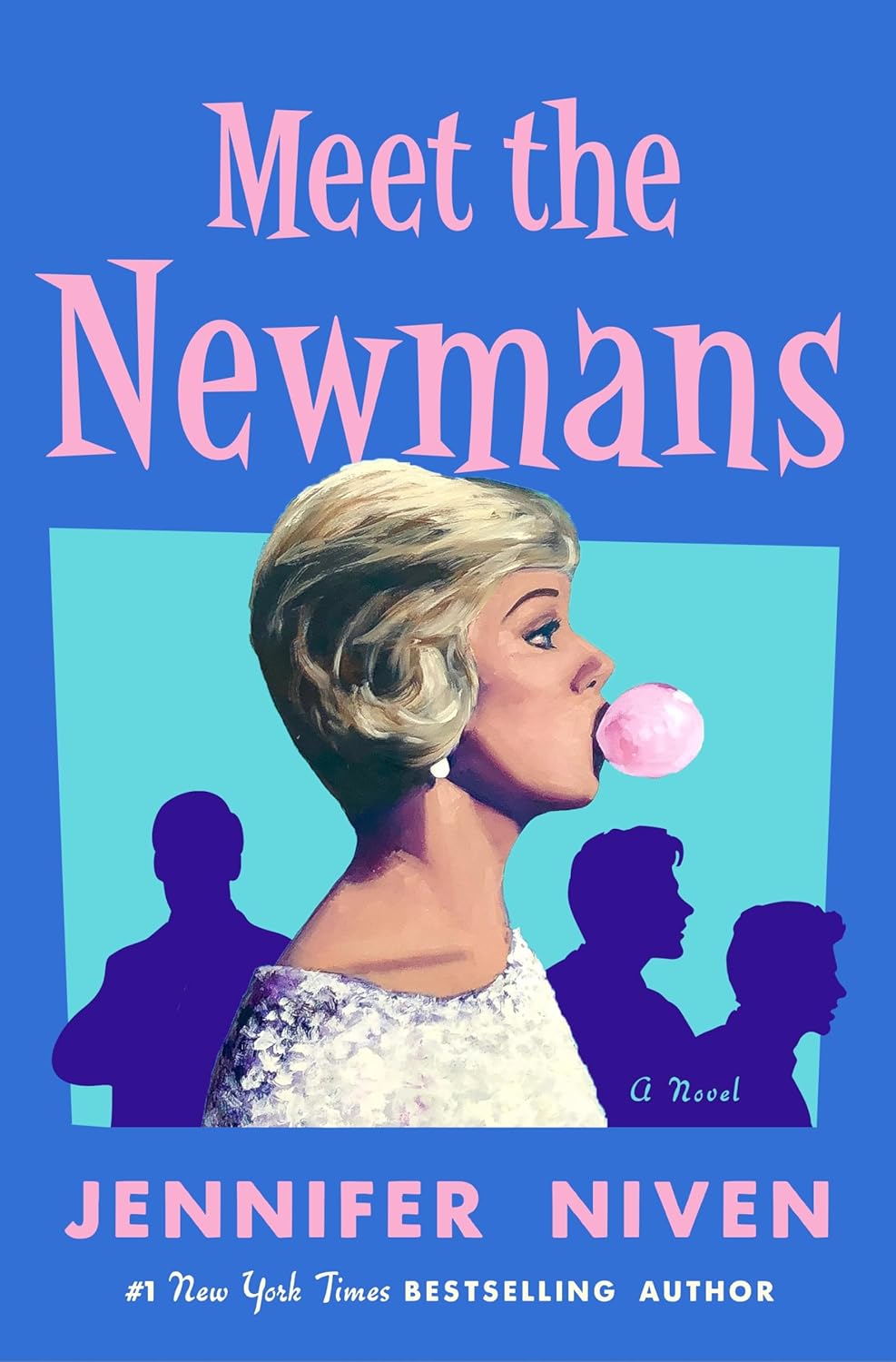
Author: Jennifer Niven
Genre: Humour, Historical Fiction
There’s a familiar promise attached to novels about messy families: a blend of humour, dysfunction, and the quiet hope that something might, eventually, come back together. Meet the Newmans by Jennifer Niven leans into that promise, though in a way that feels more grounded than glossy. Known for her emotionally intense young adult fiction, Niven shifts here into adult territory, bringing with her a sensitivity to inner lives—but also a willingness to let things remain unresolved.
Meet the Newmans isn’t a high-concept novel. There’s no single dramatic event driving it forward, no central mystery to unravel. Instead, it builds its narrative from the slow accumulation of family tensions, private disappointments, and the kind of everyday decisions that quietly alter the course of a life.
I found myself settling into it rather than being immediately pulled in. But once the rhythms of the Newman family began to take shape, the book revealed its strength: an unvarnished look at people who are trying, often imperfectly, to hold themselves together.
For readers wondering, Is Meet the Newmans worth reading?—the answer is yes, particularly if you’re drawn to character-driven fiction that prioritises emotional honesty over plot.
Summary (Spoiler-Free Overview)
Meet the Newmans follows the members of the Newman family as they navigate a period of instability and quiet change.
At the centre is a household that appears, from the outside, relatively ordinary. But as the narrative unfolds, it becomes clear that each family member is dealing with their own set of struggles—some visible, others carefully concealed.
The story moves between perspectives, allowing readers to see how each character interprets the same events differently. Relationships are strained, misunderstandings accumulate, and small decisions take on greater significance over time.
Rather than building toward a single climactic moment, the novel unfolds through these intersecting threads. It’s less about what happens and more about how people respond—to each other, to themselves, and to the gradual shifting of their shared life.
Themes and Deeper Meaning
What stood out to me most in Meet the Newmans is its focus on the quiet fragmentation of family life.
There’s no dramatic rupture at the heart of the story. Instead, the novel explores how distance can develop slowly—through missed conversations, unspoken resentments, and the simple fact of people changing at different speeds.
Niven also touches on the idea of perception within families. Each character believes they understand the others, yet these understandings are often incomplete or outdated. I found this particularly effective. It captures a kind of emotional lag—the way people hold on to earlier versions of each other even as reality shifts.
There’s also an undercurrent of longing running through the book. Not necessarily for something specific, but for a sense of clarity or connection that feels just out of reach. This gives the novel a slightly melancholic tone, though it never becomes overwhelming.
What I appreciated is that the book doesn’t force resolution onto these themes. It allows them to exist in a more open, ambiguous space, which feels true to life, even if it’s not always satisfying in a conventional sense.
Writing Style and Narrative Voice
Jennifer Niven’s writing here is straightforward and accessible, with an emphasis on clarity over stylistic flourish.
The prose is clean and easy to follow, which suits the multi-perspective structure. Each character’s voice is distinct enough to be recognisable, though not dramatically so. The shifts between perspectives are handled smoothly, without drawing too much attention to themselves.
Pacing is steady, though it occasionally leans toward the slower side. The novel takes its time developing its characters and their relationships, which can feel immersive but also, at times, slightly meandering.
There are moments where the writing becomes more reflective, particularly when characters are grappling with internal conflicts. These sections add depth, though I did find myself wishing for a bit more variation in tone—moments where the prose might push a little further.
Character Analysis
The strength of Meet the Newmans lies largely in its characters.
Each member of the family is drawn with a degree of care, even if not all are explored equally. What makes them compelling is not that they are particularly extraordinary, but that they feel recognisable.
They make decisions that are sometimes frustrating, sometimes understandable, often both. I found myself occasionally wanting them to communicate more clearly, to confront issues more directly—but that frustration felt intentional. The novel captures how difficult that kind of clarity can be.
Because the narrative is divided among multiple perspectives, no single character dominates. This creates a more balanced view of the family, though it also means that individual arcs can feel less pronounced.
Still, the cumulative effect is strong. By the end, the family feels like a cohesive unit, even in its dysfunction.
Strengths of the Book
One of the novel’s greatest strengths is its emotional authenticity.
Niven captures the small, often overlooked dynamics of family life with precision. The interactions feel natural, the tensions believable.
The multi-perspective structure is another asset. It allows for a more nuanced understanding of events, highlighting how perception shapes reality.
I also appreciated the restraint. The book doesn’t rely on dramatic twists or heightened conflict. Instead, it builds its impact gradually, through accumulation.
Weaknesses or Criticisms
At the same time, the novel’s restraint can also be a limitation.
The lack of a strong central narrative thread may make it feel diffuse to some readers. There were moments where I found myself wanting a clearer sense of direction or momentum.
Pacing, too, can be uneven. Certain sections feel more engaging than others, and the story occasionally lingers longer than necessary.
Additionally, while the characters are well-drawn, some relationships could have been explored in greater depth. There are hints of complexity that the novel doesn’t fully pursue.
Overall Reading Experience
Reading Meet the Newmans felt like spending time with a family you gradually come to understand, rather than immediately connect with.
It’s not a book that demands urgency. I found myself reading it in steady, unhurried stretches, more interested in the characters than in what might happen next.
Emotionally, the experience is subtle. It doesn’t overwhelm, but it leaves an impression—particularly in its quieter moments.
Who Should Read This Book?
If you’re asking, Who should read Meet the Newmans?—this novel is best suited for readers who enjoy character-driven literary fiction.
If you’re drawn to stories that explore family dynamics in a realistic, understated way, this book will likely resonate.
It’s less ideal for readers looking for a plot-heavy narrative or dramatic twists.
Final Verdict
Meet the Newmans is a thoughtful, quietly observant novel that captures the complexities of family life without overstatement.
It may not be the most dynamic or tightly plotted story, but it offers something more subtle: a careful exploration of how people live alongside one another, and how easily those connections can shift.
So, is Meet the Newmans worth reading? Yes—particularly if you appreciate fiction that prioritises emotional truth over narrative spectacle.
It’s a novel that doesn’t insist on being memorable, but finds its way there anyway, through the accumulation of small, honest moments.
Recommended Similar Books
If Meet the Newmans resonated with you—especially its focus on family, perspective, and quiet emotional shifts—there are several novels that explore similar territory.
Commonwealth by Ann Patchett offers a broader, multi-generational look at family dynamics, with a similarly understated approach.
The Most Fun We Ever Had by Claire Lombardo provides a more expansive, emotionally layered portrait of a family, with deeper exploration of individual arcs.
For a slightly sharper, more satirical take, The Nest by Cynthia D’Aprix Sweeney examines sibling relationships and financial tension within a family structure.
Each of these novels, like Meet the Newmans, understands that the most significant shifts in family life are often the quietest ones—and that those shifts, over time, can reshape everything.
Leave a Reply