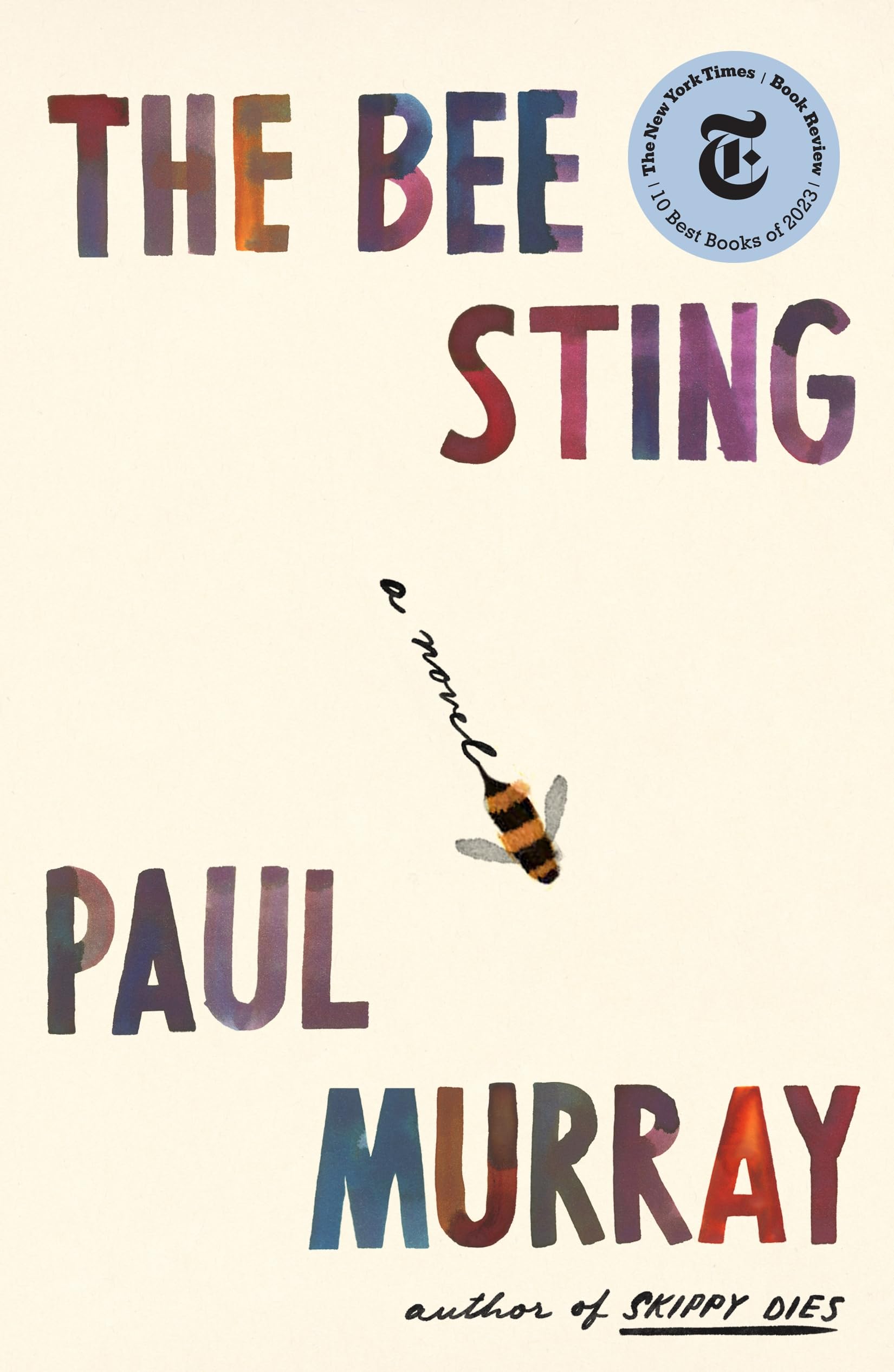
Author: Paul Murray
Genre: Humour, Psychological Fiction
There are novels that feel expansive in scope, and then there are those that seem to absorb everything around them—family, history, economy, memory—and hold it all in a kind of uneasy balance. The Bee Sting by Paul Murray belongs firmly in the latter category. It is a book that begins with the quiet disintegration of a family and gradually reveals itself to be something much larger, more intricate, and, at times, quietly devastating.
Paul Murray has always had a talent for blending humour with emotional weight, but here he pushes further. The Bee Sting is at once sharply observed and deeply compassionate, capturing the ways in which people misunderstand one another—not out of malice, but out of habit, fear, and accumulated silence.
I found myself drawn in slowly, almost cautiously. It’s not a novel that announces its intentions immediately. But once it settles into its rhythm, it becomes difficult to look away. There’s a sense that something is always just beneath the surface, waiting to emerge.
For readers asking, Is The Bee Sting worth reading?—the answer is a resounding yes. It’s one of those rare novels that feels both intimate and expansive, grounded in the specifics of one family while quietly reflecting something much broader.
Summary (Spoiler-Free Overview)
The Bee Sting centres on the Barnes family, whose lives are quietly unraveling in the aftermath of Ireland’s economic downturn.
Dickie Barnes, once a successful car dealer, has seen his business collapse. His wife Imelda clings to memories of a more glamorous past, struggling to reconcile her current life with the version she once imagined. Their daughter Cass navigates the pressures of school and social life with a growing sense of dislocation, while their son PJ retreats inward, increasingly isolated.
The novel unfolds through multiple perspectives, allowing each family member’s internal world to take shape. What becomes clear is that while they share a household, they are often moving in entirely separate emotional directions.
There is no single event that defines the narrative. Instead, the story builds through a series of moments—decisions made, things left unsaid, small misunderstandings that gradually accumulate into something more significant.
As the novel progresses, these threads begin to converge, revealing the deeper forces shaping the family’s trajectory.
Themes and Deeper Meaning
At its core, The Bee Sting is about disconnection—how people can exist in close proximity yet remain fundamentally misunderstood.
One of the most striking aspects of the novel is how it handles communication. Characters often believe they are acting in the best interest of others, yet their actions are shaped by incomplete information or unspoken assumptions. I found this both frustrating and deeply realistic. The novel captures the way miscommunication isn’t always dramatic; it’s often subtle, cumulative.
There is also a strong undercurrent of economic anxiety. The aftermath of the financial crisis is not treated as a distant backdrop but as something that permeates daily life. Dickie’s failed business is not just a plot point—it becomes a source of identity loss, shaping how he sees himself and how others see him.
Imelda’s narrative introduces another layer: the tension between past and present. Her memories are not simply nostalgic; they are almost protective, a way of insulating herself from the reality of her current situation. I found her sections particularly compelling, even when they edged into discomfort.
Cass and PJ, meanwhile, represent different responses to instability. Cass seeks control, navigating social hierarchies with increasing intensity, while PJ withdraws, his inner world becoming more complex and, at times, more troubling.
What ties these threads together is a quiet exploration of how people cope—or fail to cope—with change. The novel doesn’t offer easy resolutions. Instead, it observes, with a kind of patient clarity, how lives shift under pressure.
Writing Style and Narrative Voice
Paul Murray’s writing is one of the novel’s greatest strengths.
Each section is distinctly voiced, reflecting the character it centres on. This isn’t just a matter of tone—it extends to rhythm, structure, even punctuation. PJ’s sections, for example, adopt a more fluid, almost unbroken style that mirrors his internal state.
At first, I found some of these stylistic choices slightly disorienting. But over time, they began to feel integral to the reading experience. The shifts in voice create a sense of immersion that a more uniform narrative might not achieve.
The prose itself is precise and often quietly sharp. Murray has a gift for observation, particularly in capturing small, telling details. There are moments of humour—dry, understated—that provide relief without undermining the emotional weight.
Pacing is deliberate. The novel takes its time, allowing characters and situations to develop gradually. It’s not a fast read, but it’s a rewarding one.
Character Analysis
The Barnes family is drawn with remarkable depth.
Dickie is, in many ways, the emotional centre of the novel. His quiet withdrawal, his attempts to make sense of his failure, feel painfully real. There’s a restraint to his character that makes his struggles all the more affecting.
Imelda, by contrast, is more outwardly expressive, though her narrative reveals a complexity that goes beyond initial impressions. I found her both frustrating and fascinating—a character shaped as much by her past as by her present.
Cass is perhaps the most immediately relatable, particularly in her navigation of social dynamics. Her desire for control, for belonging, is rendered with a level of specificity that feels authentic.
PJ, however, is the character who surprised me most. His perspective introduces a different kind of tension—quieter, more internal, but no less significant. His sections are among the most distinctive in the novel.
What makes the character work so effective is how interconnected it is. Each perspective adds to the overall picture, revealing not just individual struggles but the ways in which those struggles intersect.
Strengths of the Book
One of the novel’s greatest strengths is its structure. The multi-perspective approach allows for a nuanced exploration of the family dynamic, showing how different realities can coexist within the same space.
The characterisation is another standout element. Each member of the Barnes family feels fully realised, with motivations and contradictions that make them feel real.
Murray’s attention to detail—both emotional and environmental—adds depth to the narrative. The setting is not just a backdrop; it shapes the story in meaningful ways.
Perhaps most importantly, the novel achieves a balance between humour and seriousness. It never feels overly heavy, even when dealing with difficult themes.
Weaknesses or Criticisms
That said, The Bee Sting is not without its challenges.
The pacing may feel slow for some readers, particularly in the early sections. The novel takes time to establish its characters and tone, which requires patience.
The stylistic shifts, while effective, can also be demanding. Readers who prefer a more conventional narrative structure may find them distracting.
There are also moments where the narrative feels slightly diffuse, as though it is circling its themes rather than moving toward a clear resolution.
Overall Reading Experience
Reading The Bee Sting felt, at times, like inhabiting the lives of its characters rather than simply observing them.
It’s an immersive experience, though not always an easy one. The emotional weight builds gradually, often in unexpected ways.
I found myself thinking about the characters long after I had finished reading—not because of dramatic plot points, but because of the quiet accumulation of their experiences.
Who Should Read This Book?
If you’re asking, Who should read The Bee Sting?—this novel is best suited for readers who appreciate character-driven literary fiction.
If you enjoy multi-perspective narratives that explore family dynamics in depth, this book will likely resonate.
It’s particularly well-suited to readers who value emotional nuance over plot-driven storytelling.
Final Verdict
The Bee Sting by Paul Murray is a deeply considered, richly textured novel that captures the complexity of family life with remarkable precision.
It’s not a book that rushes to impress. Instead, it builds its impact slowly, through careful observation and layered storytelling.
So, is The Bee Sting worth reading? Absolutely. It’s a novel that demands attention, but rewards it fully.
It leaves you not with a single, definitive impression, but with a series of moments—each one quietly resonant, each one difficult to forget.
Recommended Similar Books
If The Bee Sting resonated with you—particularly its exploration of family, miscommunication, and the quiet pressures of modern life—there are several novels that offer a similar depth of experience.
Skippy Dies is an obvious companion, showcasing Murray’s earlier ability to balance humour with emotional complexity, though on a different scale.
The Corrections by Jonathan Franzen offers a similarly intricate portrait of a family navigating personal and societal change.
For a more intimate but equally layered exploration of relationships, Normal People by Sally Rooney captures the subtle dynamics of connection and disconnection.
Finally, A Visit from the Goon Squad by Jennifer Egan shares a similar structural ambition, using multiple perspectives to build a broader narrative about time and change.
Each of these books, in different ways, echoes what The Bee Sting does so well: they explore how lives intersect, diverge, and, sometimes, fail to fully connect.
Leave a Reply