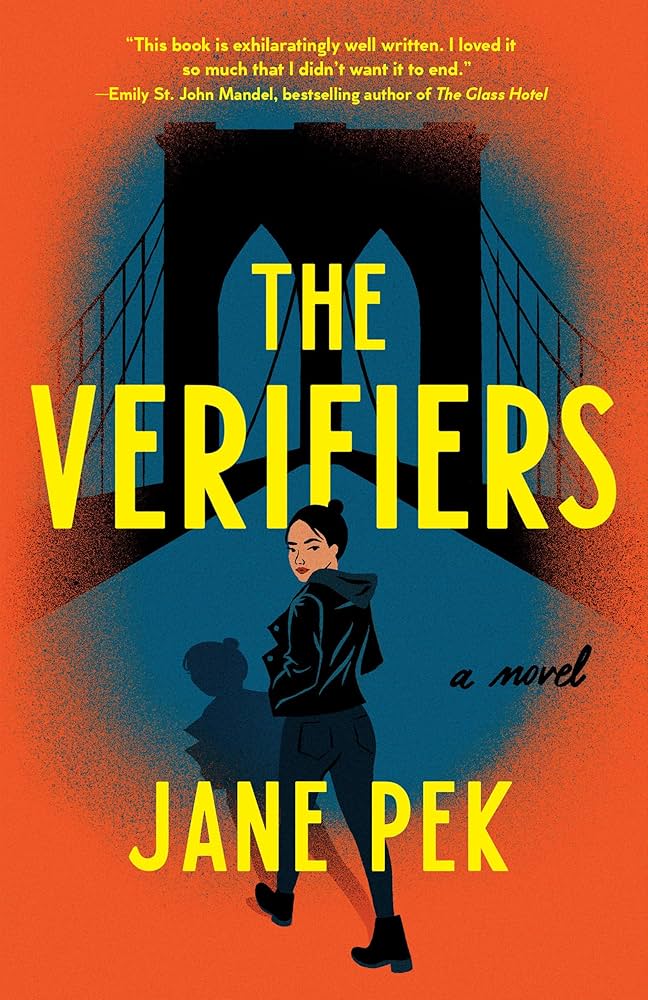
Author: Jane Pek
Genre: Mystery, SingLit
There’s something quietly intriguing about a novel that takes the mechanics of modern life—online dating, digital identities, algorithmic matchmaking—and treats them not just as background, but as the central terrain of a mystery. The Verifiers by Jane Pek does exactly that, and in doing so, positions itself at an interesting intersection: part detective story, part social observation, part character study.
Set largely in New York but filtered through a distinctly diasporic lens, The Verifiers follows a protagonist who is both inside and outside the systems she investigates. The novel arrives with the promise of a fresh angle on crime fiction—less about violent spectacle, more about the subtler manipulations of identity in digital spaces.
I went in expecting a clever premise, perhaps something lightly satirical. What I found was more measured. The novel is thoughtful, often sharp in its observations, though not always as propulsive as its setup might suggest.
For readers wondering, Is The Verifiers worth reading?—the answer is yes, particularly if you’re interested in character-driven mysteries that engage with contemporary themes, though it may not fully satisfy those seeking a tightly wound thriller.
Summary (Spoiler-Free Overview)
The Verifiers centres on Claudia Lin, a young woman who leaves her corporate job to join a somewhat secretive agency known as Veracity. The company specialises in “verifications”—investigations into online dating profiles, ensuring that clients are who they claim to be.
At first, the work seems straightforward, even slightly mundane. Claudia’s role involves examining digital footprints, cross-checking information, and uncovering inconsistencies. But when a case involving a client named Iris Lettriste takes an unexpected turn, the stakes begin to shift.
What initially appears to be a routine verification gradually evolves into something more complex. Claudia finds herself drawn deeper into the case, uncovering layers that extend beyond the digital realm and into the personal histories of those involved.
The narrative unfolds through her investigation, interwoven with her own experiences—her relationships, her family dynamics, and her sense of identity as a Singaporean American navigating multiple worlds.
Themes and Deeper Meaning
One of the most compelling aspects of The Verifiers is its exploration of identity—specifically, how identity is constructed, curated, and sometimes manipulated in digital spaces.
The premise itself lends naturally to this theme. Online dating profiles are, by definition, selective representations. The novel pushes this idea further, asking what happens when those representations are not just curated, but deliberately altered.
I found this line of inquiry particularly relevant. The book doesn’t treat digital identity as inherently deceptive, but it does highlight how easily perception can be shaped. Claudia’s work becomes a kind of lens through which these distortions are examined.
There is also a quieter exploration of belonging. Claudia’s relationship with her family, especially her expectations around career and identity, adds another layer to the narrative. These elements are not always directly tied to the central mystery, but they deepen the character’s internal landscape.
At times, I did feel that the novel introduced more ideas than it fully developed. The themes are present and often interesting, but not always pushed to their fullest potential.
Writing Style and Narrative Voice
Jane Pek’s writing is clear, controlled, and occasionally wry.
Claudia’s narrative voice carries a certain observational sharpness, particularly in her descriptions of people and situations. There are moments of subtle humour that lighten the tone without undermining the seriousness of the investigation.
The pacing, however, is somewhat uneven. The novel begins with a slower, more deliberate build, focusing on Claudia’s entry into Veracity and the mechanics of her work. While these sections are informative, they can feel slightly drawn out.
As the mystery develops, the narrative gains momentum, though it never fully transforms into a high-intensity thriller. Instead, it maintains a more measured pace, prioritising character and theme over rapid plot progression.
Structurally, the novel remains straightforward, following Claudia’s perspective without significant shifts. This creates a consistent reading experience, though it also limits the sense of narrative breadth.
Character Analysis
Claudia Lin is an engaging protagonist, though not in an immediately striking way.
What I appreciated most about her is her groundedness. She is observant, thoughtful, and occasionally uncertain, particularly when it comes to her place within her family and career.
Her motivations feel believable, even when her decisions are not entirely rational. There’s a sense that she is figuring things out as she goes, which adds to the authenticity of her character.
The supporting cast is functional, though not always deeply developed. Characters within Veracity serve their roles in advancing the investigation, but few leave a lasting impression.
Claudia’s family, on the other hand, adds a more personal dimension to the story. These relationships feel more nuanced, even if they are not the primary focus of the narrative.
Strengths of the Book
One of the novel’s strongest elements is its premise. The idea of a company dedicated to verifying online identities is both timely and intriguing.
The integration of digital culture into the narrative feels natural rather than forced. The novel understands the nuances of online interaction without over-explaining them.
Claudia’s perspective also anchors the story effectively. Her observations provide insight into both the investigation and the broader social context.
Additionally, the book’s tone—measured, occasionally humorous—makes it an easy and engaging read.
Weaknesses or Criticisms
The main limitation of The Verifiers lies in its pacing.
The novel takes time to establish its world, which can make the early sections feel slow. While this groundwork is necessary, it occasionally comes at the expense of narrative momentum.
The mystery itself, while interesting, does not always reach the level of tension that the premise suggests. I found myself more engaged with the ideas than with the unfolding plot.
There is also a sense that certain elements—both thematic and character-related—could have been explored more deeply. The novel introduces compelling ideas but sometimes moves on before fully developing them.
Overall Reading Experience
Reading The Verifiers felt like engaging with a story that is more interested in observation than in urgency.
It’s not a book that demands to be read in one sitting. Instead, it unfolds gradually, offering insights along the way.
I found it consistently interesting, though not always gripping. The appeal lies less in the suspense and more in the way the novel engages with contemporary life.
Who Should Read This Book?
If you’re asking, Who should read The Verifiers?—this novel is well-suited for readers who enjoy character-driven mysteries with a modern, technological angle.
If you’re interested in stories that explore identity and perception in digital spaces, this book will likely appeal.
It’s also a good fit for readers who prefer a more measured pace over high-intensity plotting.
Final Verdict
The Verifiers is a thoughtful, quietly engaging novel that offers a fresh take on the mystery genre.
While it may not fully capitalise on its premise in terms of tension, it succeeds in presenting a nuanced exploration of identity, perception, and the complexities of modern life.
So, is The Verifiers worth reading? Yes—particularly if you’re willing to appreciate its strengths beyond the conventions of traditional thrillers.
It’s a novel that doesn’t rush to impress, but instead builds its impact through observation and reflection—leaving you with questions that extend beyond the final page.
Recommended Similar Books
If The Verifiers intrigued you—especially its blend of mystery, identity, and contemporary themes—there are several novels that explore similar ideas.
The Appeal offers a mystery told through unconventional formats, focusing on perception and misinterpretation.
Such a Fun Age by Kiley Reid examines social dynamics and identity with a sharp, observational tone.
For a more technology-focused narrative, An Absolutely Remarkable Thing by Hank Green explores how online visibility shapes identity and behaviour.
Each of these books, like The Verifiers, engages with the question of how we present ourselves—and how easily those presentations can be misunderstood.
Leave a Reply