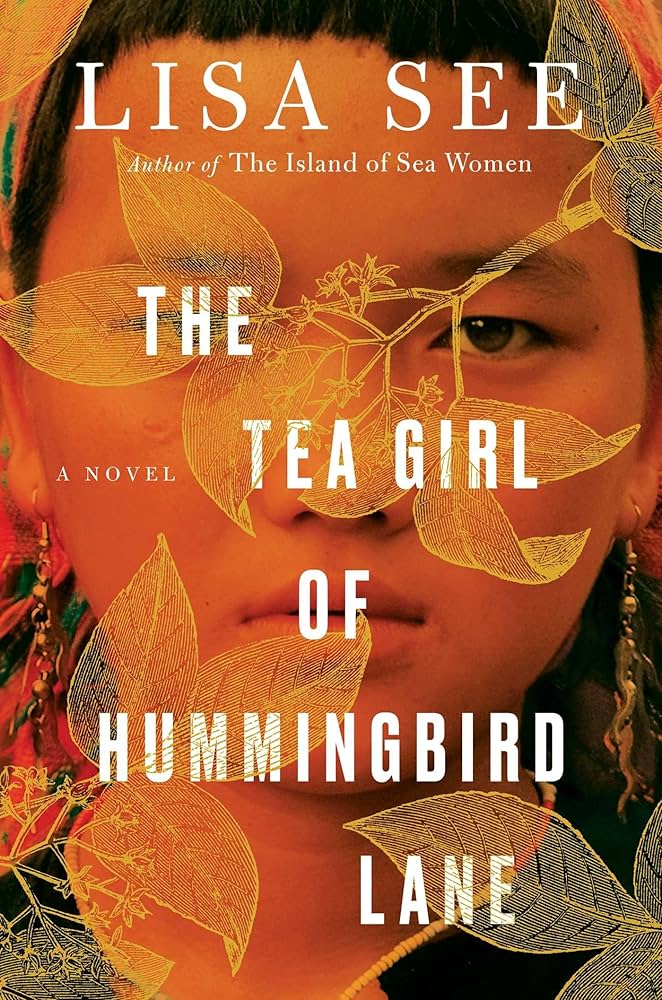
Genre: Author: Lisa See
Genre: Novel, Historical Fiction, Domestic Fiction
Some novels invite you into a world so specific, so textured, that it feels almost unfamiliar at first—until you realise the emotions beneath it are deeply recognisable. The Tea Girl of Hummingbird Lane by Lisa See does exactly that, opening with the traditions of an Akha village in rural Yunnan and gradually expanding into a story that spans continents, generations, and shifting identities.
Lisa See has built a reputation for excavating overlooked histories through intimate narratives, often centred on women navigating restrictive cultural frameworks. In The Tea Girl of Hummingbird Lane, she turns her attention to tea culture, ethnic minority traditions, and the emotional complexities of adoption. The result is a novel that is both expansive and deeply personal.
I went into this expecting a richly detailed historical narrative—and that expectation is certainly met. What I didn’t fully anticipate was how emotionally direct the book would be. It doesn’t hide its intentions; it wants you to feel, and it often succeeds.
For readers asking, Is The Tea Girl of Hummingbird Lane worth reading?—the answer is yes, especially if you’re drawn to stories that combine cultural immersion with strong emotional stakes.
Summary (Spoiler-Free Overview)
The Tea Girl of Hummingbird Lane follows Li-yan, a young girl growing up in an Akha village where life is governed by tradition, ritual, and a deep connection to tea cultivation.
As Li-yan comes of age, she begins to question some of the customs that shape her world, particularly those surrounding education, gender roles, and social expectations. Her life takes a significant turn when she gives birth to a daughter under circumstances that place her at odds with her community.
Unable to raise the child within the confines of her society, Li-yan makes a decision that reverberates through the rest of the novel: she gives her daughter up for adoption.
The narrative then follows two parallel paths—Li-yan’s life as she moves beyond her village and becomes involved in the evolving tea trade, and her daughter’s life in the United States, where she grows up as Haley, navigating her own questions of identity and belonging.
The novel alternates between these perspectives, gradually building toward a convergence that feels both inevitable and emotionally charged.
Themes and Deeper Meaning
At its core, The Tea Girl of Hummingbird Lane is about connection—between people, between cultures, and between past and present.
The theme of motherhood is central, explored through both presence and absence. Li-yan’s decision to give up her daughter is not framed as a simple sacrifice, but as a complex, deeply human choice shaped by circumstance. The novel returns to this decision repeatedly, examining its emotional consequences from multiple angles.
Identity is another key theme, particularly in the sections following Haley. Growing up in a different cultural context, she experiences a kind of dislocation that feels both specific and universal. I found these sections especially compelling, as they capture the subtle ways in which identity can feel both inherited and constructed.
Tea itself functions as more than a setting detail. It becomes a symbol of continuity, linking Li-yan’s past to her present, and eventually to her daughter. The detailed descriptions of tea cultivation and trade add depth to the narrative, though at times they verge on the informational.
There is also a broader exploration of change—how traditions evolve, how communities adapt, and how individuals navigate these shifts. The novel does not present these changes as purely positive or negative; instead, it acknowledges their complexity.
Writing Style and Narrative Voice
Lisa See’s writing in this novel is clear, immersive, and occasionally lyrical, particularly in scenes set within the Akha village.
The early sections are rich with detail, introducing readers to customs and rituals with a careful, almost anthropological attention. I found these passages fascinating, though they do slow the pacing initially. It takes time to fully settle into the world of the novel.
As the story expands geographically and temporally, the prose becomes more streamlined, allowing the narrative to move more quickly between Li-yan’s and Haley’s perspectives.
The alternating structure works well overall, though there are moments where one storyline feels more engaging than the other. I found myself more consistently drawn to Li-yan’s journey, particularly in the earlier sections.
Emotionally, the writing is direct. The novel does not shy away from sentiment, and while this can be effective, there are moments where it feels slightly overemphasised.
Character Analysis
Li-yan is a compelling and well-developed protagonist.
Her journey from a traditional village upbringing to a more independent, self-defined life is handled with care. What I appreciated most is that her growth feels gradual and grounded. She does not reject her past entirely, but rather learns to navigate it in new ways.
Haley, her daughter, represents a different kind of complexity. Her struggle with identity, belonging, and cultural disconnection is portrayed with sensitivity, though at times her arc feels slightly more conventional.
The supporting characters—family members, community figures, and individuals encountered along the way—add texture to the narrative. Some are more fully realised than others, but they collectively contribute to the sense of a lived-in world.
Strengths of the Book
One of the novel’s greatest strengths is its cultural specificity. The depiction of Akha traditions and tea culture is detailed and immersive, offering readers insight into a world that is rarely represented in mainstream fiction.
The dual narrative structure is another strong element, allowing the story to explore its themes from multiple perspectives.
The emotional core of the novel—particularly the mother-daughter relationship—is handled with sincerity and depth, even when it leans toward sentimentality.
Weaknesses or Criticisms
At the same time, the novel is not without its limitations.
The pacing in the early sections can feel slow due to the density of cultural detail. While informative, these passages occasionally interrupt the narrative flow.
The emotional tone, while effective, can sometimes feel a bit heavy-handed. Certain moments are emphasised more than necessary, reducing their subtlety.
Additionally, the balance between the two narrative threads is not always even. Li-yan’s story often feels richer and more complex than Haley’s.
Overall Reading Experience
Reading The Tea Girl of Hummingbird Lane is an immersive experience, though not always a seamless one.
It requires some patience in the beginning, but once the narrative gains momentum, it becomes easier to engage with.
Emotionally, the book is direct and affecting. It aims to resonate, and for the most part, it does.
Who Should Read This Book?
If you’re asking, Who should read The Tea Girl of Hummingbird Lane?—this novel is well-suited for readers who enjoy historical fiction with strong cultural and emotional elements, such as the author’s other book Shanghai Girls.
If you’re interested in stories about identity, family, and cross-cultural experiences, this book will likely appeal.
Final Verdict
The Tea Girl of Hummingbird Lane is a richly detailed, emotionally driven novel that offers both cultural insight and personal storytelling.
While it occasionally leans toward sentimentality and uneven pacing, its strengths—particularly in character and setting—make it a compelling read.
So, is The Tea Girl of Hummingbird Lane worth reading? Yes. It may not be perfectly balanced, but it offers a story that is both expansive and deeply human.
It’s a novel that lingers, not because of its plot, but because of the connections it so carefully builds.
Recommended Similar Books
If The Tea Girl of Hummingbird Lane resonated with you, there are several novels that explore similar themes of identity, family, and cultural heritage.
Pachinko by Min Jin Lee offers a sweeping, multi-generational exploration of identity and displacement.
The Joy Luck Club by Amy Tan similarly examines mother-daughter relationships across cultural divides.
For a more contemporary take on identity and belonging, Everything I Never Told You by Celeste Ng provides a more intimate, character-driven narrative.
Each of these books, like The Tea Girl of Hummingbird Lane, explores the ways in which identity is shaped by both heritage and experience—and how those forces can both connect and divide.

Leave a Reply