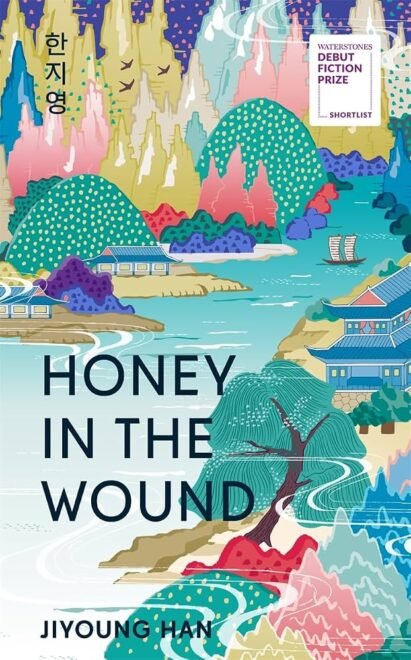
There are certain periods of history that are difficult enough to read about in nonfiction, let alone encounter through the lives of fictional characters. Japan’s occupation of Korea is one of them, particularly when it comes to the experiences of Korean women who were subjected to violence, exploitation and sexual slavery during the early twentieth century.
In Honey in the Wound, Jiyoung Han approaches this painful history through a rather unexpected literary device: magic.
The women in her novel possess extraordinary abilities passed down through generations. One can transform into a tiger, another can compel people to tell the truth, while a young girl discovers that the food she prepares carries the emotions she puts into it.
It’s an unusual premise for a novel concerned with such devastating historical events. Yet the combination of magical realism and historical fiction allows Han to explore something that conventional historical narratives don’t always capture: the private anger, grief and resilience of women whose lives were shaped by circumstances they had little power to control.
At the centre of the story is Young-Ja, a Korean girl whose childhood is destroyed by Japanese imperial violence. Her ability to infuse food with emotion initially seems like a charming gift, but as her circumstances become increasingly brutal, that same ability takes on a darker significance.
The novel spans approximately ninety years and several generations, making it an appealing choice for readers who enjoyed Pachinko by Min Jin Lee or Homegoing by Yaa Gyasi. However, Honey in the Wound is considerably more fantastical than either, using Korean folklore to examine historical trauma and the ways suffering can echo across generations.
It’s also worth knowing from the outset that this is not a gentle historical family saga. Behind its lyrical premise are some profoundly disturbing experiences, particularly those involving violence against women.
Synopsis
In 1902, twins Geum-Ja and Geum-Jin are born into a Korean family living in a mountainous region of the country.
Their childhood unfolds against the growing threat of Japanese imperialism, which gradually transforms the lives of the people around them.
As the twins grow older, Geum-Ja discovers that she possesses an extraordinary ability. She can transform into a tiger, escaping the constraints of ordinary human life and moving through the mountains with a freedom that becomes increasingly difficult for her family to enjoy.
Years later, the family’s descendants begin revealing unusual gifts of their own.
Among them is Young-Ja, a girl with an extraordinary talent for cooking. When she prepares food, her emotions become part of what she makes, allowing those who eat her creations to experience something of what she is feeling.
During her happier childhood moments, her food carries warmth, love and delight.
But in 1931, Japanese soldiers destroy her family’s home and the life she has always known.
Separated from the people she loves, Young-Ja must find a way to survive in a society where Korean women face extraordinary danger and possess very little control over their circumstances.
Her unusual gift eventually attracts the attention of a Korean resistance fighter, who brings her to Manchuria, where she becomes involved with a network of women operating from a teahouse frequented by Japanese officials.
As Young-Ja experiences the consequences of occupation and war, the emotions she channels through her cooking become increasingly powerful.
Across the decades, the novel follows the women of her family as they struggle with loss, survival and the difficult task of preserving memories that others would prefer to forget.
What Works Well
The most compelling aspect of Honey in the Wound is the way Jiyoung Han uses magical realism to explore the experience of living under colonial oppression.
At first glance, supernatural abilities might seem out of place in a novel dealing with real historical atrocities. There’s an understandable concern that introducing magic into such a setting could diminish the seriousness of what happened.
But the premise works precisely because the women’s abilities do not remove them from the realities of their circumstances.
They may possess extraordinary powers, but they are still vulnerable to the violence and social restrictions imposed upon them.
Geum-Ja’s ability to transform into a tiger is particularly interesting within this context.
The tiger occupies an important place in Korean folklore, often associated with strength, protection and the natural world. Giving a young woman the ability to assume that form creates a striking contrast with the limited freedom available to women living under occupation.
Her transformation represents a kind of independence that ordinary life cannot offer.
Young-Ja’s gift is even more compelling because of how closely it connects to everyday domestic labour.
Cooking is traditionally associated with nourishment, care and the responsibility of looking after others. It’s an activity that often takes place quietly in the background, particularly within families where women’s contributions are expected rather than openly acknowledged.
By giving Young-Ja the ability to transfer her emotions into food, Han transforms this familiar domestic activity into something much more significant.
Food becomes a means of communication, expression and eventually resistance.
There’s something particularly effective about this choice. Young-Ja doesn’t need a conventional weapon or a position of political influence to possess power. Her abilities emerge from an activity that society might otherwise regard as ordinary women’s work.
Another strength is the novel’s multigenerational structure.
Rather than concentrating exclusively on one woman’s experiences, Han traces how occupation, war and personal trauma affect different members of the same family.
This creates a broader understanding of historical suffering.
The consequences of violence don’t necessarily end when a war concludes or when someone manages to escape immediate danger. Survivors must continue living with their experiences, while younger generations inherit family histories that may be incomplete, painful or deliberately concealed.
I also find the novel’s emphasis on memory particularly interesting.
Official histories often concentrate on political decisions, military campaigns and the actions of powerful individuals. The experiences of ordinary women, particularly those subjected to sexual violence, have historically been more vulnerable to silence and marginalisation.
By placing these women at the centre of her story, Han challenges the idea that their experiences are secondary to the larger events taking place around them.
The historical context also gives the novel significance beyond its fictional narrative.
Japan’s system of military sexual slavery during the Second World War remains an important subject of historical research, public remembrance and disputes over responsibility and redress.
Han’s novel approaches this history through individual lives rather than abstract numbers, encouraging readers to consider the people behind events that can otherwise feel distant.
What Could Be Better
Although the combination of historical fiction and magical realism is one of the novel’s most distinctive qualities, it may also divide readers.
Those who prefer realistic historical narratives may find the supernatural elements distracting, particularly when the subject matter is so serious.
The story asks readers to accept extraordinary abilities alongside meticulously researched historical circumstances. For some, this will make the characters’ experiences more emotionally powerful. Others may feel that the fantastical elements create an uncomfortable distance from reality.
The novel’s treatment of violence is another important consideration.
Han does not shy away from the brutality experienced by Korean women during the Japanese occupation. Some passages deal with sexual violence, abuse and the profound dehumanisation associated with military sexual slavery.
These experiences are central to the story rather than incidental moments of shock, but the material is nevertheless extremely difficult.
Readers looking for an emotionally moving family saga without graphic depictions of suffering should approach the book with caution.
The ambitious historical scope may also create challenges.
Covering approximately ninety years of family history within 320 pages means that some characters and periods inevitably receive less attention than others.
Young-Ja is the emotional centre of the novel, but the earlier and later generations play important roles in establishing the family’s history.
Readers who become particularly attached to individual characters may occasionally wish that their stories had been given more room to develop.
There is also a broader literary question surrounding the representation of historical trauma.
Novels about oppression and violence can risk defining their female characters primarily through the suffering they endure. The challenge is to give those women identities, relationships and ambitions that extend beyond what happens to them.
Han’s use of family relationships, folklore and inherited abilities provides one way of addressing this concern, although individual readers may differ in how they respond to the balance between suffering and moments of hope.
Ultimately, Honey in the Wound seems best suited to readers who are comfortable with emotionally demanding historical fiction and appreciate speculative elements that serve a larger thematic purpose.
Themes and Discussion
One of the central themes of Honey in the Wound is the relationship between power and powerlessness.
The women in Han’s novel possess abilities that would seem extraordinary under ordinary circumstances. Yet they live within political and social systems that deny them control over many of the most basic aspects of their lives.
This contradiction becomes the foundation of the novel’s exploration of resistance.
Power doesn’t always take the form of physical strength, wealth or political authority. It can also emerge through knowledge, communication, memory and the refusal to surrender one’s sense of self.
Young-Ja’s relationship with food is particularly effective in illustrating this idea.
What begins as a way of caring for other people gradually becomes connected to her anger and grief. The transformation of her abilities mirrors the changes in her emotional life, suggesting that experiences of violence can fundamentally alter the way a person interacts with the world.
Another important theme is intergenerational trauma.
When families experience war, displacement and persecution, the consequences can continue affecting their descendants long after the immediate events have passed.
Children and grandchildren may inherit silences, fears and difficult relationships without fully understanding the experiences that created them.
This is especially relevant when survivors have been discouraged from discussing what happened to them.
The history of Korean women subjected to Japanese military sexual slavery has been shaped not only by the violence they endured but also by the stigma, silence and long struggle for public acknowledgement that followed.
The novel’s multigenerational structure creates an opportunity to explore how these experiences become part of a family’s collective memory.
Food also functions as an important symbol of identity and connection.
For many families, recipes are among the most enduring links between generations. Particular dishes can preserve memories of childhood, home and relatives who are no longer alive.
In Young-Ja’s case, that connection becomes literal.
Her food carries her emotions, transforming cooking into a physical expression of memory.
The title itself suggests an uncomfortable relationship between sweetness and suffering.
Honey is associated with nourishment, comfort and traditional remedies, yet sweetness cannot necessarily remove the damage caused by a serious wound.
It’s an appropriate image for a novel that explores the possibility of healing without pretending that historical trauma can simply be erased.
Perhaps the most significant theme, however, is the importance of testimony.
When suffering is deliberately concealed or dismissed, telling the story becomes an act of resistance.
Han’s novel suggests that survival is not necessarily the end of a person’s struggle. Being heard, believed and remembered can be equally important.
Writing Style
Jiyoung Han combines historical detail with the heightened imagery of folklore, creating a narrative that moves between the ordinary and the extraordinary.
The magical elements are woven into the lives of the characters rather than presented through an elaborate system of supernatural rules.
This is important because the novel isn’t particularly interested in explaining how its powers work. Their significance lies in what they reveal about the women who possess them.
The tiger, the truth-compelling voice and the emotionally charged food all function as expressions of identity and resistance.
Han’s approach has drawn praise from critics for its combination of historical research and imaginative storytelling.
The novel’s chronological sweep also gives it the character of a family chronicle, with successive generations revealing different aspects of the same history.
Rather than treating every period as an isolated episode, Han connects personal experiences across time.
The result is a story that appears to place as much importance on what families remember and conceal as on the events themselves.
Readers who enjoy the emotional scope of multigenerational fiction may appreciate this structure, particularly if they’re comfortable with stories that shift between different characters and historical periods.
At 320 pages in the US hardcover edition, Honey in the Wound is relatively concise for a novel covering nearly a century of family history.
Final Verdict
Honey in the Wound is an ambitious and emotionally demanding debut that brings together Korean history, folklore and the experiences of women whose voices have too often been excluded from conventional historical narratives.
Jiyoung Han’s decision to give her characters supernatural abilities is particularly interesting because it doesn’t protect them from the realities of imperial violence.
Instead, their gifts become ways of expressing emotions and forms of resistance that might otherwise remain invisible.
Young-Ja’s ability to infuse food with her feelings is perhaps the novel’s most memorable idea. It transforms an ordinary act of care into something that can communicate love, grief, anger and the consequences of surviving experiences that should never have happened.
The book’s historical subject matter is undeniably difficult. Readers should be prepared for an unflinching portrayal of violence against women, including experiences connected to the Japanese military’s system of sexual slavery.
But the novel also offers a perspective on the importance of remembering these experiences, particularly when survivors have spent decades struggling to have their stories acknowledged.
I would recommend Honey in the Wound to readers who appreciate multigenerational historical fiction, particularly novels that examine how political violence shapes family relationships long after the events themselves have ended.
Fans of Pachinko may appreciate its exploration of Korean history and displacement, while readers who enjoyed Homegoing may recognise its interest in generational trauma and the long consequences of oppression.
The supernatural elements make it a different kind of reading experience from either novel, but they also give the story a distinctive emotional and symbolic vocabulary.
Ultimately, Honey in the Wound is concerned with a question that extends beyond its historical setting: how


Leave a Reply