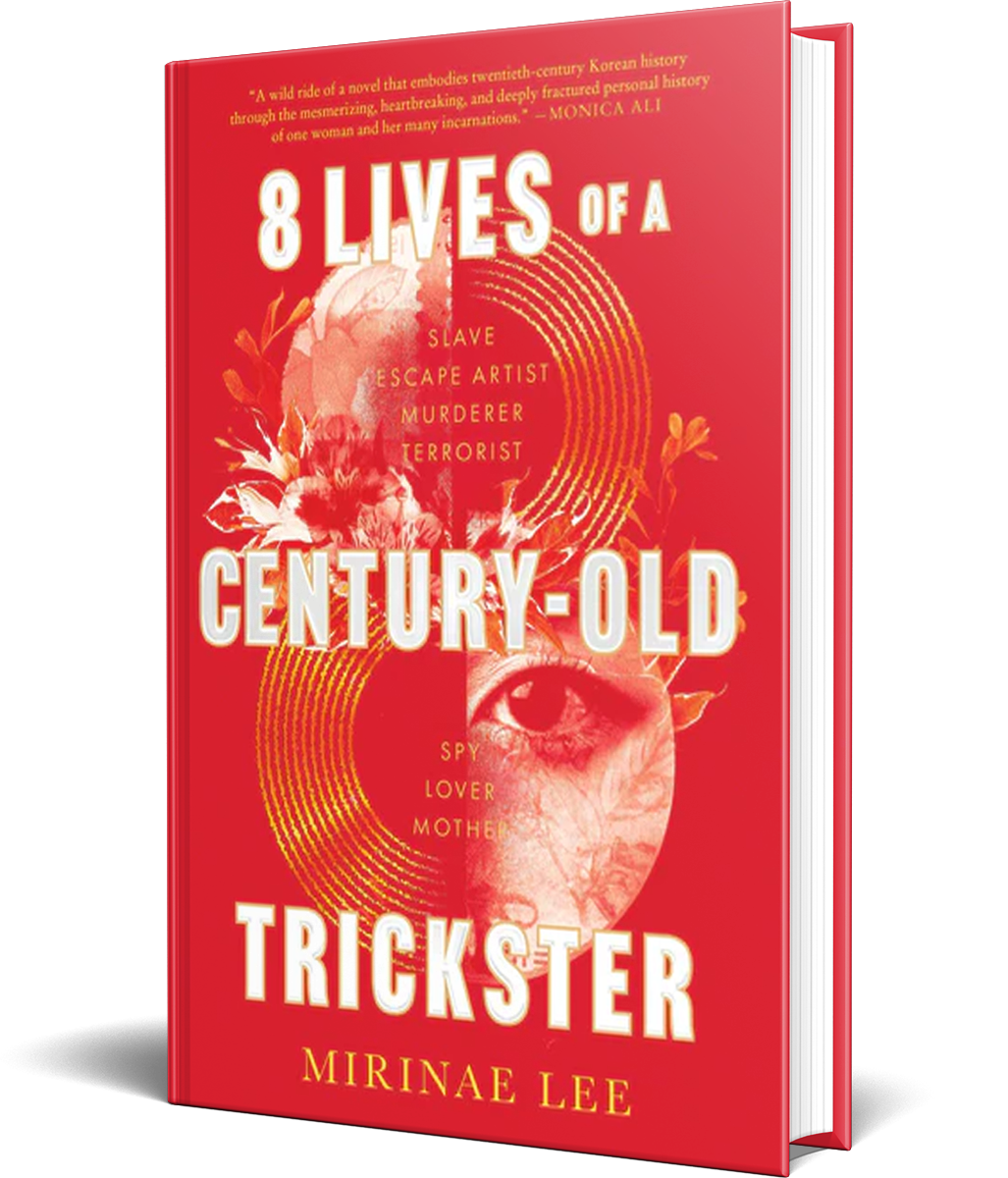
Author: Mirinae Lee
Genre: Historical Fiction, War story
There are novels you admire from a distance, and then there are those that unsettle you in a quieter, more persistent way—books that don’t ask to be liked so much as they insist on being considered. The Eight Lives of a Century-Old Trickster by Mirinae Lee falls firmly into that second category. It’s the kind of novel that leaves you slightly off-balance, not because it is confusing, but because it refuses to offer the kind of emotional clarity readers are often trained to expect.
I found myself both drawn in and held at arm’s length. That tension, I suspect, is entirely intentional. Mirinae Lee is not interested in giving us a protagonist we can easily root for. Instead, she presents a figure who slips through identities, allegiances, and moral frameworks with unsettling ease. In a literary landscape that often rewards redemption arcs and emotional accessibility, The Eight Lives of a Century-Old Trickster feels almost defiant.
For anyone asking, Is The Eight Lives of a Century-Old Trickster worth reading?—my answer leans toward yes, but with a caveat. This is a novel that asks more of you than it gives back immediately. It lingers, but not always comfortably.
Summary (Spoiler-Free Overview)
The novel traces the life—or rather, lives—of a man most commonly known as Mook Miran, who navigates nearly a century of Korean history by continually reinventing himself. Each “life” introduces a different identity, a different set of circumstances, and often, a different moral posture.
What struck me early on is how little the book tries to guide your interpretation. There is no clear framing that tells you how to feel about this man. In one chapter, he appears almost sympathetic, shaped by forces beyond his control. In another, he is calculating, even unsettlingly opportunistic.
The story moves across major historical periods—colonial occupation, war, political upheaval—but these are not treated as grand backdrops. Instead, they function as shifting terrains that the protagonist navigates, sometimes deftly, sometimes questionably.
Rather than building toward a single climax, the novel accumulates meaning through its fragments. By the end, you are left not with a tidy understanding of the protagonist, but with a series of impressions—some contradictory, some unresolved.
Themes and Deeper Meaning
What stayed with me most after finishing The Eight Lives of a Century-Old Trickster was its uneasy relationship with identity. The novel doesn’t just suggest that identity is fluid—it pushes the idea to its limit. If a person can repeatedly reinvent themselves, adopting new names, roles, and moral positions, then what, if anything, anchors them?
At times, I found this deeply compelling. There’s a kind of intellectual thrill in watching the protagonist adapt, reshape, and survive. But there were also moments where it felt almost disquieting, as if the novel was quietly asking whether survival alone is enough to justify one’s choices.
Morality, in this book, is not a stable ground. It shifts with circumstance, with necessity, with opportunity. I appreciated that Lee doesn’t impose a clear judgment. Still, I occasionally found myself wanting a bit more resistance—some force within the narrative that pushes back more explicitly against the protagonist’s decisions.
History, too, is treated in an interesting way. It’s present, undeniably so, but it never fully takes centre stage. Instead, it presses in from the edges, shaping what is possible and what is not. I found this approach refreshing, though at times I wished for slightly deeper immersion into certain historical moments.
There’s also something quietly provocative about how the novel handles memory. Each “life” feels both self-contained and incomplete, suggesting that any attempt to piece together a coherent narrative is inherently flawed. As a reader, you’re left assembling fragments, aware that something essential may always remain just out of reach.
Writing Style and Narrative Voice
Mirinae Lee’s prose is restrained, almost deliberately so. It doesn’t call attention to itself, and in many ways, that works in the novel’s favour. The writing allows the structure and ideas to take precedence.
That said, I did find myself occasionally wishing for more variation in tone. The consistency of the voice, while effective in maintaining cohesion across different time periods, can feel a little flat in places. There were moments where I wanted the language to rise to meet the emotional weight of the situation, to take a slightly bigger risk.
The fragmented structure is, without question, the book’s defining feature. Each section feels like a window into a different version of the protagonist, and while this creates a compelling sense of multiplicity, it also demands a certain level of patience. It took me a while to fully settle into the rhythm of the book.
Once I did, though, I began to appreciate how carefully the pieces are arranged. The gaps between sections are not oversights—they’re part of the design. Still, I suspect this will be a point of friction for some readers.
Character Analysis
Mook Miran is, quite simply, one of the more elusive protagonists I’ve encountered in recent fiction. And I mean that both as praise and as a challenge.
There’s something undeniably fascinating about him. He is adaptable, observant, and often surprisingly pragmatic. But he is also difficult to trust. Just when you think you’ve understood him, the narrative shifts, and you’re forced to reconsider everything.
I found myself oscillating between curiosity and distance. There were moments where I leaned in, trying to grasp his motivations more clearly. And then there were moments where I pulled back, unsure whether I wanted to fully understand him at all.
This emotional push and pull is, I think, central to the novel’s effect. Lee doesn’t offer easy access to her protagonist. Instead, she presents him as a series of impressions, each one partial.
The supporting characters, while less developed, serve their purpose. They ground the narrative, offering points of contrast and, occasionally, moments of clarity. But it is always the protagonist who dominates the frame, even when he remains frustratingly opaque.
Strengths of the Book
What The Eight Lives of a Century-Old Trickster does exceptionally well is commit to its vision. It never softens its edges to make itself more accessible, and I found that integrity admirable.
The structure, while challenging, is also one of its greatest strengths. It allows the novel to explore identity in a way that a more conventional narrative simply couldn’t.
I also appreciated the way the book engages with history without becoming overly didactic. It trusts readers to understand the broader context without spelling everything out.
And then there’s the protagonist himself. He may not be likable, but he is undeniably compelling. Few characters linger in the mind quite like this—not because they are beloved, but because they resist resolution.
Weaknesses or Criticisms
That same commitment to ambiguity can, at times, feel limiting.
There were stretches where I felt a certain emotional distance from the story. The novel’s refusal to guide the reader is intellectually stimulating, but it can also create a sense of detachment. I didn’t always feel invested in the way I might have hoped.
The pacing, too, can be uneven. Some sections feel richly detailed, while others pass more quickly, leaving me wanting a bit more depth.
And while the fragmented structure is effective overall, there were moments where the transitions felt abrupt rather than purposeful. Not confusing, exactly, but slightly jarring.
Overall Reading Experience
Reading The Eight Lives of a Century-Old Trickster felt, at times, like assembling a puzzle without being entirely sure what the final image would look like.
It’s not a book I rushed through. In fact, I found myself reading it in shorter stretches, letting each section settle before moving on. There’s a density to it—not in the prose, but in the ideas—that benefits from that kind of pacing.
Emotionally, the experience is somewhat muted, but not in a negative sense. The impact comes later, in reflection, rather than in the moment.
Who Should Read This Book?
If you’re asking, Who should read The Eight Lives of a Century-Old Trickster?—I would recommend it to readers who enjoy being challenged a little.
If you’re drawn to novels that experiment with structure, that explore morally complex characters, or that leave room for interpretation, this will likely resonate.
If you enjoyed literary fiction that prioritises ideas and character over plot, there’s a good chance you’ll appreciate what Mirinae Lee is doing here.
But if you’re looking for a deeply emotional, character-driven narrative in the traditional sense, this may feel somewhat distant.
Final Verdict
The Eight Lives of a Century-Old Trickster is not a novel that tries to win you over. It doesn’t offer easy empathy, nor does it resolve its central tensions neatly. And yet, I found myself thinking about it long after I had finished.
It’s a book that rewards attention and, perhaps more importantly, tolerance for ambiguity. There were moments where I admired it more than I loved it—but even that feels like part of its design.
So, is The Eight Lives of a Century-Old Trickster worth reading? Yes, especially if you’re open to a novel that challenges your expectations of character and narrative.
It may not give you a clear answer about who its protagonist really is. But in refusing to do so, it captures something far more interesting—the uneasy, shifting nature of identity itself.
Leave a Reply