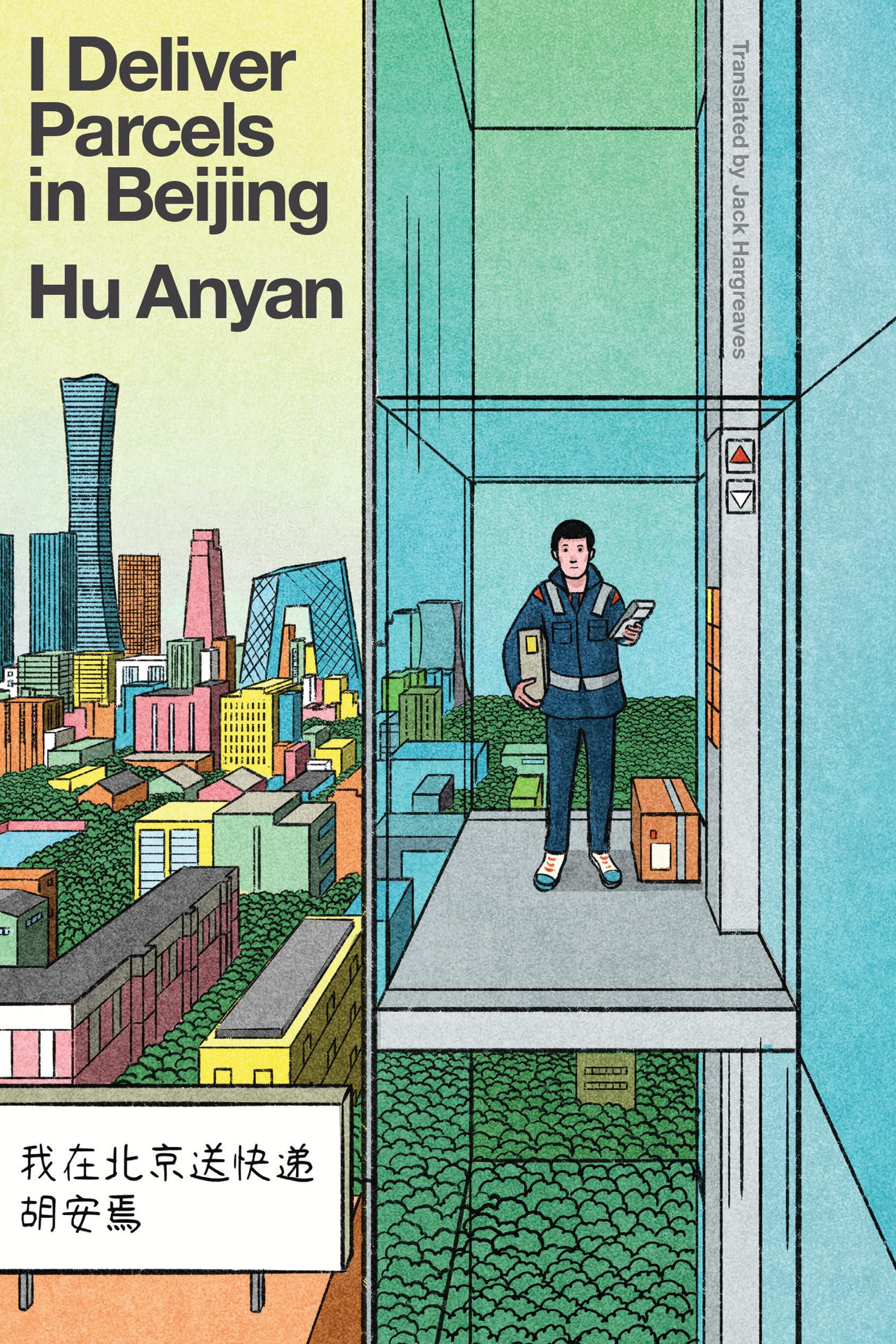
Author: Hu Anyan
Genre: Autobiography
There’s something quietly disarming about books that document ordinary work. Not the kind dressed up for inspiration, not stories polished into neat arcs of triumph, but accounts that stay close to the ground—close enough that you can almost feel the fatigue in the body, the repetition in the hours. I Deliver Parcels in Beijing by Hu Anyan is one of those books. It doesn’t try to elevate its subject into something grand. If anything, it does the opposite. It keeps returning to the mundane, the exhausting, the easily overlooked.
I’ll admit, I went into I Deliver Parcels in Beijing expecting something more overtly political or analytical—perhaps a sharper critique of the gig economy or a more structured narrative of hardship and resilience. Instead, what I encountered was more restrained, even slightly detached at times. And yet, that restraint becomes part of the book’s effect. It refuses to dramatise what is already difficult.
For readers wondering, Is I Deliver Parcels in Beijing worth reading?—my answer is yes, but it depends on what you’re looking for. This is not a story that performs emotion. It’s one that accumulates it, almost quietly, until you realise it has settled in.
Summary (Spoiler-Free Overview)
I Deliver Parcels in Beijing follows Hu Anyan’s experience as a courier navigating the relentless pace of Beijing’s delivery economy. Coming from a rural background, he enters the city with a familiar mix of necessity and hope, quickly finding himself absorbed into a system that is both efficient and unforgiving.
The book unfolds through a series of episodes—daily routes, interactions with customers, conversations with fellow couriers, and reflections on the physical and mental toll of the work. There is no singular dramatic turning point. Instead, the narrative builds through repetition, mirroring the structure of the job itself.
What emerges is a portrait of a life defined by movement—constant motion across the city, governed by deadlines and algorithms, punctuated by brief moments of rest or connection. The focus remains firmly on the lived experience of the work, rather than on abstract commentary.
Themes and Deeper Meaning
One of the most striking aspects of I Deliver Parcels in Beijing is its exploration of invisibility. Delivery workers are everywhere, yet rarely acknowledged as individuals. Hu Anyan doesn’t state this outright in heavy terms; instead, he lets it surface through small, almost incidental moments. A customer who barely makes eye contact. A rushed exchange that feels transactional in every sense. Over time, these moments accumulate into something more revealing.
What I found particularly compelling is how the book resists turning this invisibility into a clear moral argument. It would have been easy to frame the narrative as a critique of urban indifference. And while that critique is certainly present, it’s not foregrounded. Instead, it sits in the background, allowing readers to arrive at their own conclusions.
There’s also a recurring tension between aspiration and limitation. Like many migrant workers, Hu arrives in Beijing with the implicit promise of opportunity. But the reality is far more constrained. The job offers income, yes, but it also imposes a rhythm that leaves little room for anything beyond survival.
Time becomes a central motif. Everything is measured—delivery windows, distances, daily quotas. And yet, paradoxically, time also blurs. Days begin to resemble one another, marked more by physical exhaustion than by distinct events. I found this aspect of the book particularly effective. It captures something difficult to articulate: the way repetitive labour can compress and distort one’s sense of time.
Perhaps what stayed with me most, though, is the book’s refusal to romanticise resilience. There’s endurance here, but it’s not framed as something admirable or transformative. It simply exists because it has to.
Writing Style and Narrative Voice
Hu Anyan’s prose is plain, almost deliberately so. At first, I wondered if this simplicity might limit the book’s impact. But as I read on, it became clear that the restraint is part of the point.
The language mirrors the work it describes—direct, functional, unembellished. There are moments of reflection, but they are rarely expansive. Instead, they emerge in brief observations, often tucked into descriptions of routine.
The structure is episodic, which feels entirely appropriate given the subject matter. Each chapter functions like a delivery route—self-contained, yet part of a larger pattern. That said, I did occasionally feel the weight of this repetition. Some sections blur together, not because they are indistinct, but because the work itself is.
The narrative voice remains consistent throughout: observant, measured, and slightly detached. I wouldn’t describe it as emotionally expressive, but that doesn’t mean it lacks feeling. Rather, the emotion is understated, often implied rather than stated.
Character Analysis
As a memoir, the focus is squarely on Hu Anyan himself. What’s interesting is how he presents himself—not as a central figure demanding attention, but almost as a lens through which the reader observes the system around him.
There’s a quiet self-awareness in his narration. He recognises the constraints of his situation, but he doesn’t overinterpret them. This gives the narrative a sense of authenticity, though it also creates a certain distance. I didn’t always feel deeply connected to him in an emotional sense, but I did trust his perspective.
The supporting figures—other couriers, customers, supervisors—appear briefly, often defined by a single interaction. At first, I found myself wanting more depth here. But over time, I began to see how this approach reflects the nature of the work. Relationships are fleeting, shaped by circumstance rather than sustained connection.
Still, I can’t help but feel that a few more fully developed secondary characters might have added another layer to the narrative.
Strengths of the Book
What I Deliver Parcels in Beijing does exceptionally well is capture the texture of everyday labour. It doesn’t generalise or abstract; it stays close to the details—the physical strain, the constant movement, the small decisions that shape each day.
The authenticity of the voice is another major strength. This doesn’t feel like a story shaped to meet reader expectations. It feels recorded, almost in real time, with all the unevenness that entails.
I also appreciated the book’s restraint. It would have been easy to heighten the drama or emphasise certain themes more explicitly. Instead, Hu allows the narrative to speak for itself, which ultimately makes its impact more lasting.
Weaknesses or Criticisms
That same restraint can also be limiting.
There were moments where I found myself wanting a deeper dive—into the systemic structures behind the work, into the emotional landscape of the narrator, into the lives of those around him. The book touches on these elements, but often stops short of fully exploring them.
The episodic structure, while appropriate, can feel repetitive. This is, in part, unavoidable given the subject matter, but it does affect the pacing.
And while the simplicity of the prose is effective, it may not appeal to readers looking for more stylistic richness or narrative variation.
Overall Reading Experience
Reading I Deliver Parcels in Beijing is a gradual experience. It doesn’t pull you in with dramatic tension. Instead, it draws you into its rhythm, one day, one delivery at a time.
I found myself reading it in shorter stretches, partly because of the structure, but also because it invites that kind of pacing. It’s a book that benefits from pauses, from moments of reflection between chapters.
Emotionally, it’s understated. But that doesn’t mean it’s without impact. In fact, I’d argue the opposite. The lack of overt emotional cues forces you to engage more actively, to notice what’s not being said.
Who Should Read This Book?
If you’re asking, Who should read I Deliver Parcels in Beijing?—this is a book for readers interested in contemporary social realities, particularly those related to labour and urban life.
If you appreciate nonfiction that prioritises authenticity over narrative drama, this will likely resonate. It’s also a strong choice for readers curious about the human side of systems we often take for granted.
However, if you’re looking for a fast-paced or emotionally intense narrative, this may feel too restrained.
Final Verdict
I Deliver Parcels in Beijing is not a book that seeks to impress. It doesn’t build toward a dramatic conclusion or offer neatly packaged insights. And yet, I found it quietly affecting.
There’s something about its honesty—its refusal to embellish or simplify—that lingers. It doesn’t tell you what to think, but it leaves you with a clearer sense of what it means to live within the rhythms it describes.
So, is I Deliver Parcels in Beijing worth reading? Yes, particularly if you’re willing to meet it on its own terms.
It’s a book that asks you to pay attention—to the work, to the people who do it, and to the systems that shape it. And once you do, it becomes difficult to look at something as simple as a delivered parcel in quite the same way again.

Leave a Reply