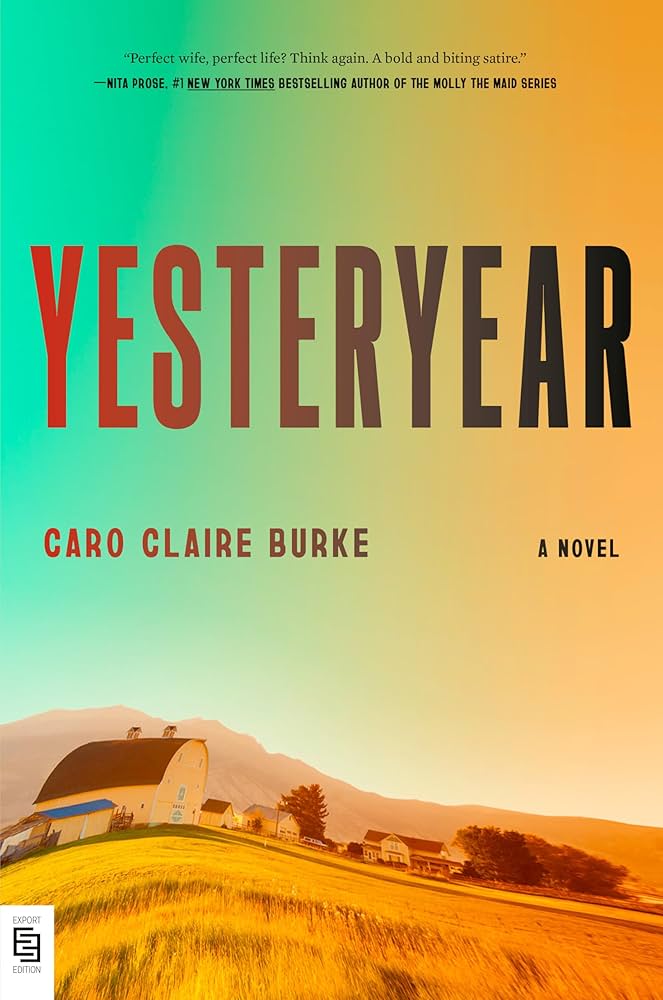
There’s a particular kind of novel that seems engineered for internet discourse: high-concept, psychologically messy, politically charged, emotionally provocative, and just ambiguous enough to keep readers arguing long after they finish it. Yesteryear by Caro Claire Burke is exactly that kind of book.
The premise alone almost guarantees attention. Natalie Heller Mills, a wildly successful “tradwife” influencer with millions of followers, wakes up one morning seemingly transported to 1855, forced to live the kind of “traditional womanhood” she has long romanticised online. The setup is clever enough that it immediately explains why the novel generated intense buzz even before publication, including major adaptation interest and endless social media debate.
But what surprised me while reading Yesteryear is that it’s less interested in mocking tradwife culture than in dissecting the psychology beneath it. The novel certainly satirises influencer aesthetics, performative femininity, and conservative nostalgia, but underneath the satire is a much darker exploration of rage, self-erasure, motherhood, ambition, and the exhausting performance of modern womanhood itself.
The result is messy, provocative, occasionally frustrating, and extremely difficult to stop reading.
For readers wondering, Is Yesteryear worth reading?—yes, absolutely, though whether you ultimately admire it may depend on your tolerance for morally abrasive protagonists and structurally chaotic psychological fiction.
Summary
Yesteryear follows Natalie Heller Mills, a wealthy Idaho tradwife influencer whose social media empire is built around idealised domestic femininity. She bakes sourdough bread, raises children on a picturesque ranch, promotes conservative family values, and performs a version of pioneer-era motherhood carefully curated for millions of online followers.
But almost immediately, the novel destabilises that carefully controlled image.
Natalie wakes up in what appears to be 1855, inside a distorted version of her own life. The ranch remains familiar yet altered. Modern conveniences disappear. Physical labour becomes brutal. Motherhood becomes dangerous rather than aesthetic. Daily survival itself turns punishing.
From there, the narrative fractures intentionally. The novel moves through flashbacks, memory distortions, influencer history, childhood trauma, marriage dynamics, and increasingly disorienting psychological episodes as Natalie attempts to understand what has happened to her. Has she genuinely time-travelled? Is she mentally unraveling? Is this punishment, hallucination, divine intervention, or something even stranger?
As Natalie’s reality becomes increasingly unstable, the novel gradually exposes the emotional machinery underlying her online persona: resentment, ambition, insecurity, exhaustion, suppressed rage, and a desperate need for control.
What begins as speculative satire slowly mutates into psychological horror.
Themes and Deeper Meaning
What makes Yesteryear compelling is that it understands the tradwife phenomenon as fundamentally performative rather than ideological alone.
Natalie does believe in aspects of her worldview, certainly, but the novel repeatedly suggests that performance itself has become inseparable from identity in the age of influencer culture. Natalie’s femininity, religiosity, motherhood, and domesticity are all monetised spectacles. Even her supposed “authenticity” functions as branding.
I found the novel especially sharp in its portrayal of rage. Natalie is furious almost constantly—at feminism, at other women, at motherhood, at her audience, at herself. But because her entire career depends on projecting softness, serenity, and submission, that rage has nowhere healthy to go. Instead, it curdles inward and outward simultaneously.
The novel also interrogates nostalgia in fascinating ways. Natalie’s entire brand depends on romanticising a version of the past stripped of physical suffering, racial violence, economic precarity, and female vulnerability. When she is seemingly forced into the “real” past, the aesthetic fantasy collapses almost immediately. Laundry destroys her hands. Childbirth becomes terrifying. Domestic labour becomes relentless rather than picturesque.
There’s also a surprisingly bleak examination of motherhood running beneath the satire. Natalie loves aspects of motherhood but also feels profoundly trapped by it. One of the novel’s most uncomfortable ideas is that contemporary motherhood often demands total emotional and physical sacrifice while simultaneously insisting women should find complete fulfillment within that sacrifice.
What stayed with me most, though, is the novel’s interest in self-erasure. Natalie has built a career performing an ideal womanhood so successfully that she no longer seems entirely certain where performance ends and selfhood begins.
Writing Style and Narrative Voice
Caro Claire Burke writes with enormous confidence.
The prose is sleek, fast-moving, and highly contemporary in rhythm. Several critics have described the novel as “MFA-polished,” which honestly feels accurate, though not necessarily negatively so. The writing is designed to be compulsively readable, and it absolutely succeeds on that level.
Natalie’s narration is one of the novel’s greatest strengths. She is cruel, funny, intelligent, self-aware, deeply unlikeable, and strangely magnetic all at once. Her internal monologue often reads like a collision between influencer branding language and suppressed psychological breakdown.
I found the humour especially effective because it’s so acidic. Natalie’s observations about sex, marriage, religion, and social media often become genuinely hilarious before immediately turning unsettling.
Structurally, however, the novel is intentionally disorienting. The flashback-heavy narrative and shifting realities can feel chaotic initially, though I eventually realised the confusion itself is part of the point. Readers are trapped inside Natalie’s increasingly unstable psychological landscape.
That said, the narrative occasionally prioritises momentum and twist-building over emotional depth. Several reviewers have criticised the book for sacrificing thematic complexity in favour of psychological-thriller escalation, and I partially agree.
Still, the novel remains incredibly readable throughout.
Character Analysis
Natalie Heller Mills is one of those protagonists readers will either find fascinating or unbearable, sometimes both simultaneously.
Personally, I found her exhausting but extremely compelling. She’s manipulative, judgmental, emotionally detached from her children at times, and deeply invested in maintaining her own mythology. Yet the novel also makes clear that Natalie herself has been shaped by systems rewarding female self-sacrifice, aesthetic perfection, and ideological performance.
What makes her work is that she’s painfully self-aware without being fully self-understanding. Natalie recognises many of the hypocrisies around her but consistently misinterprets their underlying causes.
Her marriage is similarly fascinating. The relationship between Natalie and her husband feels built partially on mutual performance. They are not simply husband and wife—they are co-creators of a profitable fantasy brand.
The children, interestingly, function more symbolically than psychologically in many sections of the novel. Some critics found this a weakness, and I understand why. But I also think the emotional distance is intentional. Natalie increasingly experiences even her family through the lens of content creation and self-performance.
And honestly, one of the book’s strongest achievements is making readers repeatedly question whether they should pity Natalie, despise her, or recognise parts of themselves in her.
Strengths of the Book
The premise is undeniably brilliant.
A tradwife influencer forced to confront the actual realities behind the romanticised historical fantasy she sells online is an incredibly effective setup for satire, horror, and psychological collapse simultaneously.
The novel is also extremely current without feeling shallow. Burke clearly understands influencer culture, aesthetic capitalism, online identity construction, and the strange emotional economy of social media performance.
Natalie herself is another major strength. She’s one of the more memorable literary protagonists I’ve encountered recently precisely because the novel refuses to soften her contradictions.
I also admired the book’s atmosphere. Even when the plot becomes fragmented or surreal, there’s a constant underlying sense of wrongness that keeps the narrative emotionally tense.
And perhaps most importantly, Yesteryear understands that reactionary nostalgia often emerges not from happiness, but from fear, exhaustion, and unresolved rage.
Weaknesses or Criticisms
That said, the novel is undeniably uneven.
Thematically, it occasionally gestures toward larger political questions—race, white nationalism, religious extremism, reproductive ideology—without fully interrogating them. Several critics have noted this limitation, and I think it’s fair.
The psychological-thriller elements also gradually overtake some of the more interesting social commentary. By the final sections, the novel becomes increasingly focused on unraveling its mystery rather than fully exploring the systems it critiques.
I also found certain emotional relationships underdeveloped, particularly regarding Natalie’s children.
And structurally, readers who dislike ambiguity or fragmented timelines may find the novel frustrating rather than immersive.
Still, even the messiness feels strangely aligned with the novel’s emotional chaos.
Overall Reading Experience
Reading Yesteryear felt like being trapped inside someone else’s spiraling nervous breakdown while simultaneously recognising uncomfortable truths inside it.
The novel is funny, disturbing, exhausting, occasionally ridiculous, and genuinely difficult to stop thinking about afterward.
What lingered with me most was not the speculative premise itself, but the emotional reality underneath it: the terrifying pressure modern women face to transform every aspect of life—motherhood, femininity, marriage, beauty, domesticity—into performance.
Even when the novel stumbles, it remains intensely alive on the page.
Who Should Read This Book?
If you’re asking, Who should read Yesteryear?—this is ideal for readers who enjoy psychologically messy literary thrillers and socially sharp speculative fiction.
It’s especially suited to readers interested in influencer culture, performative femininity, tradwife aesthetics, and novels centered on morally abrasive female protagonists.
Final Verdict
Yesteryear is messy, provocative, psychologically jagged, and far more emotionally unsettling than its viral premise initially suggests.
Caro Claire Burke understands that tradwife culture is not simply about baking bread or wearing prairie dresses. It’s about performance, control, nostalgia, rage, visibility, and the impossible contradictions women are still expected to navigate.
So, is Yesteryear worth reading? Absolutely.
It may not fully resolve every political or emotional question it raises, but honestly, part of the novel’s power lies in that instability. Like Natalie herself, the book remains simultaneously seductive, frightening, performative, and quietly furious.
Leave a Reply